

Group Chats About ICE Whereabouts Are Protected Speech. The FBI Is Investigating Anyway.
FBI Director Kash Patel pays lip service to the First and Second Amendments while casting suspicion on people who exercise their First or Second Amendment rights.
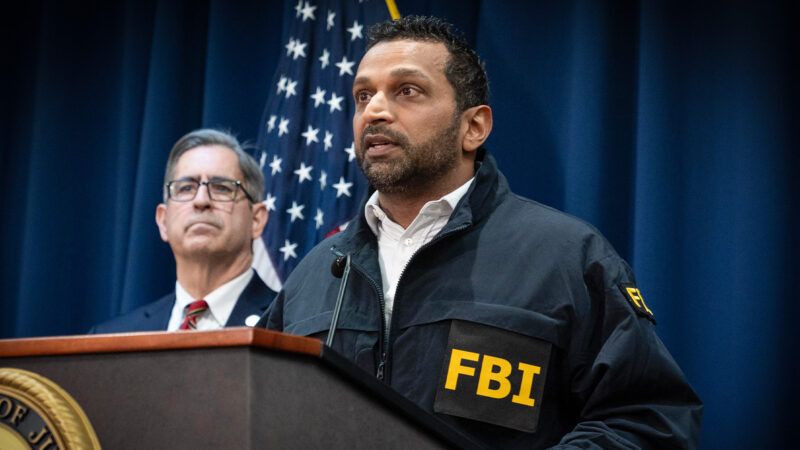
Group chats about Immigration and Customs Enforcement (ICE) agents aren't illegal. But FBI Director Kash Patel doesn't seem to care.
On Monday, Patel told conservative podcaster Benny Johnson that the FBI was investigating a Signal group in which people had been chatting about ICE agents' whereabouts.
The Trump administration has said that people are doxing federal agents, employing a term once reserved for the act of publishing private information about someone's identity or address online. "Doxing" generally implies that this sharing is done with ill intent.
But there are all sorts of perfectly benign reasons why Americans—whether in the country legally or not—might want to keep tabs on where immigration authorities are going. Sharing this information allows people to protest, observe, or document ICE activity, or avoid run ins with ICE agents.
Chatting about ICE agent whereabouts is unambiguously speech that's protected by the First Amendment. So the idea that the FBI would investigate on these grounds is worrying.
"There does not appear to be any lawful basis for this investigation," said Aaron Terr, director of public advocacy for the Foundation for Individual Rights and Expression (FIRE). "The First Amendment generally protects the publication of legally-obtained information, including much of what the Trump administration has labeled 'doxxing.' That protection extends to using an app to share information about ICE activity."
In his interview with Johnson, Patel paid lip service to the First Amendment. Yet he also framed Signal chats pertaining to ICE whereabouts as inherently suspect and/or likely to lead to criminal actions. "You cannot create a scenario that illegally entraps and puts law enforcement in harm's way," he said, drawing a direct link between constitutionally protected activity and criminality.
Of course, trapping ICE agents and harming them would indeed be illegal. But the illegal part of that is the trapping, the plotting harm, and the harming, not merely the knowing where the agents are or chatting about where they are. And even if some individual ultimately uses the location information to inflict harm, it still would not make the mere sharing of that information illegal.
"The First Amendment has narrow exceptions for true threats and speech intended and likely to provoke imminent unlawful action, but the government cannot trigger those exceptions simply by claiming that speech puts officials in harm's way," notes Terr. "The First Amendment also does not protect criminal conspiracy, but that requires evidence of an agreement to commit a specific crime and a substantial step toward carrying it out. No such evidence appears in the Signal messages that have been made public."
The Trump administration's efforts to frame speech about ICE whereabouts as something sinister align with its broader approach to people protesting ICE deportation antics and violence, including the killing of two U.S. citizens, Renee Good and Alex Pretti. Officials have been trying to portray peaceful protests as "left wing agitation"—as if the only goal is to foment unrest and smear Republicans—or even as "domestic terrorism."
Their goal seems to be discrediting the very idea that protesting government actions is at the core of protected First Amendment speech.
Likewise, Patel and others in the Trump administration seem intent on discrediting people exercising their Second Amendment rights. In his interview with Johnson, Patel paid lip service to the fact that it's OK to bring a gun to a protest (as Pretti did) "as long as you don't incite violence or commit another crime in doing so."
But Patel followed up that comment by asking, "Why would you bring a firearm in a situation that is so volatile right now?…That is just not smart. It is just not going to lead to a good scenario."
Carrying a firearm to protect oneself and others against armed agents of the state is at the core of protected Second Amendment activity. But Patel is trying to cast it as somehow suspicious—as if it's only proper for federal agents, and not the people who might need protection against them, to be armed.
In talking about people exercising their First or Second Amendment rights in service of protesting and protecting themselves from ICE, Patel seems intent on conflating legal actions with illicit ones.
"Patel did not say which laws he thought Minnesota residents [in a Signal group chat about ICE] may have violated," notes NBC News. "An FBI spokesperson said the bureau had no further information to provide."
A quiet investigation into potential illegal activity fostered through Signal group chats would be one thing—still not great, but at least theoretically justifiable, if the FBI had reason to suspect criminal activity. The fact that Patel is openly talking about this investigation (while bungling information about its legal basis) indicates that this is more about striking fear and chilling legal speech.




