
A Trump-Appointed Federal Judge Orders Lindsey Halligan To Stop 'Masquerading' As a U.S. Attorney
The lawyer, who delivered the grudge-driven indictments that the president demanded, refused to relinquish her job after another judge ruled that her appointment was illegal.
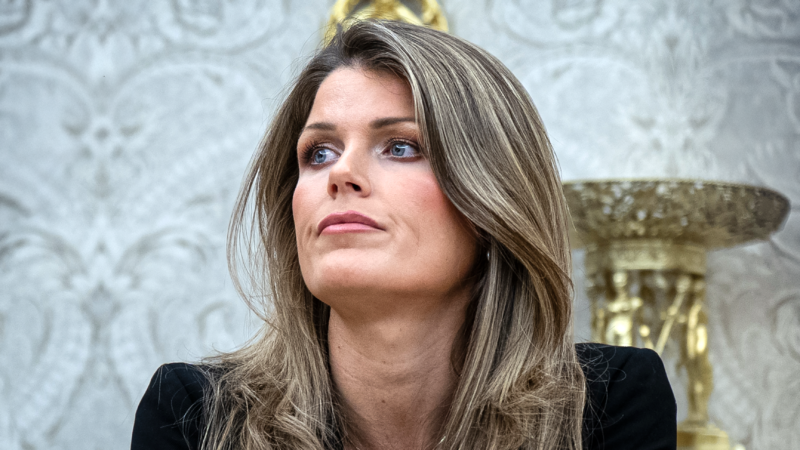
On Tuesday night, Attorney General Pam Bondi said Lindsey Halligan, the lawyer whom President Donald Trump tried to install as the chief federal prosecutor for the Eastern District of Virginia, will no longer serve in that role. That may sound like old news, since it has been two months since U.S. District Judge Cameron McGowan Currie concluded that Halligan's appointment was illegal. But instead of slinking away after Currie's ruling, Halligan stuck around, copying the strategy that George Costanza attempted after he dramatically resigned from his job as a real estate agent: She pretended nothing had happened and hoped no one would notice.
George did not get away with it, and neither did Halligan. "This charade of Ms. Halligan masquerading as the United States Attorney for this District in direct defiance of binding court orders must come to an end," U.S. District Judge David J. Novak, a Trump appointee, declared on Tuesday in a criminal case involving an indictment signed by Halligan. Novak barred Halligan from "representing herself as the United States Attorney in any pleading or otherwise before this Court until such time as she may lawfully hold the office either by Senate confirmation or appointment by this Court."
It was an appropriately ignominious conclusion to Halligan's brief career as a federal prosecutor, which began because Trump needed a loyalist who would not hesitate to seek indictments against two of his nemeses: former FBI Director James Comey and New York Attorney General Letitia James. Halligan promptly delivered the grudge-driven indictments that Trump demanded, only to see them dismissed because the president was in such a hurry that he flouted statutory restrictions on the appointment of interim U.S. attorneys.
From the beginning, Halligan's service in that position was marked by legal irregularities and embarrassing errors. Her ineptitude was not surprising, since she had no previous prosecutorial experience and could not rely on the help of her underlings, who were unwilling to participate in the cases against Comey and James because they did not think there was enough evidence to justify them. Halligan's main qualification for the office was her willingness to overlook the problems with those cases, which distinguished her from Erik Siebert, the career prosecutor whom Trump initially picked as U.S. attorney.
Trump forced Siebert out on September 19, angered by his resistance to pursuing charges against Comey and James. In a Truth Social post the next day, Trump announced that Halligan would replace Siebert while ordering Bondi to get on with it already. "We can't delay any longer," he told Bondi. "JUSTICE MUST BE SERVED, NOW!!!"
Although Trump described Halligan as "a really good lawyer," her background did not include any work as a prosecutor, which you might think would be a minimum requirement for a U.S. attorney. Halligan, who obtained her law degree from the University of Miami in 2013, practiced insurance law for about a decade. Beginning in 2022, she served on Trump's legal team.
Halligan helped defend Trump in the federal case that charged him with improperly retaining presidential records after he left office in 2021. She participated in a lawsuit improbably alleging that CNN had defamed Trump by describing his stolen-election fantasy as "the Big Lie"—a claim that a Trump-appointed federal judge dismissed in 2023. Halligan also helped beat back challenges to Trump's eligibility as a 2024 presidential candidate.
When Trump picked Halligan to replace Siebert, she was serving as a special assistant to the president and the White House's senior associate staff secretary. During her stint in the White House, she was the main advocate of Trump's executive order aimed at "restoring truth and sanity to American history" by excising "the influence of a divisive, race-centered ideology" from the Smithsonian Institution.
Whatever you make of that record, it demonstrably did not prepare Halligan for her new gig. The Comey indictment, which she delivered just three days after taking office, was a skimpy, two-page document that was hazy on exactly how he had allegedly lied to Congress. And when she presented the indictment to U.S. Magistrate Judge Lindsey Vaala, Halligan accidentally submitted two different versions.
"This has never happened before," Vaala remarked when Halligan submitted the indictment on September 25. "I've been handed two documents that are inconsistent with one another. There seems to be a discrepancy. They're both signed by the [grand jury] foreperson."
One indictment listed the two charges approved by the grand jury, while the other mentioned a third count that the grand jury rejected. The latter document, Vaala noted, described "a failure to concur in an indictment" but did not specify which count was rejected, so "it looks like they failed to concur across all three counts." The judge said she was "a little confused as to why I was handed two things with the same case number that are inconsistent."
Halligan seemed even more confused. She said she had "only reviewed" one of the indictments, "did not see the other one," and didn't "know where that came from." When Vaala pointed out that the document Halligan claimed she never saw "has your signature on it," the neophyte prosecutor was nonplussed. "OK," she said. "Well."
It turned out that the grand jurors, except for the foreperson, had not seen the revised indictment—the one that Halligan said was the correct version. As U.S. Magistrate Judge William E. Fitzpatrick noted in a November 17 ruling, that switcheroo raised the question of whether the indictment that Halligan was using had been properly approved by the grand jury.
A week later, Currie identified another problem with the indictment—one that proved fatal. "I agree with Mr. Comey that the Attorney General's attempt to install Ms. Halligan as Interim U.S. Attorney for the Eastern District of Virginia was invalid," she wrote. "And because Ms. Halligan had no lawful authority to present the indictment, I will grant Mr. Comey's motion and dismiss the indictment without prejudice."
That decision hinged on Trump and Bondi's defiance of the federal statute that says what is supposed to happen when a U.S. attorney position is vacant. The law authorizes the attorney general to pick an interim replacement, who can serve no more than 120 days unless the judges of the district authorize an extension. Siebert's temporary appointment would have expired on May 21. But on May 9, the district's judges voted to let him remain in that position pending the appointment of a permanent U.S. attorney.
Since Siebert had already hit the 120-day limit, Currie ruled, Trump and Bondi could not restart the clock by picking someone else. Under the law, she said, only the district's judges could choose a replacement. To hold otherwise, she noted, would override the legislative branch's constitutional authority under the Appointments Clause.
For the same reasons, Currie also dismissed the James indictment, which Halligan had delivered on October 9. That four-page document, which charged James with mortgage fraud, was twice as long as the Comey indictment, but it likewise was short on compelling evidence, which helps explain why two different grand juries subsequently declined to approve a substitute indictment. Those back-to-back rejections were striking because grand jurors, who hear only the government's side of a case, almost always approve charges proposed by federal prosecutors.
Crucially, both the Comey indictment and the original James indictment were signed only by Halligan, which reflected internal skepticism of the cases. That is why Currie felt compelled to dismiss both.
Even after Currie said Halligan was not the U.S. attorney, she continued to pretend she was, much to the dismay of judges in the district. "Despite Judge Currie's rulings, Ms. Halligan has continued to identify herself as the United States Attorney for this District in pleadings, including on the Indictment and other pleadings in this case," Novak notes in yesterday's order. "Some of my colleagues have orally struck the invalid moniker, while others have made notations that indicate their rejection of Ms. Halligan's identification as the United States Attorney. I elected to give Ms. Halligan an opportunity to explain her position."
On January 6, Novak ordered Halligan to file "a pleading explaining the basis for [her] identification of herself as the United States Attorney, notwithstanding Judge Currie's contrary ruling." In response, Halligan, joined by Bondi and Deputy Attorney General Todd Blanche, averred that Novak's inquiry "reflects a fundamental misunderstanding of Judge Currie's orders" and "flouts no fewer than three separate lines of Supreme Court precedent on elementary principles like the role of federal courts, the effect of district court rulings, and the nature of our adversarial system." As they told it, Novak had made one "rudimentary legal error" after another.
Novak was "adding insult to injury," Halligan et al. said, by suggesting that Halligan's continued self-identification as the U.S. attorney might amount to "a factual misrepresentation that could trigger attorney discipline." That "thinly veiled threat
to use attorney discipline to cudgel the Executive Branch into conforming its legal position in all criminal prosecutions to the views of a single district judge," they complained, "is a gross abuse of power and an affront to the separation of powers." Halligan "has not 'misrepresented' anything," they said, "and the Court is flat wrong to suggest that any change to the Government's signature block is warranted in this or any other case."
Novak was clearly annoyed by the tone of that response. It "contains a level of vitriol more appropriate for a cable news talk show and falls far beneath the level of advocacy expected from litigants in this Court, particularly the Department of Justice," he writes. "The Court will not engage in a similar tit-for-tat and will instead analyze the few points that Ms. Halligan offers to justify her continued identification of her position as United States Attorney before the Court."
Novak notes that Currie was "acting at the direction" of 4th Circuit Chief Judge Albert Diaz when she "ruled on behalf of the district judges of this District that Ms. Halligan was invalidly appointed as the United States Attorney." He concludes that "Ms. Halligan's continued identification of herself as the United States Attorney for this District ignores a binding court order and may not continue; otherwise, Ms. Halligan and anyone who joins her on a pleading containing the improper moniker [subject] themselves to potential disciplinary action in this Court."
Although Currie determined that Halligan's appointment as U.S. attorney was unlawful, Halligan, Bondi, and Blanche claimed, that did not mean she had to stop describing herself as the U.S. attorney. After all, they noted, Currie did not expressly tell her to stop doing that. And even if Currie had, they argued, such an order would be invalid under Trump v. CASA, the 2025 decision in which the Supreme Court said injunctions issued by federal judges must be limited to the plaintiffs involved in the case. Novak says that argument misrepresents the nature of Currie's ruling.
"Chief Judge Diaz assigned Judge Currie to resolve not a particular motion in a
particular case, but a specific issue: the validity of Ms. Halligan's appointment," Novak writes. "With words that could not have been clearer, Chief Judge Diaz directed Judge Currie to resolve any and all motions, 'pending and future,' concerning the appointment of the United States Attorney, both in the Comey case and [in] other cases 'involving similar challenges' to Ms. Halligan's appointment. In so doing, Chief Judge Diaz, in his capacity as Chief Judge of the Fourth Circuit, granted Judge Currie the authority to resolve the issue of the legality of Ms. Halligan's appointment on behalf of all judges regularly sitting in the Eastern District of Virginia."
Halligan, Bondi, and Blanche also complained that Novak did not wait for a defense motion before asking her to explain her refusal to relinquish her job title. "It remains emphatically within the power of every federal judge to 'preserve the integrity of the judicial process' in service of the rule of law," Novak writes. "Judges also shoulder
an unequivocal duty to act in the face of threats to that integrity stemming from the actions of lawyers practicing before them." Given those responsibilities, he says, "the Court's identification of potential ethics violations by Ms. Halligan, who appears before this Court as an attorney of record, and its provision of notice to Ms. Halligan regarding these concerns fall squarely within its Article III authority."
In essence, Halligan "asserts that she is free to act in an unlawful capacity, because she disagrees that she does so unlawfully," Novak writes. "But that's not how our legal system works." By continuing to "exercise a position to which she was unconstitutionally appointed," he says, Halligan "exercised 'power that [she] did not lawfully possess.' In the words of Justice Gorsuch, since Ms. Halligan was 'unconstitutionally installed,' she 'cannot wield executive power except as Article II provides. Attempts to do so are void.'"
Despite "all of her machinations," Halligan "has no legal basis to represent to this Court that she holds the position" of U.S. attorney, Novak concludes. "And any such representation going forward can only be described as a false statement made in direct defiance of valid court orders."
Novak declined to seek sanctions against Halligan for her past misrepresentations. "The Court recognizes that Ms. Halligan lacks the prosecutorial experience that has long been the norm for those nominated to the position of United States Attorney in this District," he says. "In light of her inexperience, the Court grants Ms. Halligan the benefit of the doubt and refrains from referring her for further investigation and disciplinary action regarding her misrepresentations to this Court at this time." It looks like Halligan's lack of relevant experience finally paid off for her in at least one respect.
On the same day that Novak rebuked Halligan, M. Hannah Lauck, chief judge of the U.S. District Court for the Eastern District of Virginia, published a notice seeking applicants for the job that Halligan claimed was hers. Lauck noted that her court is exercising its statutory authority to "appoint an Interim United States Attorney for the Eastern District of Virginia until the position is filled by a Senate confirmed person." Then she added, "No prosecutorial experience necessary." Just kidding.
