

'We Are Not Investigating' the Shooting of Renee Good, the Deputy Attorney General Says
Todd Blanche joins other top administration officials in declaring that ICE agent Jonathan Ross was justified in killing Good. Most Americans disagree.
After Immigration and Customs Enforcement (ICE) agent Jonathan Ross fatally shot Minneapolis protester Renee Good on January 7, the head of Minnesota's Bureau of Criminal Apprehension (BCA) complained that his agency had been excluded from the investigation of the incident. After initially agreeing to "a joint investigation," BCA Superintendent Drew Evans said, the U.S. Attorney's Office for the District of Minnesota decided the probe "would now be led solely by the FBI." Judging from recent comments by Deputy Attorney General Todd Blanche, there is little hope that investigation will clarify the circumstances of the shooting, which most Americans view as unjustified based on the evidence they have seen so far.
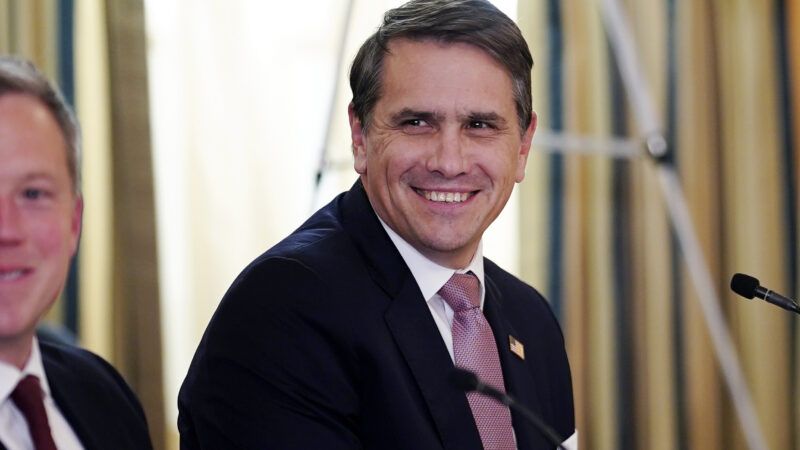
"Is the FBI conducting an investigation into that agent, into the shooting?" Shannon Bream asked Blanche on Fox News Sunday. "What can you tell us about that? Will it be made public?"
Blanche did not answer directly, instead saying the Justice Department's Civil Rights Division was not looking into the shooting. "We don't just go out and investigate every time an officer is forced to defend himself against somebody [who was] putting his life in danger," he said. "We never do." Blanche added that "there are over a thousand shootings every year where law enforcement [officers] are put in danger by individuals and they have to protect themselves, and they have a lawful right to do so."
Blanche, in other words, joins Secretary of Homeland Security Kristi Noem, President Donald Trump, and Vice President J.D. Vance in asserting that Ross acted in self-defense when he fired three shots into Good's Honda Pilot. How does Blanche know that?
"What happened on that day has been reviewed by millions and millions of Americans" who have seen bystander video of the incident, Blanche noted. That footage, he suggested, confirmed that the shooting was "objectively reasonable" given "the totality of the circumstances"—the Fourth Amendment test that the Supreme Court has applied to the use of deadly force by law enforcement officers.
Blanche did not mention that the "millions and millions of Americans" who have seen that footage disagree passionately about what it shows, which underlines the need for further investigation to resolve the issue. As of now, most Americans do not share Blanche's view.
In a YouGov poll conducted from January 9 through January 11, two-thirds of the respondents said they had heard a lot about the shooting, and 70 percent said they had watched video of the incident. Just 28 percent thought the shooting was justified, while 53 percent said it was not and 18 percent said they weren't sure. The breakdown was similar when people were asked whether Ross should face criminal charges.
As you might expect, Republicans were much more inclined than Democrats to view the shooting as justified. But while 88 percent of Democrats said the shooting was not justified, a substantially smaller majority of Republicans (61 percent) said it was. Even among Republicans, more than a third either said the shooting was not justified (15 percent) or said they weren't sure (24 percent). Most independents (58 percent) said the shooting was not justified.
Those finding are broadly consistent with the results of another YouGov poll conducted in collaboration with Yahoo News from January 8 through January 12. Just 27 percent of respondents thought the shooting was justified, while 52 percent said it was not and 21 percent were unsure. People who had watched video of the encounter were more likely to express an opinion: In that group, 57 percent thought the shooting was not justified, while 35 percent said it was.
In a Quinnipiac University survey conducted during the same period, 53 percent of respondents said the shooting was not justified, while 35 percent thought it was and 12 percent did not offer an opinion. In that poll, the partisan difference was sharper than in the YouGov surveys. Still, nearly a quarter of Republicans (23 percent) were not persuaded that the shooting was justified. And among independents, 59 percent said the shooting was not justified.
Public opinion, of course, cannot resolve the legal question. But these results suggest that, contrary to what Blanche implied, the video evidence is inconclusive at best.
Blanche left open the possibility that new evidence might justify a Justice Department inquiry, but that seems quite unlikely given the position he has already taken. "We investigate when it's appropriate to investigate," he said. "That is not the case here. It wasn't the case when it happened, and it's not the case today. If circumstances change and there's something that we do need to investigate around that shooting or any other shooting, we will. But we are not going to bow to pressure from the media, bow to pressure from politicians and do something that we never do—not under this administration, not under the last administration. And so no, we are not investigating, and if there comes a time when we need to, we will, but it's not now."
Blanche added that the Department of Homeland Security (DHS) is conducting an internal investigation of the shooting, as law enforcement agencies routinely do when officers fire their weapons. In an interview on the CBS show Face the Nation, Noem confirmed that Ross had been placed on adminstrative leave pending an investigation by her department's Office of Professional Responsibility. In addition to the question of whether the shooting complied with the Fourth Amendment, that review should ask whether Ross and the other ICE agents at the scene followed DHS policy. But there can be little doubt about the outcome of the DHS investigation, since Noem herself has repeatedly said Ross followed his training and acted in self-defense.
Noem first offered that judgment just hours after the shooting, saying Good was engaged in "domestic terrorism" because she "weaponize[d] her vehicle" by "attempt[ing] to run a law enforcement officer over." She said Ross, "fearing for his life," fired "defensive shots," in accordance with "his training," to "save his own life and [those] of his colleagues." The following Sunday, Noem defended that assessment, including her portrayal of Good as a domestic terrorist, during a contentious interview with CNN's Jake Tapper.
"Why did you not wait for an investigation before making your comments?" Tapper wondered. "Well," Noem replied, "everything that I have said has been proven to be factual and the truth."
The implication was that Noem's snap judgment on the day of the shooting, which she said was based on "videos" and conversations with ICE supervisors, had been retroactively validated by additional evidence. But she did not elucidate that evidence, even though she bragged that the Trump administration "is the most transparent and open government that we have ever had."
On Face the Nation yesterday, Noem, like Blanche, said "everybody can watch the videos and see" that Good deliberately tried to run Ross down. But if it were true that the videos leave no doubt on that score, why do 57 percent of Americans who have seen that footage say Good "was not trying to kill" Ross and that he "acted recklessly"? Why do 60 percent of those people reject Noem's characterization of Good's conduct as "domestic terrorism"? Probably because the videos cast serious doubt on Noem's description of what happened.
The videos show two ICE agents approaching Good's SUV, which she had parked sideways on Portland Avenue, forcing motorists to drive around her, a few minutes earlier. A witness reported that one of the agents initially told Good to drive away, which would have been a straightforward and peaceful way to resolve the situation. But another agent took a more aggressive approach. "Get out of the car," he told Good. "Get out of the car. Get out of the fucking car. Get out of the car."
Immediately after those rapid-fire commands, that agent grabbed the handle of the door next to Good and reached inside the car. At that point, Good backed up a bit and then started moving forward, steering to the right—away from the ICE agents. "Drive, baby, drive," said Good's wife, who was standing outside the car. We all know what happened next.
Although Noem is intent on portraying Good as an attempted murderer, that account seems inconsistent with Good's cheerful demeanor in Ross' cellphone video of the encounter as well as the direction in which she was pointing her car. But that does not necessarily mean the shooting was not legally justified.
Whatever Good's intent, she reportedly "clipped" Ross as she began to drive away. Although Ross seems uninjured in footage recorded after the shooting, unnamed government sources have told news outlets he suffered "internal bleeding." Noem, who had previously said Ross was treated at a hospital and released the same day, declined to discuss the extent of his injuries on Face the Nation. But regardless of how serious the damage was, Good's recklessness demonstrably posed a threat to Ross, especially because he had positioned himself in front of the car, contrary to standard police training.
Since Ross quickly moved out of the way, however, it is not clear that the shooting was justified self-defense, as opposed to angry retaliation (as suggested by his "fucking bitch" comment after he killed Good). It is hard to tell from the videos whether Ross was still in the SUV's path when he fired the first shot, which entered the car through the lower left corner of the windshield. He was definitely out of the way when he fired the second and third shots, which went through the side window next to Good.
When Tapper asked Noem about the justification for the second and third shots, she noted that Ross was making a "split-second" decision, which might count in his favor in the Fourth Amendment analysis. That's assuming it was reasonable to think killing Good was an effective way to neutralize the threat she allegedly posed, which seems doubtful given what actually happened: The unguided SUV careened down the street, stopping only after it crashed into a parked car.
Reasonable people can (and do!) disagree about how to weigh these considerations. But the dispute cries out for additional evidence beyond the ambiguous videos that persuaded Blanche and Noem, including witness accounts, the car's trajectory, and Ross' location when he fired his weapon. "This administration wants to operate in transparency," Noem told Tapper. Even if DHS and the FBI (assuming it is still investigating the shooting) absolve Ross—as seems inevitable—transparency demands a detailed explanation of the reasons for that conclusion. It does not seem like we will get that.




