
Why the DOJ Has Stopped Describing Maduro as the Head of a Literal Drug Cartel
That embarrassing mistake highlights the slipperiness of Trump's attempts to justify legally dubious policies by invoking the specter of "foreign terrorist organizations."
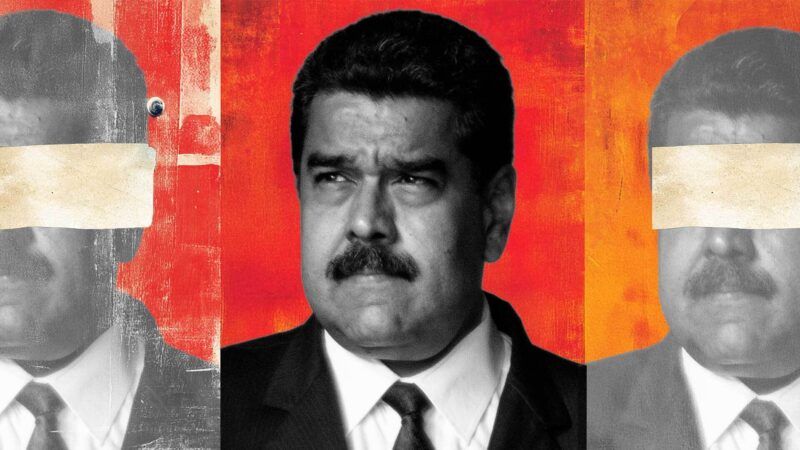
On the same day that U.S. forces invaded Venezuela to capture Nicolás Maduro, the Justice Department published a federal indictment that supposedly justified the operation. Like the 2020 indictment that federal prosecutors obtained during President Donald Trump's first term, the revised version charges the former Venezuelan dictator with participating in conspiracies involving "narco-terrorism," cocaine trafficking, and machine gun possession. But there is a notable difference that highlights the slipperiness of Trump's attempts to justify legally dubious policies, including summary deportation of alleged gang members and his deadly military campaign against suspected drug boats, by describing his targets as "foreign terrorist organizations" (FTOs).
The 2020 indictment places Maduro at the center of "the Venezuelan Cártel de los Soles," which it describes as a "drug-trafficking organization comprised of high-ranking Venezuelan officials who abused the Venezuelan people and corrupted the legitimate institutions of Venezuela—including parts of the military, intelligence apparatus, legislature, and the judiciary—to facilitate the importation of tons of cocaine into the United States." That "drug-trafficking organization," the indictment says, "participated in a corrupt and violent narco-terrorism conspiracy" with Fuerzas Armadas Revolucionarias de Colombia (FARC), a Marxist guerrilla group that relies on the cocaine trade for funding.
The indictment explains that the Venezuelan group's name, which means "Cartel of the Suns," refers to "the sun insignias affixed to the uniforms of high-ranking Venezuelan military officials who are members of the Cartel." It mentions Cártel de los Soles, which the Treasury Department and the State Department designated as an FTO last year, 33 times.
The new indictment, by contrast, refers just twice to Cártel de los Soles, which it describes as "a patronage system" run by top Venezuelan officials. It alleges that Maduro "participates in, perpetuates, and protects a culture of corruption in which powerful Venezuelan elites enrich themselves through drug trafficking and the protection of their partner drug traffickers." The "profits of that illegal activity," it says, "flow to corrupt rank-and-file civilian, military, and intelligence officials."
That description, New York Times reporter Charlie Savage notes, is more in line with reality, since Cártel de los Soles "is actually a slang term, invented by the Venezuelan media in the 1990s, for officials who are corrupted by drug money." As Savage explained in November, citing "a range of specialists in Latin American criminal and narcotics issues," Cártel de los Soles "is not a literal organization" but rather "a figure of speech in Venezuela."
In 2020, in other words, the Justice Department made a pretty embarrassing mistake, which it has sought to rectify in the revised indictment. Yet the Treasury Department and the State Department are still listing Cártel de los Soles, which federal prosecutors now say refers to "a patronage system" created by a bunch of corrupt government officials, as an FTO, which under federal law means "a foreign organization" that "engages in terrorist activity" threatening "the security of United States nationals or the national security of the United States."
Counterintuitively, the FTO list includes profit-motivated criminal organizations, along with ideologically or religiously motivated groups that use violence to achieve political goals. The latter set of FTOs fits the conventional definition of terrorism: "the unlawful use of violence or threats to intimidate or coerce a civilian population or government, with the goal of furthering political, social, or ideological objectives." Under that definition, a violent gang that simply aims to make money by robbing banks, kidnapping people, or selling drugs is not engaged in terrorism.
That understanding of the term is reflected in the FBI's definition of "domestic terrorism," which entails "violent, criminal acts committed by individuals and/or groups to further ideological goals stemming from domestic influences, such as those of a political, religious, social, racial, or environmental nature." By contrast, the FBI says, "international terrorism" refers to "violent, criminal acts committed by individuals and/or groups who are inspired by, or associated with, designated foreign terrorist organizations or nations."
An FTO, in short, is "a foreign organization" that "engages in terrorist activity," which means unlawful violence committed by an FTO. As Reason's Matthew Petti notes, such "circular logic" is convenient for the executive branch, allowing it to designate any foreign organization that commits violent crimes, regardless of its motivation, as an FTO.
Even in light of that broad license, classifying "a patronage system" as an FTO is a stretch. That label seems nonsensical if Cártel de los Soles is "a figure of speech" rather than "a literal organization."
In an interview with Savage, Elizabeth Dickinson, deputy director for Latin America at the International Crisis Group, welcomed the Justice Department's correction but noted that it is inconsistent with the FTO designations. "I think the new indictment gets it right, but the designations are still far from reality," she said. "Designations don't have to be proved in court, and that's the difference. Clearly, they knew they could not prove it in court."
Legally, an FTO designation means the Treasury Department can block transactions involving a listed group's assets and the Justice Department can prosecute people for supplying it with "material support or resources." But for Trump, the main purpose of the label is rhetorical and political, and in that respect it has been very useful.
When Trump invoked the Alien Enemies Act against suspected members of the Venezuelan gang Tren de Aragua (TDA) in May, he opened by describing the group as "a designated Foreign Terrorist Organization." That FTO "operates in conjunction with Cártel de los Soles, the Nicolas Maduro regime-sponsored, narco-terrorism enterprise based in Venezuela," Trump averred. Tren de Aragua, he claimed, was "supporting the Maduro regime's goal of destabilizing democratic nations in the Americas."
Tren de Aragua "is closely aligned with, and indeed has infiltrated, the Maduro regime, including its military and law enforcement apparatus," Trump said. According to his proclamation, the gang was "undertaking hostile actions and conducting irregular warfare against the territory of the United States both directly and at the direction, clandestine or otherwise, of the Maduro regime in Venezuela."
Those allegations were aimed at supporting Trump's improbable assertion that Tren de Aragua was a "foreign nation or government" that had "perpetrated, attempted, or threatened" an "invasion or predatory incursion against the territory of the United States." But in the judgment of U.S. intelligence agencies, there was little reason to believe the Venezuelan government was closely collaborating with Tren de Aragua, let alone directing its activities.
"Maduro regime leadership probably sometimes tolerates TDA's presence in Venezuela, and some government officials may cooperate with TDA for financial gain," an April 2025 intelligence memo said. But it added that "the Maduro regime probably does not have a policy of cooperating with TDA and is not directing TDA movement to and operations in the United States."
The Maduro indictment likewise offers little evidence to support the claim that Tren de Aragua was doing his bidding. In 2019, it says, the gang's leader, Guerrero Flores, "discussed drug trafficking with an individual he understood to be working with the Venezuelan regime." During "multiple" phone calls, Flores "offered to provide escort services for drug loads" and explained that Tren de Aragua "could handle the logistics of every aspect of the drug trade." Even assuming that Flores was in fact talking to a Venezuelan official, that is a far cry from "undertaking hostile actions and conducting irregular warfare against the territory of the United States" at "the direction" of "the Maduro regime."
In Trump's telling, however, one FTO, Tren de Aragua, had joined with another, Cártel de los Soles, in mounting an "invasion or predatory incursion" against the United States. He also leaned heavily on Tren de Aragua's status as an FTO when he described the September 2 attack that inaugurated his new policy of summarily executing suspected cocaine smugglers, which so far has killed 115 people in 35 operations.
After the first attack, Trump gleefully announced that "U.S. Military Forces" had "conducted a kinetic strike against positively identified Tren de Aragua Narcoterrorists," adding that the gang "is a designated Foreign Terrorist Organization, operating under the control of Nicolas Maduro." The operation, he bragged, "resulted in 11 terrorists killed in action."
The classification of Tren de Aragua as an FTO did not, strictly speaking, make Trump's reading of the Alien Enemies Act any more plausible. Nor did it provide a legal basis for his lethal anti-drug strategy, since an FTO designation is not a license to kill that transforms murder into self-defense. But the claim that he had killed "terrorists" lent superficial credence to his otherwise patently preposterous conflation of drug smuggling with violent aggression.
After U.S. forces blew up another boat on September 15, Trump likewise rejoiced in the deaths of three "confirmed narcoterrorists from Venezuela." Four days later, he announced a third attack that he said had killed three people "affiliated with a Designated Terrorist Organization" who were "conducting narcotrafficking."
In those cases, Trump did not specify which FTO he was talking about, and the government typically has not supplied that information after subsequent attacks. But it hardly matters: Last month, The New York Times reported that Trump had authorized Defense Secretary Pete Hegseth to "target vessels in international waters carrying drugs for any of 24 Latin American 'narco-terrorist' groups."
That list is secret, and it can always be amended. The only requirement, as far as Trump is concerned, seems to be an FTO designation, which the administration can supply at will, even when it makes little sense, as with the listing of Cártel de los Soles.
Secretary of State Marco Rubio is still pretending that the "patronage system" is a literal drug cartel. "We will continue to reserve the right to take strikes against drug boats that are bringing drugs toward the United States that are being operated by transnational criminal organizations, including the Cártel de los Soles," Rubio said on Meet the Press last Sunday. "Of course, their leader, the leader of that cartel, is now in U.S. custody and facing U.S. justice in the Southern District of New York. And that's Nicolás Maduro."
