
Could the Feds Throw You in Jail for Merely Filming ICE Immigration Raids?
Homeland Security Secretary Kristi Noem said "videotaping" agents was violence—but Border Patrol brought a film crew to Chicago-area raids.
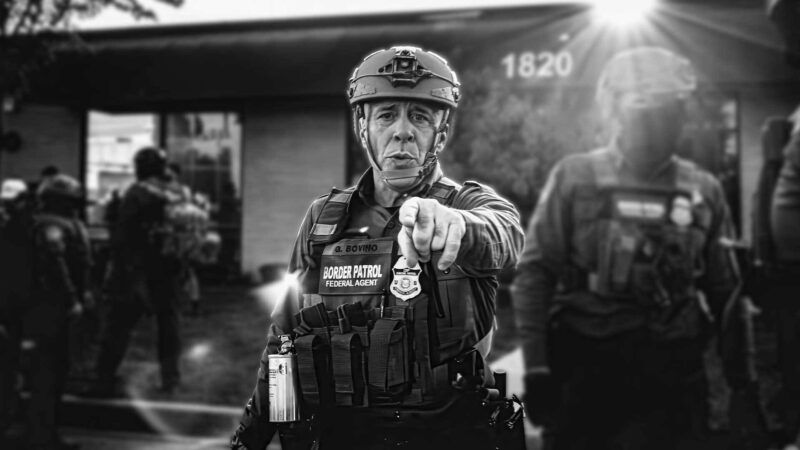
After leaving the Chicago area in November, United States Border Patrol Commander Gregory Bovino made an unexpected return on December 16, along with several hundred federal agents and a film crew. Returning to the same aggressive tactics that sparked protests earlier this year, local officials criticized Bovino for using immigration operations as a form of political theater.
In a statement to the Chicago Sun-Times, a spokesperson for Chicago Democratic Mayor Brandon Johnson called out agents for arresting people indiscriminately, without arrest warrants, and seemingly for content creation. "This activity is occurring alongside a film crew, which appears to be using these raids to create content at the expense of traumatizing families," said the spokesperson. "The crew's presence turns these operations into a spectacle, showing a disregard for the humanity of those impacted.…These tactics are destabilizing, wrong, and must be condemned."
But this is not the first time a federal agency has filmed immigration operations for political theater. In addition to being tasked with carrying out record levels of deportations, the Department of Homeland Security (DHS) under President Donald Trump has seemingly been transformed into a propaganda arm to sell the public on the president's increasingly unpopular immigration policies. Examples include a video posted on X by DHS Secretary Kristi Noem of agents raiding a South Shore apartment building on September 30, and a video posted on the DHS' official Instagram account depicting various immigration arrests.
As Bovino and the DHS have embraced the power of cinema to document immigration arrests and promote current policies, the Trump administration is also cracking down on individuals who choose to record immigration operations. During a July press conference, Noem spoke out against the alleged surge of violence against ICE agents, which she defined as, in addition to physical violence, "anything that threatens [agents] and their safety, so it's doxing them, it's videotaping them where they're at when they're out on operations." In a recent statement to Reason's C.J. Ciaramella, the DHS stated that "recording or following federal law enforcement 'sure sounds like obstruction of justice,'" an opinion that courts have overwhelmingly disagreed with.*
However, much of what the Trump administration complains about is often observers merely recording on-duty officers—an activity firmly protected by the First Amendment when no physical interference or danger is present, and an important tool for holding public officials accountable. DHS seems to have an official "nationwide policy of intimidating and threatening people who attempt to observe and record DHS operations," according to David Bier, the director of immigration studies at the Cato Institute.
Ironically, by the DHS' logic, even its own camera crews and media hired specifically to record and publish details of immigration operations in an attempt to influence policy by persuading the public could potentially be inciting violence against the agency. The right to free speech isn't taken away when someone says or does something that the government disagrees with. Attempting to define who is and isn't protected by the First Amendment is not only unconstitutional, but a strategy that could put even Trump's allies at the mercy of federal prosecutors.
DHS, the Justice Department, and ICE did not respond to requests for comment before deadline.
*CORRECTION: This article has been updated to remove reference to a Justice Department memo that does not refer to merely filming ICE operations.
