

The DOJ Assails D.C.'s 'Assault Weapon' Ban As an Arbitrary, Historically Ungrounded Gun Law
The department's lawsuit notes that the prohibited firearms are "in common use" for "lawful purposes," meaning they are covered by the Second Amendment.
In Washington, D.C., a gun cannot be legally owned unless it is registered, and it cannot be registered if it qualifies as an "assault weapon" under D.C. law. That policy, the U.S. Justice Department argues in a lawsuit it filed this week in the U.S. District Court for the District of Columbia, violates the Second Amendment by arbitrarily banning guns that are commonly used for lawful purposes.
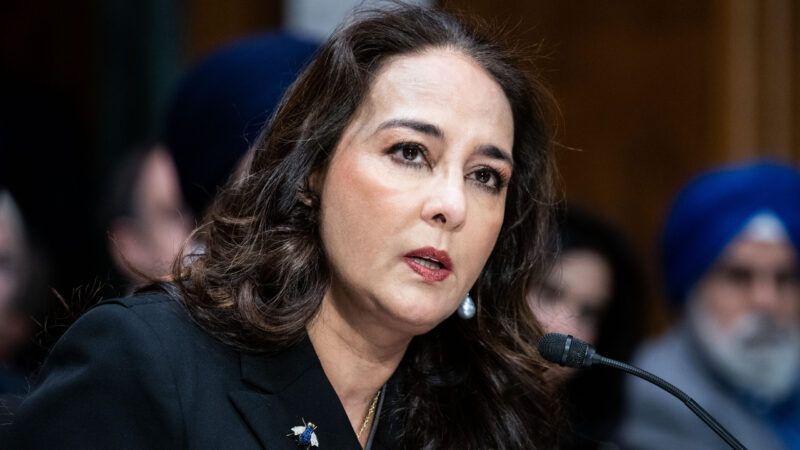
The lawsuit, which seems to be the first case pursued by a new Second Amendment Section within the Justice Department's Civil Rights Division, "underscores our ironclad commitment to protecting the Second Amendment rights of law-abiding Americans," Attorney General Pam Bondi said on Monday. Assistant Attorney General Harmeet Dhillon, who runs the Civil Rights Division, said she is determined to "defend American citizens from unconstitutional restrictions [on] commonly used firearms."
The statutory basis for the lawsuit, which names the District of Columbia, the Metropolitan Police Department, and D.C. Police Chief Pamela Smith as defendants, is 34 USC 12601, which prohibits any law enforcement "pattern or practice" that "deprives persons of rights, privileges, or immunities secured or protected by the Constitution or laws of the United States." That statute authorizes the attorney general to address such abuses by filing civil actions seeking "appropriate equitable and declaratory relief."
In this case, Dhillon alleges a pattern or practice that deprives D.C. residents of the constitutional right to keep and bear arms. That right, the Supreme Court said in the landmark Second Amendment case District of Columbia v. Heller, encompasses ownership of firearms "in common use" for "lawful purposes like self-defense." Since handguns are "the quintessential self-defense weapon," the Court said, they clearly fall into that category, which made D.C.'s ban on them unconstitutional.
The Court's 2022 decision in New York State Rifle & Pistol Association v. Bruen, which overturned New York's restrictions on carrying handguns in public for self-defense, reiterated that point. "Whatever the likelihood that handguns were considered 'dangerous and unusual' during the colonial period, they are indisputably in 'common use' for self-defense today," the majority said. Colonial laws that "prohibited the carrying of handguns," the Court concluded, "provide no justification for laws restricting the public carry of weapons that are unquestionably in common use today."
The guns banned by D.C.'s "assault weapon" law likewise are "unquestionably in common use today." The law covers a long list of firearm models, including AR-15 rifles, along with guns that meet specified criteria. Any semi-automatic rifle that accepts detachable magazines, for example, is considered an "assault weapon" if it has a pistol grip, a thumbhole stock, a folding or adjustable stock, or a flash suppressor.
Since 1990, more than 30 million "modern sporting rifles" have been sold in the United States, and as many as 24 million Americans have owned AR-15s or similar rifles for lawful purposes such as self-defense, hunting, and recreational target shooting. "The AR–15 is the most popular rifle in the country," the Supreme Court noted in a recent decision.
Under Bruen, a restriction on conduct covered by the "plain text" of the Second Amendment is constitutional only if the government can show it is "consistent with this Nation's historical tradition of firearm regulation." Yet as Dhillon notes, there is no "historically analogous" precedent for a "broad ban" on firearms "commonly used" by "law-abiding citizens" for "lawful purposes" such as "self-defense inside the home"—the right recognized in Heller.
Dhillon notes that D.C.'s "assault weapon" ban, like other laws of this sort, "is based on little more than cosmetics, appearance, or the ability to attach accessories." More to the point, it "fails to take into account whether the prohibited weapon is 'in common use today'" or whether "law-abiding citizens may use these weapons for lawful purposes protected by the Second Amendment."
Although the Justice Department's nine-page complaint is skimpy, federal judges have elaborated on these points. Like the law at issue in Heller, U.S. District Judge Peter Sheridan noted last year, New Jersey's AR-15 ban amounts to "the total prohibition [of] a commonly used firearm for self-defense…within the home." And under Heller, "a categorical ban on a class of weapons commonly used for self-defense is unlawful."
Sheridan highlighted testimony showing that "AR-15s are well-adapted for self-defense." When it upheld Maryland's AR-15 ban a week later, by contrast, the U.S. Court of Appeals for the 4th Circuit declared that such rifles are "ill-suited and disproportionate to the need for self-defense."
That conclusion, Judge Julius Richardson noted in a dissent joined by four of his colleagues, ignored the self-defense advantages of AR-15s, including better accuracy, greater recoil absorption, and more stopping power than handguns. While handguns also have certain advantages, Richardson said, the appeals court had no business second-guessing gun owners' weighing of these rifles' pros and cons, thereby "replac[ing] Americans' opinions of their utility with its own."
Where Richardson saw self-defense advantages, the majority saw features that make AR-15s especially deadly in mass shootings. These clashing perspectives illustrate the folly of trying to draw a legal distinction between guns that are suitable for legitimate purposes and guns that supposedly are good for nothing but killing innocent people.
Also last year, a federal judge in Illinois issued a permanent injunction against that state's "assault weapon" ban, deeming it "an unconstitutional affront to the Second Amendment." In his 168-page opinion, U.S. District Judge Stephen P. McGlynn explained why that law did not pass the Bruen test, which requires the government to cite historical analogs that are "relevantly similar" in motivation and scope.
Considering the purported historical analogs on which Illinois relied, McGlynn noted that "only 4% (9 out of 225) of the cited statutes entirely restricted the sale and/or possession of entire classes of weapons." The government "relies predominantly and overwhelmingly on concealed carry statutes, statutes restricting the discharge of firearms, and statutes proscribing brandishing or causing terror," he wrote.
Those laws, like the Illinois ban, were aimed at "preventing death or injury from firearms," McGlynn conceded. But they were not similar in scope. He concluded that the state "clearly cannot demonstrate" that its law "follows any historical tradition of sweeping prohibitions on the sale, transfer, and possession of vast swaths of firearms."
The District of Columbia will face similar challenges in defending its "assault weapon" ban under Bruen. And assuming the Supreme Court eventually agrees to hear this case or a similar one, at least four justices seem inclined to be skeptical of the constitutional justification for such laws. In addition to Brett Kavanaugh, who as a judge on the U.S. Court of Appeals for the D.C. Circuit dissented from a 2011 decision upholding the D.C. ban, Clarence Thomas, Samuel Alito, and Neil Gorsuch have indicated their receptiveness to the arguments sketched by Dhillon.
Last June, when the Supreme Court declined to hear an appeal of the 4th Circuit decision upholding Maryland's "assault weapon" ban, Kavanaugh emphasized the importance of addressing those arguments. "Given that millions of Americans own AR–15s and that a significant majority of the States allow possession of those rifles, petitioners have a strong argument that AR–15s are in 'common use' by law-abiding citizens and therefore are protected by the Second Amendment under Heller," he wrote, highlighting the difficulty of "distinguish[ing] the AR–15s at issue here from the handguns at issue in Heller."
While "AR–15s are semi-automatic," Kavanaugh noted, "so too are most handguns." Both kinds of weapons are used "for a variety of lawful purposes, including self-defense in the home," he added. "For their part, criminals use both AR–15s and handguns, as well as a variety of other lawful weapons and products, in unlawful ways that threaten public safety. But handguns can be more easily carried and concealed than rifles, and handguns—not rifles—are used in the vast majority of murders and other violent crimes that individuals commit with guns in America."
The denial of review in the Maryland case "does not mean that the Court agrees" with the 4th Circuit's decision "or that the issue is not worthy of review," Kavanaugh emphasized. "The AR–15 issue was recently decided by the First Circuit and is currently being considered by several other Courts of Appeals. Opinions from other Courts of Appeals should assist this Court's ultimate decisionmaking on the AR–15 issue. Additional petitions for certiorari will likely be before this Court shortly and, in my view, this Court should and presumably will address the AR–15 issue soon, in the next Term or two."




