Trump's Economic Adviser Says Tariff Refunds Would Be 'Very Complicated' and Unlikely
Oh, so now the Trump administration is worried about the complexity of its tariff polices?

The Trump administration is finally confronting the complicated reality of its complex and costly tariff policies.
Oh, not when it comes to collecting those tariffs. The administration is happy to keep doing that.
But if the U.S. Supreme Court rules that Trump's tariffs are illegal and requires the administration to issue refunds—then, suddenly, the complexity is an unsolvable problem. At least, that's the line that Kevin Hassett, director of the White House's National Economic Council, is trying out.
If the Supreme Court rules against Trump's tariffs, "it's going to be pretty unlikely that they're going to call for widespread refunds, because it would be an administrative problem to get those refunds out to there," Hassett told CBS News on Sunday.
"It'd be very complicated," he added. "It's a mess, and that's why I think the Supreme Court wouldn't do it."
As a legal matter, it would certainly be strange for the Supreme Court to decide that the Trump administration had unlawfully imposed tariffs but also decide that it is just too gosh darn difficult to set things right.
Imagine applying Hassett's logic to other high-profile Supreme Court cases over the years. Sure, school segregation is unconstitutional, but don't you know how complicated it would be to make sure everyone has equal access to public education? Yeah, of course the police should have to remind arrestees of their right to an attorney, but that sounds like a real administrative problem!
By comparison, refunding tariff payments is relatively easy. There are records of those payments, and all the federal government would have to do is issue refunds to the American importers and businesses that paid those taxes over the course of the past several months. It would be politically awkward after all that misleading talk about how other countries are paying the tariffs, but not difficult.
Indeed, the federal government collected over $5 trillion in taxes last year and spent over $7 trillion. But processing roughly $200 billion in tariff refunds is prohibitively complicated? Give me a break.
Still, the real kicker here is how Hassett is positioning the Trump administration as the victim. If he thinks refunding the tariffs would be complicated, wait until he sees what goes into collecting them in the first place.
The Trump administration's tariff policies have created a process that is "mind-numbingly difficult for even the most skilled technicians and biggest corporations," wrote Scott Lincicome, vice president of general economics at the Cato Institute, earlier this month in a must-read dive into the complexity of the tariff regime. For smaller businesses without the connections, staff, or resources to navigate the tariffs, the past nine months have been a nightmare.
Lincicome and his team at Cato also put together this fantastic infographic to illustrate the maze that all American imports must now navigate.
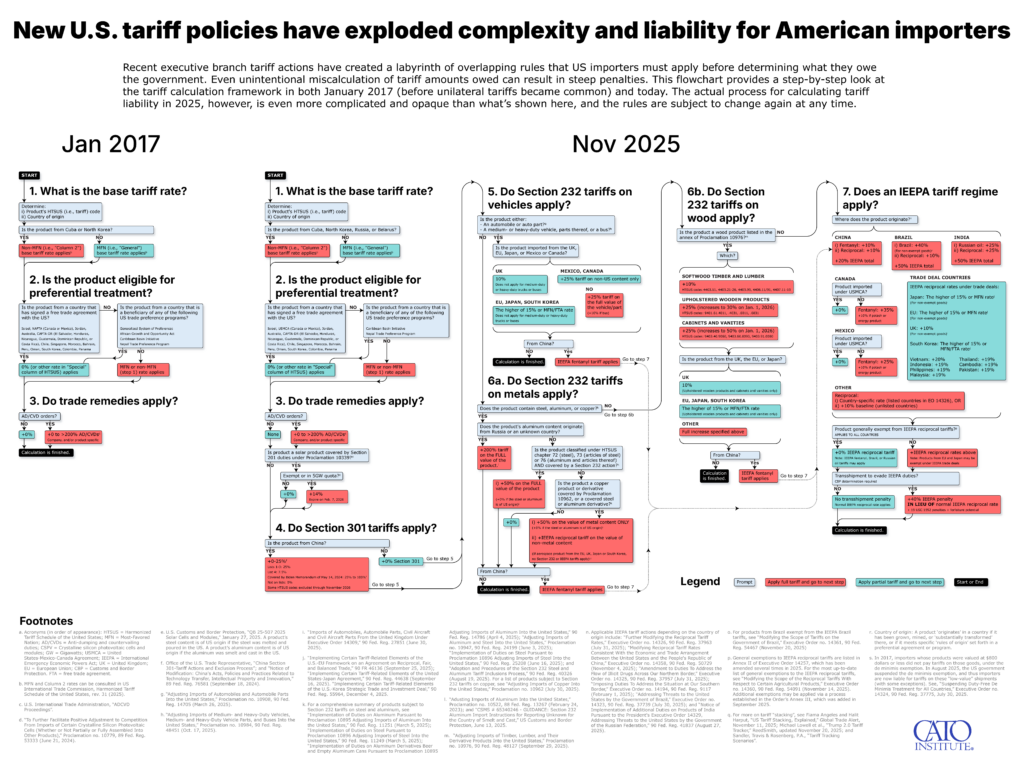
Adding to the complexity is the fact that tariff rates and exemptions have changed from week to week depending on Trump's mood. A fact sheet published in August by U.S. Customs and Border Protection, which was ostensibly meant to help businesses comply with the new rules, contains a darkly hilarious disclaimer saying that it should not be relied upon because "exemptions and details of each tariff action are not fully covered." The tariffs are so complicated that even the government agency tasked with enforcing them can't accurately describe what they are.
Against that backdrop, Hassett's comments about the complexity of refunding the tariffs are not just laughable but downright infuriating.
The Trump administration has forced American businesses to navigate an ever-changing gauntlet of new regulations in order to pay higher taxes that were imposed via questionably legal means and without congressional authorization. If the Supreme Court decides that refunds are necessary to ensure that justice is done, there will be approximately zero sympathy for the federal officials who created this "mess" in the first place.