

Trump's Designation of Fentanyl As a 'Weapon of Mass Destruction' Is a Drug-Fueled Delusion
The executive order does not accomplish much in practical terms, but it jibes with the president's conflation of drug trafficking with violent aggression.
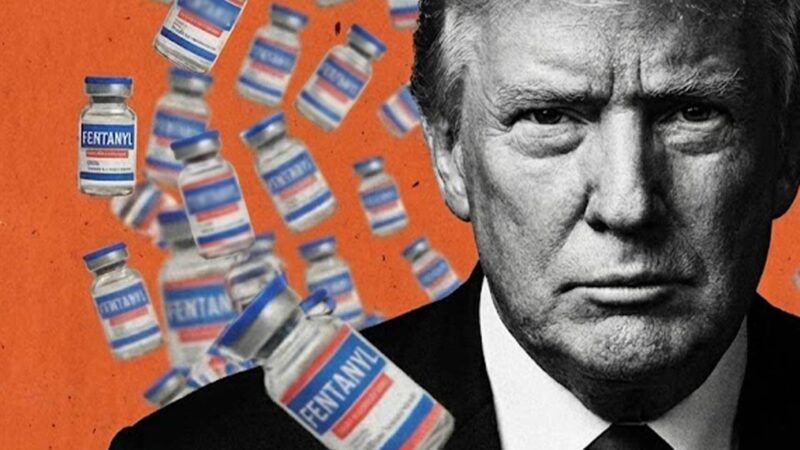
Although President Donald Trump frequently decries the threat that fentanyl poses to Americans, his comments reveal several misconceptions about the drug. He thinks Canada is an important source of illicit fentanyl, which it isn't. He thinks fentanyl smugglers pay tariffs, which they don't. He thinks the boats targeted by his deadly military campaign against suspected cocaine couriers in the Caribbean and the eastern Pacific are carrying fentanyl, which they aren't. Even if they were, his oft-repeated claim that he saves "25,000 American lives" each time he blows up one of those boats—which implies that he has already prevented nine times more drug-related deaths than were recorded in the United States last year—would be patently preposterous.
Trump's fentanyl fantasies reached a new level of absurdity this week, when he issued an executive order "designating fentanyl as a weapon of mass destruction." As relevant here, federal law defines a "weapon of mass destruction" (WMD) to include "any weapon that is designed or intended to cause death or serious bodily injury through the release, dissemination, or impact of toxic or poisonous chemicals."
The fentanyl implicated in U.S. drug deaths is not a "weapon." It is a psychoactive substance that Americans voluntarily consume, either knowingly or because they thought they were buying a different drug. Nor is that fentanyl "designed or intended" to "cause death or serious bodily injury." It is designed or intended to get people high, and to make drug traffickers rich in the process.
Trump nevertheless claims "illicit fentanyl is closer to a chemical weapon than a narcotic." How so? "Two milligrams, an almost undetectable trace amount equivalent to 10 to 15 grains of table salt, constitutes a lethal dose," he says. But that observation also applies to licit fentanyl, which medical practitioners routinely and safely use as an analgesic or sedative.
Dentists, for example, frequently use fentanyl combined with a benzodiazepine such as diazepam (Valium) or midazolam (Versed) for "conscious sedation." On a couple of occasions, I have received that combo during dental surgery. I was not at all worried that I would die of a drug overdose, and I certainly did not think my dental surgeon was attacking me with a weapon, let alone a weapon of mass destruction.
Contrary to what Trump implies, the danger posed by fentanyl in illicit drug markets is only partly a function of its potency. The core problem is that the introduction of fentanyl—initially as a heroin booster or replacement, later as an adulterant in stimulants or as pills passed off as legally produced pharmaceuticals—made potency, which was already highly variable, even harder to predict. It therefore compounded a perennial problem with black-market drugs: Consumers generally don't know exactly what they are getting.
That is not true in legal drug markets, whether you are buying booze at a liquor store or taking narcotic pain relievers prescribed by your doctor. The difference was dramatically illustrated by what happened after the government responded to rising opioid-related deaths by discouraging and restricting opioid prescriptions. Although those prescriptions fell dramatically, the upward trend in opioid-related deaths not only continued but accelerated. That result was not surprising, since the crackdown predictably encouraged nonmedical users to replace reliably dosed pharmaceuticals with much iffier black-market products.
The concomitant rise of illicit fentanyl magnified that hazard, and that development likewise was driven by the prohibition policy that Trump is so keen to enforce. Prohibition favors especially potent drugs, which are easier to conceal and smuggle. Stepped-up enforcement of prohibition tends to reinforce that effect. From the perspective of traffickers, fentanyl had additional advantages: As a synthetic drug, it did not require growing and processing crops, making its production less conspicuous and much cheaper.
Traffickers were not responding to a sudden consumer demand for fentanyl. They were responding to the incentives created by the war on drugs.
Trump is oblivious to all of this, which is why he thinks the solution to the hazards posed by prohibition is more aggressive enforcement of prohibition. "Hundreds of thousands of Americans have died from fentanyl overdoses," he says, without pausing to consider the role that the policy he supports played in those deaths. Yet he concedes the problem is not fentanyl per se but "illicit fentanyl," which would not exist without prohibition.
Even taking the war on drugs as a given, Trump's claim that fentanyl is a WMD makes little sense. There is nothing inherently aggressive about supplying Americans with the drugs they want. And even when dealers knowingly pass off fentanyl as heroin or Percocet, they might be guilty of a particularly dangerous form of consumer fraud, but that is a far cry from setting off a dirty bomb or lobbing mustard gas.
Trump tries to make his conflation of drug trafficking with an armed attack seem more plausible by noting that the illicit fentanyl trade funds organizations that engage in "assassinations, terrorist acts, and insurgencies around the world." He adds that drug cartels "engage in armed conflict over territory and to protect their operations, resulting in large-scale violence and death that go beyond the immediate threat of fentanyl itself." But like the special hazards of illegal intoxicants, the profit potential of selling banned substances and the black-market violence Trump describes are products of prohibition, and neither supports his characterization of fentanyl as a WMD.
Trump also mentions "the potential for fentanyl to be weaponized for concentrated, large-scale terror attacks by organized adversaries," which he views as "a serious threat to the United States." That hypothetical scenario does resemble the threat posed by WMDs, but it is nothing like the actual situation that Trump is addressing.
Legally and practically speaking, Trump's counterintuitive WMD designation does not do much. His order instructs Attorney General Pam Bondi to "pursue investigations and prosecutions" related to "fentanyl trafficking," which she was already doing. The same goes for Trump's instructions to Secretary of State Marco Rubio and Treasury Secretary Scott Bessent, whom he wants to "pursue appropriate actions against relevant assets and financial institutions in accordance with applicable law for those involved in or supporting the manufacture, distribution, and sale of illicit fentanyl and its core precursor chemicals."
The only new action that might be triggered by Trump's order seems to be "the provision of resources" from the Defense Department to support the Justice Department's anti-fentanyl efforts. Trump cites 10 USC 282, which says the defense secretary "may provide assistance in support of Department of Justice activities relating to the enforcement" of WMD laws "during an emergency situation" involving such weapons.
The main function of Trump's order is rhetorical. It jibes with his reality-defying argument that drug trafficking amounts to "an armed attack against the United States," which he thinks justifies summary execution of suspected smugglers without legal authorization or any semblance of due process. Like Trump's previous orders describing drug cartels as "foreign terrorist organizations" and declaring drug trafficking across the southern and northern borders "a national emergency," the WMD order also aims to make him look tough and determined.
Never mind the implausibility of designating fentanyl as a WMD, equating profit-motivated criminal organizations with ideological groups that use violence to achieve political goals, or asserting that the problem of drug-related deaths, which goes back decades, constitues a "national emergency" involving an "unusual and extraordinary threat," which Trump claims empowers him to impose tariffs on countries he deems insufficiently cooperative in waging the war on drugs. As with much of what Trump says and does, the vibe is what matters, and logic is beside the point.




