
Hottest Country
Plus: Karoline Leavitt's injection sites, Dan Bongino leaves FBI, Tesla trapped, and more...
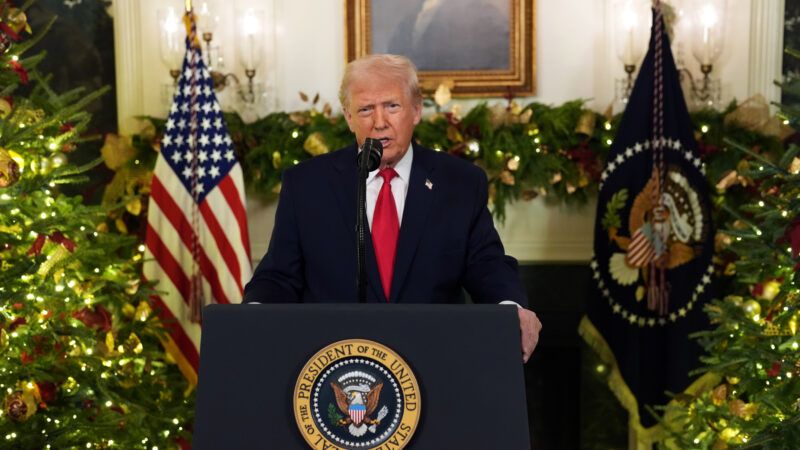
Trump's totally pointless 18-minute speech: "One year ago, our country was dead. We were absolutely dead," said President Donald Trump in a kind of rambling and weird address to the nation last night. "Our country was ready to fail. Totally fail. Now we're the hottest country anywhere in the world." Is that so? Americans largely beg to differ.
In the spring, Americans will see "the largest tax refund season of all time," he teased. And the government will soon be sending checks of $1,776 to all members of the military. OK. He said nothing about a possible war with Venezuela—what most political observers had expected the address to focus on—and was very light on foreign policy, heavy on domestic.
The Reason Roundup Newsletter by Liz Wolfe Liz and Reason help you make sense of the day's news every morning.
It's hard not to see the whole thing as a response to his falling approval ratings; just 36 percent of the surveyed American public approves of Trump's handling of the economy these days. It's also hard to see this as anything that will reverse them. Like so many meetings that could've just been emails, this was an address to the nation that probably could've just been a forgettable Truth Social post.
Inflation report surprises: Another Consumer Price Index (CPI) report was released this morning, showing a slower-than-expected inflation rise. The CPI "rose 2.7 percent from the same time last year," reports The New York Times. "That fell short of the previous 3 percent pace and was well below economists' expectations for a 3.1 percent rise."
Of course, the Bureau of Labor Statistics' October release never happened due to the government shutdown, so it's possible expectations were out of whack (and we have no official month-over-month data to analyze).
Breakdowns of specific categories—like grocery prices, year over year—can be found here. Interestingly, per Bloomberg, "over the two-month period—comparing November to September—lodging away from home (hotels), recreation, and clothing prices saw outright declines. Household furnishings, communication goods and personal care items were up."
Federal Reserve Chair Jerome Powell "sees tariffs generating only a one-time increase to prices rather than persistently higher inflation" and roughly predicts that "the peak impact on everyday goods to hit in the first quarter of 2026." Still, we've seen basically the end of stockpiling—companies that had hunkered down and braced for impact by hoarding materials and goods have now depleted their reserves—and more consumer prices reflecting the impact of tariffs, so it's not totally clear what inflation data will look like for the rest of the year and the start of the next one.
"An immediate takeaway is that these numbers really do move the inflation narrative firmly into the doves camp," writes Enda Curran for Bloomberg. "Of course, we know this data set is noisy but if this trend continues then it is a very different Fed debate."
Scenes from New York: Cardinal Timothy Dolan will be replaced by a relatively unknown Illinois bishop, Ronald Hicks, who is expected to "bring a markedly different leadership style" to our archdiocese here in New York. More here.
QUICK HITS
- "In nearly every country on Earth, the arrival of children tends to coincide with a lasting drop in employment and earnings for moms but not dads. Conversations about how to better support working mothers typically focus on family policy, such as subsidized child care and paid parental leave. But one significant factor affecting moms' employment remains under-discussed: the commute," writes Stephanie Murray at The Atlantic.
- What happens if your Tesla won't let you out?
- "The affordability crisis that upended global politics last year continues to ripple across some of the world's biggest democracies—punishing incumbents and undermining longstanding political alliances," reports Politico, looking at polling results from the United States, United Kingdom, Canada, Germany, and France.
- Dan Bongino leaving the FBI in January.
- A Massachusetts Institute of Technology professor, Nuno F.G. Loureiro, was murdered in his home. He was a decorated scientist and had served as the director of the school's Plasma Science and Fusion Center, winning an award from former President Joe Biden just a few years prior.
- "On Tuesday, Vanity Fair published a two-part story by Chris Whipple about the inner circle of President Donald Trump's staff featuring unusually candid conversations with Chief of Staff Susie Wiles. It also featured remarkably unvarnished portraits of Wiles, JD Vance, Marco Rubio and Karoline Leavitt, all photographed by Christopher Anderson," reports The Washington Post. They interviewed him, asking point-blank, "What is your response to people who say that these images are unfair? There's been a lot of attention about Karoline Leavitt's lips and [what appear to be] injection sites." Whipple's response? "I didn't put the injection sites on her. People seem to be shocked that I didn't use Photoshop to retouch out blemishes and her injection marks. I find it shocking that someone would expect me to retouch out those things."
- I've been on this for years:
More of us need to find the courage to tell teachers to pound sand. Not one penny more — and many cases, we should pay them a lot less. pic.twitter.com/0Jpci4Uy4U
— Nicholas Decker (@captgouda24) December 17, 2025
