
Reason.com - Free Minds and Free Markets
Reason logo Reason logo
  • Latest
  • Magazine
    • Current Issue
    • Archives
    • Subscribe
    • Crossword
  • Video
    • Reason TV
    • The Reason Roundtable
    • Just Asking Questions
    • Free Media
    • The Reason Interview
  • Podcasts
    • All Shows
    • The Reason Roundtable
    • The Reason Interview With Nick Gillespie
    • The Soho Forum Debates
    • Just Asking Questions
  • Volokh
  • Newsletters
  • Donate
    • Donate Online
    • Donate Crypto
    • Ways To Give To Reason Foundation
    • Torchbearer Society
    • Planned Giving
  • Subscribe
    • Reason Plus Subscription
    • Gift Subscriptions
    • Print Subscription
    • Subscriber Support

Login Form

Create new account
Forgot password

Supreme Court

A Judicial Solution for Presidential Overreach and Congressional Abdication

The Supreme Court should take a page from its own history.
Damon Root | 12.11.2025 7:00 AM

Share on FacebookShare on XShare on RedditShare by emailPrint friendly versionCopy page URL Add Reason to Google
Media Contact & Reprint Requests
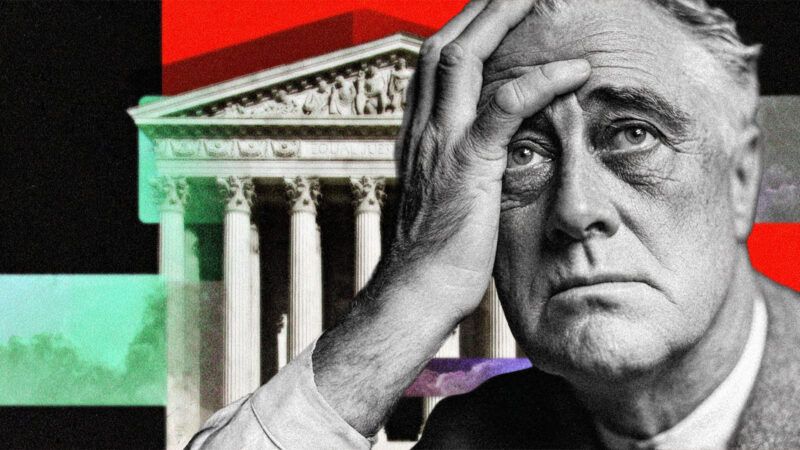
The Supreme Court building, and Franklin D. Roosevelt | Illustration: Eddie Marshall | Midjourney
(Illustration: Eddie Marshall | Midjourney)

The recent high-profile cases of Trump v. Slaughter and Learning Resources v. Trump might not initially appear to share very much in common. Yes, they both involve President Donald Trump, but the former is about the president's purported authority to fire the heads of federal agencies at will, while the latter is about the president's purported authority to unilaterally impose tariffs. Totally different legal issues, right?

Well, yes and no. Trump's name may dominate the headlines, but both cases are also about the actions of Congress. Or perhaps it might be better to say that both cases are about the inactions of Congress; about how Congress has relinquished its lawmaking power over many years both to the executive branch and to the executive-ish federal agencies who wield what a notable jurist once called "quasi-legislative" authority. In other words, both cases are about the separation of powers.

You’re reading Injustice System from Damon Root and Reason. Get more of Damon’s commentary on constitutional law and American history.

This field is for validation purposes and should be left unchanged.

The framers of the U.S. Constitution famously divided power among three branches of government so that, as James Madison explained in Federalist 51, the "constituent parts may, by their mutual relations, be the means of keeping each other in their proper places." The constitutional separation of powers was absolutely vital, Madison argued, because "ambition must be made to counteract ambition."

Notice the key assumptions on which this argument rests: Madison assumed that each branch would seek to enlarge its powers; but he also assumed that each branch would jealously guard its powers from being seized by the other branches.

President after president after president has certainly behaved as Madison assumed. But what about Congress?

Consider the constitutional authority "To declare War," which is granted exclusively to Congress via Article 1, Section 8. Yet Congress has officially done nothing in response to Trump carrying out repeated acts of war without even the slightest hint of congressional authorization. When an ambitious president meets a supine Congress, what's left of the separation of powers?

What's left is the third branch of government. Madison described the proper role of the judiciary as being "an impenetrable bulwark against every assumption of power in the legislative or executive."

I know what some of you are thinking, and you're right: The Supreme Court has undeniably failed to perform that judicial duty on many occasions. But there are some estimable past examples worth remembering, and emulating, today.

In 1935, the Supreme Court weighed the fate of the National Industrial Recovery Act of 1933 (NIRA), which President Franklin Roosevelt had championed as "the most important and far-reaching legislation ever enacted by the American Congress." Among other things, the NIRA placed unprecedented lawmaking power in the hands of the president.

Yet "such a sweeping delegation of legislative power" cannot be reconciled with the Constitution, declared Chief Justice Charles Evans Hughes in Schechter Poultry Corp. v. United States. "Congress cannot delegate legislative power to the President to exercise an unfettered discretion to make whatever laws he thinks may be needed or advisable for the rehabilitation and expansion of trade or industry."

The Court's Schechter ruling was 9–0, which meant that even the Progressive legal hero Justice Louis Brandeis lined up against Roosevelt. In fact, shortly after the decision came down, Brandeis personally delivered a blunt message to White House lawyers Tommy Corcoran and Ben Cohen. "This is the end of this business of centralization," Brandeis said to them, "and I want you to go back and tell the president that we're not going to let this government centralize everything."

By enforcing the non-delegation doctrine (and other venerable constitutional principles) in Schechter, the Supreme Court did its part to enforce the separation of powers. And the Court did so, it is worth noting, even though the legislative branch had voluntarily surrendered some of its powers to the president.

That same judicial solution to the intertwined problems of executive overreach and congressional abdication is still an option today. Or at least it is still an option if the current Supreme Court is prepared to do its job.

Start your day with Reason. Get a daily brief of the most important stories and trends every weekday morning when you subscribe to Reason Roundup.

This field is for validation purposes and should be left unchanged.

NEXT: These Researchers Are Turning Plastic Waste Into Fuel

Damon Root is a senior editor at Reason and the author of A Glorious Liberty: Frederick Douglass and the Fight for an Antislavery Constitution (Potomac Books). His next book, Emancipation War: The Fall of Slavery and the Coming of the Thirteenth Amendment (Potomac Books), will be published in June 2026.

Supreme CourtExecutive PowerCongressDonald TrumpTariffsConstitutionLaw & GovernmentSeparation of PowersHistory
Share on FacebookShare on XShare on RedditShare by emailPrint friendly versionCopy page URL Add Reason to Google
Media Contact & Reprint Requests

Show Comments (3)

Latest

A Judicial Solution for Presidential Overreach and Congressional Abdication

Damon Root | 12.11.2025 7:00 AM

These Researchers Are Turning Plastic Waste Into Fuel

Jeff Luse | From the January 2026 issue

Brickbat: Poor Sports

Charles Oliver | 12.11.2025 4:00 AM

Federal Reserve Defers to Donald Trump by Cutting Interest Rates by 25 Points

Jack Nicastro | 12.10.2025 5:21 PM

The MAHA Administration Bails Out Big Seed Oil

Christian Britschgi | 12.10.2025 4:25 PM

Recommended

  • About
  • Browse Topics
  • Events
  • Staff
  • Jobs
  • Donate
  • Advertise
  • Subscribe
  • Contact
  • Media
  • Shop
  • Amazon
Reason Facebook@reason on XReason InstagramReason TikTokReason YoutubeApple PodcastsReason on FlipboardReason RSS Add Reason to Google

© 2025 Reason Foundation | Accessibility | Privacy Policy | Terms Of Use

This site is protected by reCAPTCHA and the Google Privacy Policy and Terms of Service apply.

r

I WANT FREE MINDS AND FREE MARKETS!

Help Reason push back with more of the fact-based reporting we do best. Your support means more reporters, more investigations, and more coverage.

Make a donation today! No thanks
r

I WANT TO FUND FREE MINDS AND FREE MARKETS

Every dollar I give helps to fund more journalists, more videos, and more amazing stories that celebrate liberty.

Yes! I want to put my money where your mouth is! Not interested
r

SUPPORT HONEST JOURNALISM

So much of the media tries telling you what to think. Support journalism that helps you to think for yourself.

I’ll donate to Reason right now! No thanks
r

PUSH BACK

Push back against misleading media lies and bad ideas. Support Reason’s journalism today.

My donation today will help Reason push back! Not today
r

HELP KEEP MEDIA FREE & FEARLESS

Back journalism committed to transparency, independence, and intellectual honesty.

Yes, I’ll donate to Reason today! No thanks
r

STAND FOR FREE MINDS

Support journalism that challenges central planning, big government overreach, and creeping socialism.

Yes, I’ll support Reason today! No thanks
r

PUSH BACK AGAINST SOCIALIST IDEAS

Support journalism that exposes bad economics, failed policies, and threats to open markets.

Yes, I’ll donate to Reason today! No thanks
r

FIGHT BAD IDEAS WITH FACTS

Back independent media that examines the real-world consequences of socialist policies.

Yes, I’ll donate to Reason today! No thanks
r

BAD ECONOMIC IDEAS ARE EVERYWHERE. LET’S FIGHT BACK.

Support journalism that challenges government overreach with rational analysis and clear reasoning.

Yes, I’ll donate to Reason today! No thanks
r

JOIN THE FIGHT FOR FREEDOM

Support journalism that challenges centralized power and defends individual liberty.

Yes, I’ll donate to Reason today! No thanks
r

BACK JOURNALISM THAT PUSHES BACK AGAINST SOCIALISM

Your support helps expose the real-world costs of socialist policy proposals—and highlight better alternatives.

Yes, I’ll donate to Reason today! No thanks
r

FIGHT BACK AGAINST BAD ECONOMICS.

Donate today to fuel reporting that exposes the real costs of heavy-handed government.

Yes, I’ll donate to Reason today! No thanks