

Trump Pardons Mountain Runner Michelino Sunseri, Who Was Prosecuted for Using an Unapproved Trail
The decision is consistent with the president's avowed concerns about "overcriminalization in federal regulations."
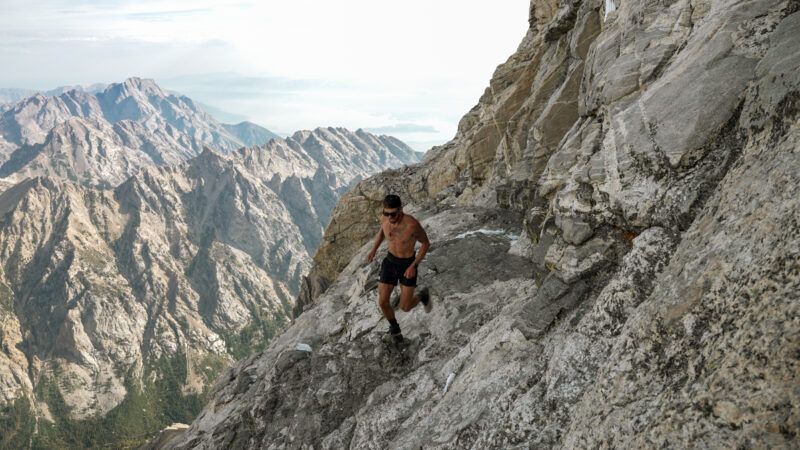
"In an unbelievable twist that even Hollywood couldn't write," mountain runner Michelino Sunseri announced on Facebook yesterday, "I woke up this morning to find out I've been given a PRESIDENTIAL PARDON from Donald J. Trump." Thus ends what Sunseri facetiously described as "the trail trial of the century"—his prosecution for taking an unauthorized route while ascending and descending Grand Teton in record time last year.
Sunseri's case attracted attention as an example of overcriminalization—in particular, the ways that general statutes authorizing criminal penalties interact with a sprawling federal regulatory code to entrap people who break the law without realizing it. That description pretty clearly applied to Sunseri, who provided the evidence that led to his prosecution by posting a map of his 13-mile Grand Teton route on social media.
On his way down, Sunseri briefly took a quarter-mile path known as "the old climber's trail" that had been used by six of seven previous Grand Teton record holders. As Cato Institute legal fellow Mike Fox noted in March, "tour guides who charge hefty sums frequently lead hikers up the same route," which WyoFile described as "a historic trail so well-used that it's become a skinny singletrack."
The National Park Service (NPS) nevertheless considered that trail "closed," although it notified the public of that designation only via two small and ambiguous signs that could easily have been misinterpreted. As the NPS saw it, Sunseri therefore had violated 36 CFR 21(b), which says a park superintendent "may restrict hiking or pedestrian use to a designated trail or walkway system." It adds that "leaving a trail or walkway to shortcut between portions of the same trail or walkway, or to shortcut to an adjacent trail or walkway in violation of designated restrictions is prohibited."
The regulation says nothing about criminal penalties, which are separately authorized by 16 USC 551. That law says violations of "rules and regulations" governing the use of public and national forests "shall be punished by a fine of not more than $500 or imprisonment for not more than six months, or both."
By authorizing prosecution for agency-defined offenses, Congress has created a bewildering situation in which the average American cannot reasonably be expected to know when he is committing a federal crime. The Code of Federal Regulations is so vast and obscure that even experts can only guess at the number of criminal penalties it authorizes—at least 300,000, they think.
"Many of these regulatory crimes are 'strict liability' offenses, meaning that citizens need not have a guilty mental state to be convicted of a crime," Trump noted in a May 9 executive order. "This status quo is absurd and unjust. It allows the executive branch to write the law, in addition to executing it."
Trump said federal prosecutors generally should eschew criminal charges for regulatory violations based on strict liability and focus on cases where the evidence suggests the defendant knowingly broke the rules. Trump also instructed federal agencies to "explicitly describe" conduct subject to criminal punishment under new regulations and prepare lists of regulatory violations that already can be treated as crimes.
After Trump issued that order, the NPS, which initially recommended Sunseri's prosecution, reconsidered, saying a plea deal offered by the government, which included a five-year ban from Grand Teton National Park as well as a fine, amounted to "an overcriminalization based on the gravity of the offense." But federal prosecutors in Wyoming, where that park is located, were undeterred. They proceeded with a two-day bench trial that ended on May 21.
After U.S. Magistrate Judge Stephanie Hambrick found Sunseri guilty in September, prosecutors offered to drop the case in exchange for 60 hours of community service. The U.S. Attorney's Office described that retreat as "an evolution of what is right," saying the decision "was made to preserve prosecutive and judicial resources while upholding the best interests of the public and the justice system."
Hambrick was irked, telling Ed Bushnell, one of Sunseri's attorneys: "It's an interesting message you send to the public. If you whine and cry hard enough, you get your way." But she said she would not decide whether to accept the belated deal until after a hearing on November 18.
Trump's pardon obviates the need for that hearing. And contrary to Hambrick's take, it sends a positive message—unlike his pardons for Capitol rioters, corrupt public officials who abused their powers for personal gain, allies in his fight to overturn the results of the 2020 presidential election, or other supporters with dubious cases for clemency. Sunseri's pardon is consistent with Trump's avowed concern about overcriminalization, which was also reflected in his May 28 pardons for two Florida diving instructors who were convicted of federal felonies after they freed sharks they mistakenly thought had been caught illegally.
Sunseri's prosecution provoked criticism from two members of the House Judiciary Committee, who saw it as inconsistent with Trump's executive order. "President Trump instructed all federal prosecutors to prioritize civil and administrative remedies over criminal enforcement where conduct was unintentional, non-harmful, or gained no advantage," Reps. Harriet Hageman (R–Wyo.) and Andy Biggs (R–Ariz.) noted in a July 17 letter to Stephanie Sprecher, the acting U.S. attorney for Wyoming.
After Sunseri was cited for using a prohibited trail, Hageman and Biggs said, he "took responsibility for his actions, expressed regret, and volunteered to help officially close the alternate path, which receives regular foot traffic." They said the decision to prosecute him anyway "appears to be a prime example of the problem of overcriminalization."
Biggs cited Sunseri's case when he introduced the Mens Rea Reform Act of 2025, which applies to federal statutory or regulatory offenses that "lack an explicit standard" regarding the defendant's state of mind. The bill would require prosecutors in such cases to prove that the defendant "knowingly" met each element of the offense.
The Pacific Legal Foundation (PLF), which assisted Sunseri's defense, welcomed Trump's pardon. "We are thrilled that Michelino's nightmare is over, but we're not done fighting against unconstitutional regulations that give low-level park officials the power to criminalize harmless conduct," said PLF attorney Michael Poon. "We are ready to help other Americans who face criminal prosecution for breaking park rules that were illegally created."




