

This Foreign Policy Precedent Might Aid Trump's Tariffs at SCOTUS
For the justices, the question is just how much deference the president deserves.
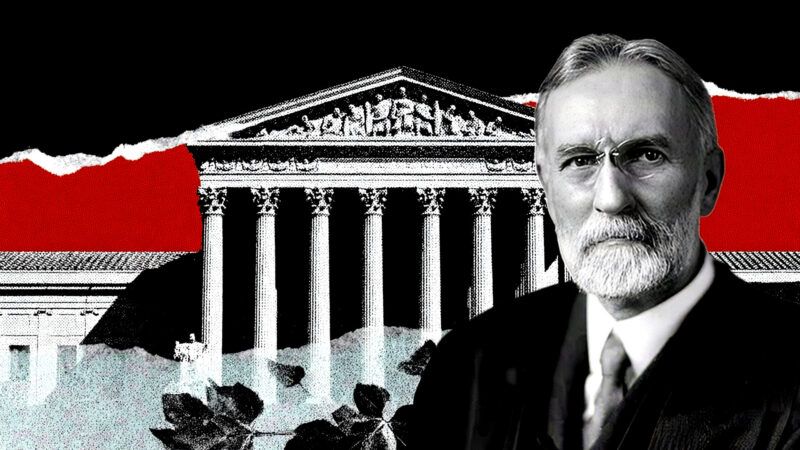
If you followed last week's U.S. Supreme Court oral arguments over President Donald Trump's supposed power to impose tariffs without first receiving clear authorization from Congress, you may have noticed that Solicitor General John Sauer repeatedly cited a Supreme Court precedent called United States v. Curtiss-Wright Export Corporation (1936). By my count, Sauer mentioned Curtiss-Wright six times by name during the arguments and referenced it obliquely several times more.
Why? The answer is simple enough: If a majority of the Supreme Court views Learning Resources v. Trump as a kind of progeny of Curtiss-Wright, then Trump's tariffs stand a good chance of emerging victorious.
You’re reading Injustice System from Damon Root and Reason. Get more of Damon’s commentary on constitutional law and American history.
The origins of the Curtiss-Wright case lie in a mostly forgotten military conflict from the 1930s between Bolivia and Paraguay known as the Chaco War. In 1934, Congress passed a resolution granting President Franklin Roosevelt discretionary power to stop U.S. firms from selling arms to either of those two nations. Roosevelt exercised this power via presidential proclamation.
The Curtiss-Wright Export Corporation then sued, arguing that the resolution was an illegal delegation of congressional power to the executive branch. The company's principal argument was that if Congress wished to prohibit the sale of arms to a particular nation, then Congress had to pass a specific law to that effect. What Congress could not do was simply hand off its own legislative power and let the president make law via executive order.
But the Supreme Court disagreed and handed Roosevelt a sweeping win. "It is important to bear in mind that we are here dealing not alone with an authority vested in the President by an exertion of legislative power," declared the majority opinion of Justice George Sutherland, but also with the "plenary and exclusive power of the President in the field of international relations—a power which does not require as a basis for its exercise an act of Congress."
When foreign affairs were at stake, Sutherland maintained, the president should be afforded the strongest possible degree of judicial deference. "The powers of external sovereignty," he wrote, do "not depend upon the affirmative grants of the Constitution." Rather, according to Sutherland, "this vast external realm" involves the "plenary and exclusive power of the President as the sole organ of the federal government."
A few years ago, I profiled Sutherland and his judicial legacy, noting that "it's safe to assume that when the White House wants a free hand to operate in the name of foreign affairs, Curtiss-Wright will be invoked."
That was certainly true last week. According to the solicitor general, the Trump administration relied on Curtiss-Wright for the proposition that "the nondelegation doctrine for domestic affairs does not apply with the same force as it does in foreign affairs."
If a majority of the Supreme Court decides that Trump's tariffs are best understood as a foreign affairs matter—rather than understanding the tariffs as a domestic matter that involves placing new taxes on American businesses and consumers—then the majority may grant Trump the Curtiss-Wright-style deference that Sauer kept bringing up.
Chief Justice John Roberts notably grappled with that aspect of the government's argument. The "foreign commerce part," Roberts told Sauer, is "two-facing. Yes, of course, tariffs and dealings with foreign powers, but the vehicle is imposition of taxes on—on Americans, and that has always been the core power of Congress." Roberts added: "So, to have the President's foreign affairs power trump that—that basic power for Congress seems to me to kind of at least neutralize between the two powers, the executive power and the legislative power."
The chief justice asked tough questions of both sides last week, but this line of questioning must have been especially worrying for Sauer. Roberts is, after all, a well-known advocate of judicial deference towards the president in the realm of foreign affairs. Yet Roberts seemed doubtful of the notion that Trump's tariffs should really count as foreign affairs here. This could mean that Roberts, who might be inclined to accept the Curtiss-Wright argument in other cases, won't buy it in this case.
In many ways, that line of questioning by Roberts captured the fundamental conflict at the heart of this case. The president has no independent constitutional authority to impose taxes or tariffs because those powers are spelled out in Article I and thus reside exclusively with Congress. But if the Trump administration can shift the legal focus away from Congress and onto what Sauer called the president's "own inherent authority to address foreign-arising emergencies," then Trump may benefit from the sweeping judicial deference embraced by Curtiss-Wright.
In other words, if the Supreme Court looks at this case from one angle, it's a separation of powers dispute in which the president has clearly overstepped. But if the Court looks at it from another angle, it's a foreign affairs matter in which the president might get wide leeway to operate. I know which way I view it. We'll find out soon which way the Court does.




