
When Does an Ugly Facebook Message Qualify as an Illegal 'True Threat' of Violence? SCOTUS Will Decide.
The Supreme Court takes up “true threats” and the First Amendment in Counterman v. Colorado.
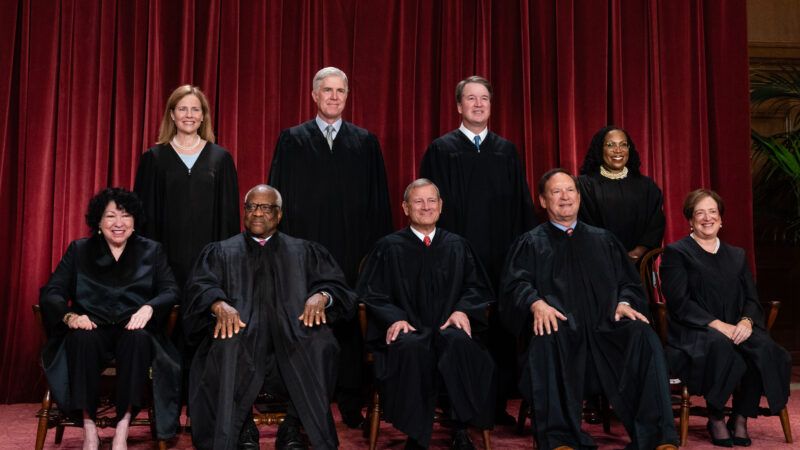
"If there is a bedrock principle underlying the First Amendment," the U.S. Supreme Court said in Texas v Johnson (1989), "it is that the government may not prohibit the expression of an idea simply because society finds the idea itself offensive or disagreeable." What that principle means in practice is that all sorts of vile and despicable speech—including hate speech—are constitutionally protected.
But the Court has also said that the First Amendment has its limits. One of them involves "true threats" of violence, which the Court in Virginia v. Black (2003) defined as "those statements where the speaker means to communicate a serious expression of an intent to commit an act of unlawful violence to a particular individual or group of individuals." The First Amendment, the Court held, "permits" the government "to ban a 'true threat.'"
Deciding what actually counts as a "true threat" is not such an easy task, however, as the Supreme Court seems to recognize. Last week, the Court agreed to hear arguments in Counterman v. Colorado, which asks, in the question presented to the Court, "whether, to establish that a statement is a 'true threat' unprotected by the First Amendment, the government must show that the speaker subjectively knew or intended the threatening nature of the statement, or whether it is enough to show that an objective 'reasonable person' would regard the statement as a threat of violence."
Billy Raymond Counterman was convicted under a Colorado anti-stalking law after sending numerous Facebook messages from different accounts to a musician, including statements to the musician such as "Fuck off permanently" and "You're not being good for human relations. Die. Don't Need You." The musician never responded to any of his messages, blocked his account, and ultimately filed a restraining order against him.
The state law that Counterman was convicted under makes it illegal to repeatedly make "any form of communication with another person…that would cause a reasonable person to suffer serious emotional distress and does cause that person…to suffer serious emotional distress." Whether or not Counterman actually intended to convey a threat was immaterial under the state law. His mindset was not at issue. The Supreme Court will now weigh that state law against its own First Amendment precedents.
Counterman v. Colorado has implications that reach far beyond the ugly Facebook messages of one man. As the Cato Institute observed in an amicus brief, "the Nation is undergoing a communications revolution, driven by unprecedented new forms of online expression—and unprecedented new attempts by government to monitor and restrict such expression. This case is the right vehicle to set clear, badly needed boundaries for government authority to limit online expression through the harsh cudgel of criminal prosecution."




