

Elizabeth Warren Blames High Food Prices on Grocery Chains' 'Record' 1 Percent Profit Margins
The Massachusetts senator advocated breaking up major grocery retailers with antitrust laws.
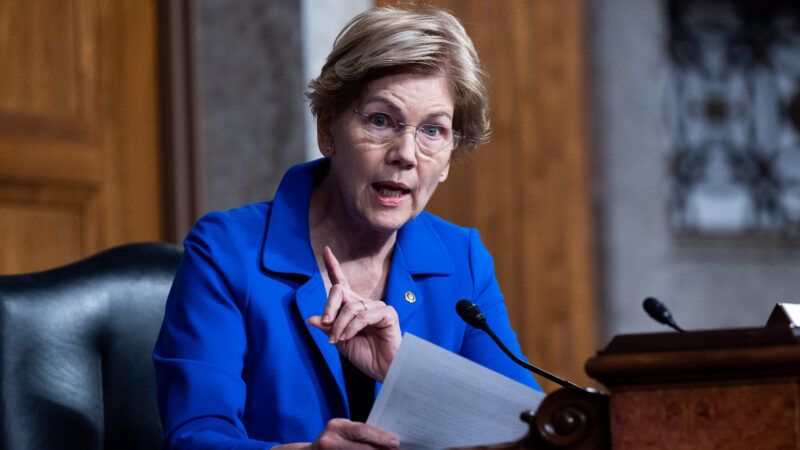
On Friday, Sen. Elizabeth Warren (D–Mass.) tweeted a video clip from her appearance on MSNBC's Stephanie Ruhle Reports a couple of days earlier.
What happens when only a handful of giant grocery store chains like @Kroger dominate an industry? They can force high food prices onto Americans while raking in record profits. We need to strengthen our antitrust laws to break up giant corporations and lower prices. pic.twitter.com/DMa9Z7adFr
— Elizabeth Warren (@SenWarren) January 7, 2022
"What happens," the caption asked, "when only a handful of giant grocery store chains like Kroger dominate an industry? They can force high food prices onto Americans while raking in record profits." Warren claimed that "a handful of giant chains" had replaced the wide selection of smaller stores that used to dot the American landscape, and she called for the use of the government's antitrust power to "break up these giant corporations."
This was not a new topic for the senator: In December, she sent a letter to Kroger, Albertsons, and Publix, excoriating the grocery giants for "passing costs on to consumers to preserve your pandemic gains" and "taking advantage of inflation to add greater burdens." The letter noted that while grocers' profits had risen during the pandemic, the chains had not reinvested that windfall into "lower prices for consumers" and "protect[ing] and compensat[ing] their workers."
But Warren could hardly have picked a worse industry to use as an example: Grocery stores consistently have among the lowest profit margins of any economic sector. According to data compiled this month by New York University finance professor Aswath Damodaran, the entire retail grocery industry currently averages barely more than 1 percent in net profit. In its most recent quarter, Kroger reported a profit margin of 0.75 percent, during a time in which Warren claims that the chain was "expanding profits" due to its "market dominance."
In actuality, for much of the last year, grocery stores have seen enormous boosts in revenue, but not increased profitability, for the simple reason that everything has been costing more: not just products, but transportation, employee compensation, and all the extra logistical steps needed to adapt to shopping during a pandemic. Couple that with persistent inflation—which Warren also recently blamed on "price gouging"—and it is no wonder that things seem a bit out of balance.
Warren has had an itchy trigger finger for antitrust laws for some time. In 2019, as part of her presidential platform, she called for using the laws to forbid retailers from selling their own products. This would affect industry leaders like Amazon and Walmart, but ironically, it would have a devastating impact on grocery stores as well: Grocers increasingly rely on their own proprietary goods to stock cheaper alternatives alongside name brands. This provides not only less expensive options for consumers, but lower costs to the stores themselves. Store brands also help fill gaps created by external supply shortages.
If Warren wishes to truly rein in the costs of Americans' groceries, the solutions are clear: Cool off inflation by paring back profligate government spending; remove protectionist restrictions to allow industries to get the supply chain back on track; in the longer term, cut back on red tape to better allow competition among suppliers. These fixes may not be as flashy as "break up Big Grocery," but they at least reflect the situation accurately.




