

Reason.com - Free Minds and Free Markets
Reason logo Reason logo
  • Latest
  • Magazine
    • Current Issue
    • Archives
    • Subscribe
    • Crossword
  • Video
    • Reason TV
    • The Reason Roundtable
    • Just Asking Questions
    • Free Media
    • The Reason Interview
  • Podcasts
    • All Shows
    • The Reason Roundtable
    • The Reason Interview With Nick Gillespie
    • The Soho Forum Debates
    • Just Asking Questions
  • Volokh
  • Newsletters
  • Donate
    • Donate Online
    • Donate Crypto
    • Ways To Give To Reason Foundation
    • Torchbearer Society
    • Planned Giving
  • Subscribe
    • Reason Plus Subscription
    • Gift Subscriptions
    • Print Subscription
    • Subscriber Support

Login Form

Create new account
Forgot password
Reason logo

Reason's Annual Webathon is underway! Donate today to see your name here.

Reason is supported by:
Brian Watts

Donate

Privacy

The Attorney General Is Determined to Undermine Your Privacy

The encryption limits that the Justice Department demands in the name of security would make all of us less secure.
Jacob Sullum | 10.16.2019 12:01 AM

Share on FacebookShare on XShare on RedditShare by emailPrint friendly versionCopy page URL Add Reason to Google
Media Contact & Reprint Requests
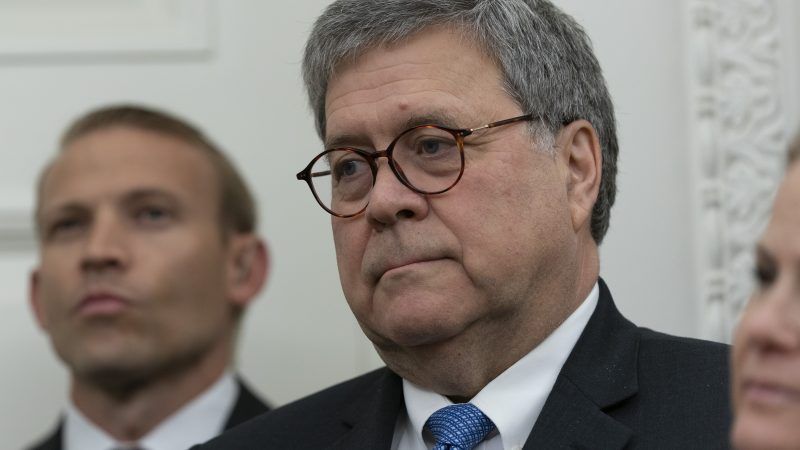
William-Barr-10-8-19-Newscom | Chris Kleponis (pool via CNP/Newscom)
(Chris Kleponis (pool via CNP/Newscom))

The Department of Justice claims to support "strong encryption, which is used by billions of people every day for services such as banking, commerce, and communications." Yet the department is actively working to weaken encryption, lest fully secure communications frustrate law enforcement agencies seeking access to possibly incriminating messages—a problem it calls "going dark."

Long before the government faced the "going dark" challenge, it faced the "going mobile" challenge posed by gasoline-powered vehicles, which Attorney General William Barr thinks offers an instructive analogy. He is right, but not for the reasons he suggests. The legal treatment of automobiles actually casts doubt on the Justice Department's insistence that the world be arranged to facilitate criminal investigations.

In a 1925 case involving enforcement of alcohol prohibition, the Supreme Court announced an exception to the Fourth Amendment's warrant requirement. Because illicit booze transported by motorized vehicles might be whisked away and hidden or destroyed before police could obtain judicial approval for a search, the Court said, the Fourth Amendment allows warrantless searches of automobiles as long as there is "probable cause" to believe they contain contraband.

Justice James Clark McReynolds dissented. "If an officer, upon mere suspicion of a misdemeanor, may stop one on the public highway, take articles away from him and thereafter use them as evidence to convict him of crime," he wondered, "what becomes of the Fourth and Fifth Amendments?"

Nowadays, when electronic warrants can be readily obtained in a matter of minutes, McReynolds' objection is stronger than ever. Although police can no longer plausibly claim that they do not have time to get a warrant before searching a lawfully stopped vehicle, the automobile exception that the Court carved out nearly a century ago continues to relieve them of that requirement.

In any case, notwithstanding the fact that automobiles facilitate all manner of crimes, the government has never tried to ban them for that reason. Yet that is what Barr and his allies are threatening to do with "end-to-end" encryption, which makes electronic messages indecipherable to anyone but the sender and the recipient.

Such technology is obviously useful to people who value their privacy, including journalists, lawyers, dissidents, and ordinary citizens discussing sensitive matters. It provides protection not only against the prying eyes of governments, many of which are unconstrained by concerns about civil liberties and the rule of law, but against hackers, con men, blackmailers, and other private-sector malefactors.

But because end-to-end encryption also is useful to criminals, Barr argues, it cannot be tolerated. Barr recently urged Facebook CEO Mark Zuckerberg to reconsider plans to include end-to-end encryption, which is already incorporated into the company's highly popular WhatsApp platform, in its other messaging services.

"Companies should not deliberately design their systems to preclude any form of access to content, even for preventing or investigating the most serious crimes," Barr wrote in an open letter to Zuckerberg. Such privacy-protecting innovation, he said, "puts our citizens and societies at risk."

For the time being, Barr is limiting his anti-privacy efforts to exhortation. But in a speech last July, he warned that "legislative and regulatory solutions" may be necessary if tech companies are not sufficiently cooperative.

Technically savvy privacy advocates have long argued that "back doors" allowing government access to encrypted communications inevitably create vulnerabilities that bad actors can exploit. Barr disputes that claim without proposing any specific solutions to the problem, merely suggesting that it can be licked if only companies like Facebook think hard enough about the challenge.

Even if you share Barr's vague confidence, it's undeniable that the access he demands for the U.S. government will also be demanded by governments with far worse human rights records, jeopardizing people who dare to think for themselves in countries that do not respect such freedom. The compromises he seeks in the name of "security," on behalf of "the public," would make the public less secure by denying them the privacy-protecting tools they manifestly want.

© Copyright 2019 by Creators Syndicate Inc.

Start your day with Reason. Get a daily brief of the most important stories and trends every weekday morning when you subscribe to Reason Roundup.

This field is for validation purposes and should be left unchanged.

NEXT: Kamala Harris Demands That Warren Promise To Ban Trump From Twitter

Jacob Sullum is a senior editor at Reason. He is the author, most recently, of Beyond Control: Drug Prohibition, Gun Regulation, and the Search for Sensible Alternatives (Prometheus Books).

PrivacyEncryptionWilliam BarrFourth AmendmentSearch and SeizureDepartment of JusticeFacebook
Share on FacebookShare on XShare on RedditShare by emailPrint friendly versionCopy page URL Add Reason to Google
Media Contact & Reprint Requests

Show Comments (19)

Webathon 2025: Dec. 2 - Dec. 9 Thanks to 1749 donors, we've reached $59,043 of our $400,000 goal!

Reason Webathon 2023

All Donations NOW Being Matched! Donate Now

Latest

The Trump Admin Wants Western Union and MoneyGram To Report on Immigrants

Matthew Petti | 12.3.2025 11:15 AM

Can America Return to Neoconservatism Without the Same Results?

Matthew Petti | 12.3.2025 9:45 AM

The Affordability Con Job

Liz Wolfe | 12.3.2025 9:30 AM

Reason's Video Docs Debunk the 'Socialists of All Parties'

Nick Gillespie | 12.3.2025 8:00 AM

Switzerland Just Overwhelmingly Rejected a New Wealth Tax. Will California Lawmakers Learn?

J.D. Tuccille | 12.3.2025 7:00 AM

Recommended

  • About
  • Browse Topics
  • Events
  • Staff
  • Jobs
  • Donate
  • Advertise
  • Subscribe
  • Contact
  • Media
  • Shop
  • Amazon
Reason Facebook@reason on XReason InstagramReason TikTokReason YoutubeApple PodcastsReason on FlipboardReason RSS Add Reason to Google

© 2025 Reason Foundation | Accessibility | Privacy Policy | Terms Of Use

This site is protected by reCAPTCHA and the Google Privacy Policy and Terms of Service apply.

r

HELP EXPAND REASON’S JOURNALISM

Reason is an independent, audience-supported media organization. Your investment helps us reach millions of people every month.

Yes, I’ll invest in Reason’s growth! No thanks
r

I WANT TO FUND FREE MINDS AND FREE MARKETS

Every dollar I give helps to fund more journalists, more videos, and more amazing stories that celebrate liberty.

Yes! I want to put my money where your mouth is! Not interested
r

SUPPORT HONEST JOURNALISM

So much of the media tries telling you what to think. Support journalism that helps you to think for yourself.

I’ll donate to Reason right now! No thanks
r

PUSH BACK

Push back against misleading media lies and bad ideas. Support Reason’s journalism today.

My donation today will help Reason push back! Not today
r

HELP KEEP MEDIA FREE & FEARLESS

Back journalism committed to transparency, independence, and intellectual honesty.

Yes, I’ll donate to Reason today! No thanks
r

STAND FOR FREE MINDS

Support journalism that challenges central planning, big government overreach, and creeping socialism.

Yes, I’ll support Reason today! No thanks
r

PUSH BACK AGAINST SOCIALIST IDEAS

Support journalism that exposes bad economics, failed policies, and threats to open markets.

Yes, I’ll donate to Reason today! No thanks
r

FIGHT BAD IDEAS WITH FACTS

Back independent media that examines the real-world consequences of socialist policies.

Yes, I’ll donate to Reason today! No thanks
r

BAD ECONOMIC IDEAS ARE EVERYWHERE. LET’S FIGHT BACK.

Support journalism that challenges government overreach with rational analysis and clear reasoning.

Yes, I’ll donate to Reason today! No thanks
r

JOIN THE FIGHT FOR FREEDOM

Support journalism that challenges centralized power and defends individual liberty.

Yes, I’ll donate to Reason today! No thanks
r

BACK JOURNALISM THAT PUSHES BACK AGAINST SOCIALISM

Your support helps expose the real-world costs of socialist policy proposals—and highlight better alternatives.

Yes, I’ll donate to Reason today! No thanks
r

STAND FOR FREEDOM

Your donation supports the journalism that questions big-government promises and exposes failed ideas.

Yes, I’ll donate to Reason today! No thanks
r

FIGHT BACK AGAINST BAD ECONOMICS.

Donate today to fuel reporting that exposes the real costs of heavy-handed government.

Yes, I’ll donate to Reason today! No thanks


