The Volokh Conspiracy

Mostly law professors | Sometimes contrarian | Often libertarian | Always independent | Est. 2002

The Volokh Conspiracy

Ukraine War Music

"We'll Withstand the Horde"

A new humorous song of Ukrainian defiance, in Russian.

|

The author and singer is Nikolay (Kolya) Serga, a Russian pop singer turned travel show host / TV personality. It's an anti-Russian sung in Russian—unsurprising in a country where most know Russian and many, including I believe President Zelensky, spoke it in preference to Ukrainian for most of their lives—and of course it's hard to fully appreciate in English. But here's a translation; I lack the gifts to translate it in full rhyme and meter, but I tried to play with a few lines to make them work that way, at the expense of some imprecision in translation. I also tried to preserve the song's contemptuous tone. (You can read the original text here.)

The footnotes explain some cultural referents (though I'm sure I've missed others), and also note some of the substantive changes I made when translating. The opening and closing lines aren't really part of the song; they are just spoken lines on the video, but they struck me as providing important framing. If anyone has any corrections to the translation (or proposed improvements), please let me know.

{[Spoken:] Together we are strong,
And the strength is in each of us!}

Russian Johnny[1] stomps our soil
With his boots covered in mud
Choosing where it would be nicest
To forever spill his blood[2]
Bullet nips on Johnny's nose
Johnny lays down on the path
So in time he can come back as a lovely patch of grass[3]

[Chorus:] Dor-dor-dor-dor-dor-dor
We'll withstand the horde[4]

Read More

Tibet uprising

Tibet's armed resistance to Chinese invasion

Part 6: The Tibetan resistance continues, and thwarts a genocide

|

This is the last of six posts in series on the Tibetan Uprising. This one is about the Tibetan resistance after 1959, when the Dalai Lama set up a government in exile in India.

Post 1 covered Tibet before the 1949 Chinese invasion, including the Tibetan government's refusal to heed the 1932 warning of the Dalai Lama to strengthen national defense against the "'Red' ideology". Post 2 was the Chinese conquest, followed by armed uprising of the people, precipitated by gun registration. Post 3 described the 1956-57 revolts, which liberated most of Eastern Tibet. Post 4 covered the creation of a unified national resistance in 1958, the Chushi Gangdruk. Post 5 described how the armed uprising in Lhasa in 1959 saved the Dalai Lama from a communist kidnap attempt, and enabled him to escape to India..

These posts are excerpted from my coauthored law school textbook and treatise Firearms Law and the Second Amendment: Regulation, Rights, and Policy (3d ed. 2021, Aspen Publishers). Eight of the book's 23 chapters are available for free on the worldwide web, including Chapter 19, Comparative Law, where Tibet is pages 1885-1916. In this post, I provide citations for direct quotes. Other citations are available in the online book chapter.

Resistance from Nepal

The Tibetan freedom fighters, the Chushi Gangdruk, were allowed to set up in Mustang, a thinly populated district in Nepal, surrounded on three sides by Tibet, populated primarily by Tibetans, and run by a friendly and mostly autonomous local king who was Tibetan. The fighters who had retreated to India in 1959 were joined by other fighters coming directly to Mustang from Tibet. Over the next several years, they caused so much trouble on the Tibetan highway from Kham to Lhasa that the Chinese had to divert traffic to the other highway 180 miles north.

In 1961, the Mustang fighters scored the biggest anti-communist intelligence coup since the Korean War, capturing over 1,600 classified documents of the Chinese "People's Liberation Army" (PLA) from a PLA commander. The documents provided much insight into the PLA and communist government, including secret codes and Sino-Soviet relations. The documents noted that the famine in China caused by Mao's "Great Leap Forward" was demoralizing PLA troops. The communist militia was acknowledged to be of almost no value militarily, and some of the militia were joining uprisings in China. Some of the captured materials were later used as evidence by the Tibetan government in exile in its international law protests against Chinese atrocities in Tibet. The documents were released in 1963 and published in 1966. The Politics of the Chinese Red Army: A Translation of the Bulletin of the Activities of the People's Liberation Army (J. Chester Cheng ed. 1966).

Through 1963, the Mustang fighters helped five thousand more Tibetans escape to India, Nepal, Bhutan, or Sikkim. The last CIA airdrop into Tibet was in 1965, and the Tibet resistance training center at Camp Hale, Colorado, was shut down. However, other CIA support for the Mustang fighters continued.

Read More

Free Speech

David Lat on the Latest Yale Law School Disruption of a Speaker

"As lawyers, we have to put aside our differences and talk to opposing counsel. If you can't talk to your opponents, you can't be an effective advocate."

|

A superb analysis, at his Original Jurisdiction newsletter. Read the whole thing, but here's an excerpt:

Here's a report from Aaron Sibarium of the Washington Free Beacon:

More than 100 students at Yale Law School attempted to shout down a bipartisan panel on civil liberties, intimidating attendees and causing so much chaos that police were eventually called to escort panelists out of the building.

The March 10 panel, which was hosted by the Yale Federalist Society, featured Monica Miller of the progressive American Humanist Association (AHA) and Kristen Waggoner of the Alliance Defending Freedom (ADF), a conservative nonprofit that promotes religious liberty. Both groups had taken the same side in a 2021 Supreme Court case involving legal remedies for First Amendment violations. The purpose of the panel, a member of the Federalist Society said, was to illustrate that a liberal atheist and a conservative Christian could find common ground on free speech issues.

For additional coverage, see … Eda Aker and Philip Mousavizadeh's article in the Yale Daily News and Robby Soave's post over at Reason.

If you read the Free Beacon's coverage, you get the sense of an out-of-control mob; if you read the YDN's coverage, you get the sense of quiet, non-disruptive protesters, threatened by the presence of police. Based on what I've heard from folks who were there, the truth lies somewhere in between.

The protesters were disruptive at the start of the event, both inside the classroom and after they repaired to the hallway. But unlike the protesters at Hastings, they did calm down (eventually), and they did not succeed in "canceling" the Yale event, which moved forward to completion.

Credit for this should go to Professor Kate Stith, moderator of the Yale FedSoc event, who had the unenviable task of dealing with this fraught situation. As you can see in video footage (via the Free Beacon), after the protesters started getting noisy inside the classroom, claiming that this was their form of "free speech," she reminded them of the school's actual free-speech policies (and told them that they needed to "grow up," for which she was jeered). She informed the protesters that they could either (1) stay in the classroom, remain quiet during the speakers' presentations, and ask questions during the Q&A, or (2) they could leave the classroom and gather in the hallway, as long as they did not disrupt the event….

Read More

Guns

Is Ownership of Guns Itself Evidence of Drug Dealing?

|

At a traffic stop for overly tinted windows, a police officer smelled marijuana, and indeed found marijuana in the car. He also found a lot of cash, which was seized, on the theory that it was likely to be drug proceeds. No, said Chief Judge Martin Reidinger (W.D.N.C.) in U.S. v. Approximately $13,205.54 in U.S. Currency Seized from Rahkim Franklin: "[T]he totality of the evidence presented by the Government fails to establish by a preponderance of the evidence that the Defendant Currency seized during the August 21, 2018 traffic stop was proceeds traceable to an exchange for controlled substances within the meaning of 21 U.S.C. § 881(a)(6)." (Apparently the cash had been intended to be a down payment on a house.) And in the process, Chief Judge Reidinger noted:

In a footnote, the Government points out that Mr. Franklin also owns several firearms, which the Government contends "have long been recognized as being 'tools of the drug trade.'" [Doc. 87 at 6 n.2 (quoting in part United States v. Ward, 171 F.3d 188, 195 (4th Cir. 1999)]. It is undisputed, however, that Mr. Franklin owned these firearms legally; he is not a convicted felon or an otherwise prohibited person. Further, none of Mr. Franklin's firearms were subject to forfeiture by the Government.

The Government has not presented any evidence from which this Court could reasonably conclude that these firearms were owned for the purpose of furthering any criminal activity. For the Government to suggest that a citizen's mere possession of firearms implicates that person in illicit drug trafficking is to strain credulity. The Government's argument presents some Second Amendment considerations that counsel has apparently not considered.

Congratulations to James W. Kilbourne, Jr. and Jesse M. Swords of Allen Stahl & Kilbourne, PLLC on the victory.

"Is Justice Kagan Done With Stare Decisis?"

|

I saw this post at the "Re's Judicata" blog, written by Prof. Richard Re (University of Virginia), and found it very interesting; I asked Prof. Re whether I could repost it, and he graciously agreed:

The Court recently heard argument in Ysleta del Sur Pueblo v. Texas, a statutory-interpretation case about Indian tribes' ability to regulate or conduct games like bingo. But perhaps the most talked-about aspect of the case was a much more broadly applicable rumination by Justice Kagan. Here it is:

JUSTICE KAGAN: I'm about to take you outside the scope of this case, so I apologize beforehand. But Justice Alito raised what to me is an interesting question that I've been thinking about a good deal about what these substantive canons of interpretation are and when they exist and when they don't exist.

They're all over the place, of course. It's not just the Indian canon. Next week, we're going to be thinking about the supposed major questions canon. There are other canons.

I mean, if you go through Justice Scalia's book, you'll find a wealth of canons of this kind, these sort of substantive canons. Some of them help the government. Some of them hurt the government.

Is there any way that the government has of coming in and saying, like, how do we reconcile our views of all these different kinds of canons? Maybe we should just toss them all out, you know.

Read More

Religion and the Law

Islamic Prenuptial Agreements in American Courts

The key is that they are agreements, enforceable under American law as non-religious agreements are.

|

From Parbeen v. Bari, decided yesterday by the Florida Court of Appeal (Fourth District), in an opinion by Judge Alan Forst, joined by Chief Judge Burton Conner and Judge Jeffrey Kuntz:

This case concerns a prenuptial agreement made by the parties on September 14, 2015, and its impact on their subsequent divorce. In lieu of a conventional prenuptial agreement, the parties opted instead to enter a type of traditional Islamic prenuptial contract known as a "Mahr." Although the agreement was entered into in Bangladesh, neither party claims that it should be interpreted under the secular laws of that nation.

The parties' Mahr agreement is only two pages long and contains few legally operative clauses other than an explicit promise by Former Husband to pay Former Wife fifteen lac Bangladeshi Taka ("15,00,000" Taka). Five lac Taka would be paid upon marriage, and ten in the event of a divorce. {The trial court determined that "10,00,000" Taka had a United States Dollar value of $11,772.43. [A "lac" or "lakh," on the Indian subcontinent, means 100,000, especially with regard to money; 100 lakh, which is to say 10,000,000, is a "crore." -EV]} …

The trial court concluded that the Mahr generally limited Former Wife's recovery to the stated amount, but the Court of Appeals disagreed:

Read More

Free Speech

How Corporate Criticism Threatened Online Anonymous Speech

"This was now in their face, and it was in print."

|

In the late 1990s, most publicly traded companies were the subjects of Yahoo! Finance bulletin boards. Yahoo! allowed users to post message under pseudonyms, so its bulletin boards quickly became a virtual water cooler for rumors about companies nationwide.

Corporate executives and public relations departments routinely monitored the bulletin boards, keenly aware that one negative post could affect employee morale and, more importantly, stock prices. While companies were accustomed to handling negative press coverage, the pseudonymous criticism on Yahoo! Finance was an entirely different world. Executives knew to whom they could complain if a newspaper's business columnist wrote about inflated share prices or pending layoffs. Yahoo! Finance's commenters, on the other hand, typically were not easily identifiable.

Not surprisingly, the Yahoo! Finance bulletin boards soon became a major early battleground for the right to anonymous online speech. Companies' attempts to unmask Yahoo! Finance posters would set the stage for years of First Amendment battles over online anonymity.

Read More

Climate Change

Fifth Circuit Stays Erroneous District Court Injunction Against Social Cost of Carbon Estimates

In a brief per curiam opinion, the Fifth Circuit concludes the plaintiff states lack standing to press their claims.

|

Last month, in Louisiana v. Biden, a federal district court in Texas enjoined all federal agencies from relying upon or otherwise considering social cost of carbon estimates developed by an Interagency Working Group appointed by President Biden. This decision misapplied multiple administrative law doctrines, as I detailed in this post.

Today, a panel of the U.S. Court of Appeals for the Fifth Circuit granted a stay of the district court's injunction, pending appeal. In a brief per curiam opinion, the panel (consisting of Judges Southwick, Graves, and Costa) explained why the district court was wrong to enjoin agencies' use of the IWG social cost of carbon estimates.

The Fifth Circuit's opinion both provides useful context, and explains why the plaintiff states do not have standing to press their specific claims (though they might well have standing to challenge specific agency actions that rely upon social cost of carbon estimates). Here are the relevant portions:

When federal agencies promulgate regulations or take other agency action with economically significant effects, they conduct a cost-benefit analysis. This has been done since the Carter administration, although presidential oversight of regulatory action through a systematic review process began as early as the Nixon administration. In 1993, President Clinton issued Executive Order 12866 which, among other things, mandates the prepublication review process for economically significant regulations. Exec. Order No. 12866 . . . states "[e]ach agency shall assess both the costs and the benefits of the intended regulation and, recognizing that some costs and benefits are difficult to quantify, propose or adopt a regulation only upon a reasoned determination that the benefits of the intended regulation justify its costs." Later administrations retained EO 12866's commitment to cost-benefit analyses and strengthened it with additional directives or guidelines for regulatory analysis.

In 2003, the Office of Management and Budget (OMB) issued Circular A-4 to provide guidance to agencies on how to conduct the cost benefit analysis implemented by EO 12866. See OMB Circular A-4 (Sept. 17, 2003). Compliance with Circular A-4 is not required by any statute or regulation and is not binding on any agency.

In conducting cost-benefit analyses, agencies consider the impact of the emissions of greenhouse gases. The impact of these emissions on various factors like health, agriculture, and sea levels, can be quantified into dollar amounts per ton of gas emitted—i.e., the Social Cost of Greenhouse Gases (SC-GHG).

To encourage consistency in determining SC-GHG, in 2009, President Obama instituted the Interagency Working Group (IWG) to develop a method for quantifying the costs and effects of emissions. In 2010, the IWG developed a method to quantify GHG emissions into social costs estimates based on peer-reviewed frameworks.

In 2017, President Trump disbanded the IWG and its method for quantifying SC-GHG in Executive Order 13783. . . . That order still contemplated, however, that agencies would continue to "monetize the value of changes in greenhouse gas emissions resulting from regulations" and that estimates would be consistent with Circular A-4 (to the extent permitted by law). . . .

In January 2021, President Biden signed Executive Order 13990 and reinstated the IWG to advise him on the SC-GHG. . . .  The IWG was also directed to develop new estimates for the SC-GHG, and until those new estimates are published, to develop Interim Estimates within 30 days, as appropriate and consistent with applicable law. Pursuant to EO 13990, agencies must use the Interim Estimates when they conduct cost-benefit analyses for regulatory or other agency action. The IWG published the Interim Estimates in February 2021. The Interim Estimates are the same as the SC-GHG estimates from 2016, adjusted for inflation.

The Plaintiff States sued the United States' Government Defendants in April 2021 to preemptively challenge the Interim Estimates. They claim the Interim Estimates will lead to increased regulatory burdens when agencies conduct cost-benefit analyses. The Plaintiff States therefore brought several challenges to Interim Estimates pursuant to the Administrative Procedures Act (APA). The Plaintiff States' claims are premised solely on the broad use of the Interim Estimates. They do not challenge any specific regulation or other agency action.

In February 2022, the district court entered a preliminary injunction enjoining the Government Defendants from using, in any manner, the Interim Estimates. The Government Defendants move to stay the injunction pending appeal arguing, among other things, the Plaintiff States lack standing, their claims are not ripe, and the Interim Estimates are not final agency action under the APA. Because we conclude the Government Defendants have made a strong showing that they are likely to succeed on the merits, and the balance of harms to the parties favors granting the stay, we GRANT the Government Defendants' motion. . . .

The Government Defendants are likely to succeed on the merits because the Plaintiff States lack standing. The Plaintiff States' claimed injury is "increased regulatory burdens" that may result from the consideration of SC-GHG, and the Interim Estimates specifically. This injury, however, hardly meets the standards for Article III standing because it is, at this point, merely hypothetical. . . . The Government Defendants are also likely to succeed in showing that the Plaintiff States have failed to meet their burden on causation and redressability. The increased regulatory burdens the Plaintiff States fear will come from the Interim Estimates appear untraceable because agencies consider a great number of other factors in determining when, what, and how to regulate or take agency action (and the Plaintiff States do not challenge a specific regulation or action). . . .

The Interim Estimates on their own do nothing to the Plaintiff States. So we discern no injury that would satisfy Article III at this stage. . . . The Plaintiff States' claims therefore amount to a generalized grievance of how the current administration is considering SC-GHG. And that fails to meet the standards of Article III standing. See Lujan, 504 U.S. at 568 ("[R]espondents chose to challenge a more generalized level of Government action," instead of "specifically identifiable Government violations of law," which is "rarely if ever appropriate for federal-court adjudication." (citation omitted)).

The Government Defendants have shown they will be irreparably harmed absent a stay. The preliminary injunction halts the President's directive to agencies in how to make agency decisions, before they even make those decisions. It also orders agencies to comply with a prior administration's internal guidance document that embodies a certain approach to regulatory analysis, even though that document was not mandated by any regulation or statute in the first place. The preliminary injunction sweeps broadly and prohibits reliance on § 5 of EO 13990, which creates the IWG, a group created to advise the President on policy questions in addition to creating the Interim Estimates. It is unclear how the Plaintiff States' qualms with the Interim Estimates justify halting the President's IWG. All of this effectively stops or delays agencies in considering SC-GHG in the manner the current administration has prioritized within the bounds of applicable law. The preliminary injunction's directive for the current administration to comply with prior administrations' policies on regulatory analysis absent a specific agency action to review also appears outside the authority of the federal courts. We therefore find the Government Defendants are irreparably harmed absent a stay of the injunction. . . .

In sum, the Plaintiff States' claims are based on a generalized grievance of the use of Interim Estimates in cost-benefit analyses of regulations and agency action. But their claimed injury does not stem from the Interim Estimates themselves, it stems from any forthcoming, speculative, and unknown regulation that may place increased burdens on them and may result from consideration of SC-GHG. We conclude the standing inquiry shows the Government Defendants' likelihood of success on the merits in this appeal, and the other factors, including the public
interest, favor granting a stay of the injunction.

It is possible that the plaintiff states will seek en banc review of this decision, perhaps in part due to the relatively "liberal" make up of this particular Fifth Circuit panel. Yet this is not a "liberal" or unorthodox panel opinion. It is, instead, a rather straightforward application of Article III's standing requirements. Moreover, as  I detailed in my prior post on this litigation, standing is but one of multiple reasons the plaintiff states' claims should have been dismissed.

I should reiterate that nothing in the Fifth Circuit's opinion presumes that the IWG social cost of carbon estimates are reasonable or reliable, nor does it presume that the Biden Administration's climate policies are the correct ones. It instead focused on whether the plaintiff states are pressing claims that federal courts can properly hear, and it did so correctly.


"Pulsed Nuclear Space Propulsion and International Law: Some Preliminary Observations"

Any fan of SF and law has got to be interested in this one.

|

Besides being InstaPundit, Prof. Glenn Reynolds has also written and taught about, among other things, space law; he and Leigh Outten (a former student of his who has a master's in nuclear engineering from MIT) have cowritten an article on space law and Orion drives, which I found very interesting. The abstract:

Pulsed Nuclear Space Propulsion, researched in the 1950s and 1960s by such eminent physicists as Freeman Dyson, Ted Taylor, Theodore von Karman, and Hans Bethe, involves propelling large spacecraft using compact nuclear explosions from specialized atomic devices. This technology is often known by the name of the Air Force project in which it was developed, Orion.

It has long been believed that the 1962 Limited Test Ban Treaty prohibits the use of nuclear pulse space propulsion. After a survey of the Orion project and its results, and a review of the applicable law, this paper concludes that language in the 1967 Outer Space Treaty may override the Test Ban agreement to permit non-weapons use of nuclear explosives for propulsion.

With a new space race taking place, and with important actors like China not subject to the Test Ban Treaty at all, the subject of pulsed nuclear space propulsion deserves another look. We hope that this paper serves as a springboard to discussion.

Much worth reading, and only 23 pages.

Free Speech

Missouri S. Ct. Strikes Down Requirement That Defense Lawyers Inform Sexual Assault Victims of Certain Matters

Such a requirement violates the First Amendment's protection against compelled speech, the court held, and can't be justified as a regulation of professional conduct.

|

Fox v. State, decided yesterday by the Missouri Supreme Court, in a unanimous opinion written by Judge Mary Russell, holds unconstitutional the following Missouri statute (enacted in 2020):

Before commencing an interview of a survivor [of sexual assault], a law enforcement officer, prosecuting attorney, or defense attorney shall inform the survivor of the following:

(a) The survivor's rights pursuant to this section and other rules and regulations …, which shall be signed by the survivor of sexual assault to confirm receipt;

(b) The survivor's right to consult with an employee or volunteer of a rape crisis center during any [such] interview … to be summoned by the interviewer before the commencement of the interview, unless no [such] employee or volunteer … can be summoned in a reasonably timely manner; [and]

(c) The survivor's right to have a support person of the survivor's choosing present during any [such] interview …, unless the [interviewer] … determines in his or her good faith professional judgment that the presence of that individual would be detrimental to the purpose of the interview ….

Here's the heart of the court's First Amendment analysis:

Notices requiring individuals to speak a specific message constitute content-based [speech] regulations. Importantly, speech uttered by "professionals" receives constitutional protection. NIFLA v. Becerra (2018). Yet less protection is provided when laws require "professionals to disclose factual, noncontroversial information in their 'commercial speech'" or regulate professional conduct and only incidentally burden speech. Aside from these categories, professionals are entitled to the protections of the First Amendment, and strict scrutiny applies when content-based regulations restrict an attorney's noncommercial speech.

Read More

Tibet uprising

Tibet's armed resistance to Chinese invasion

Part 5: 1959, Lhasa, and the Momentous Day

|

Tomorrow, March 17, is the anniversary of the Dalai Lama's 1959 escape from a Chinese communist attempt to kidnap him. This post tells the story; it is the fifth in a series on the Tibetan Uprising.

Post 1 covered Tibet before the 1949 Chinese invasion, including the Tibetan government's refusal to heed the 1932 warning of the Dalai Lama to strengthen national defense against the "'Red' ideology". Post 2 was the Chinese conquest, followed by armed uprising of the people, precipitated by gun registration. Post 3 described the 1956-57 revolts, which liberated most of Eastern Tibet. Post 4 covered the creation of a unified national resistance in 1958, the Chushi Gangdruk.

These posts are excerpted from my coauthored law school textbook and treatise Firearms Law and the Second Amendment: Regulation, Rights, and Policy (3d ed. 2021, Aspen Publishers). Eight of the book's 23 chapters are available for free on the worldwide web, including Chapter 19, Comparative Law, where Tibet is pages 1885-1916. In this post, I provide citations for direct quotes. Other citations are available in the online book chapter.

The plot to capture the Dalai Lama

As of early 1959, there were fifteen thousand Eastern Tibetans camped outside Lhasa, which is in Central Tibet. "They moved about the city fully armed and with trigger-happy eyes." Mikel Dunham, Buddha's Warriors: The Story of the CIA-Backed Tibetan Freedom Fighters, the Chinese Invasion, and the Ultimate Fall of Tibet 2619 (2004). The only remaining Tibetan supporters of communist China's occupying "People's Liberation Army" (PLA) in Lhasa were the dwindling numbers of collaborationist aristocrats.

To the immense embarrassment of the PLA, two thousand fighters of Chushi Gangdruk national resistance army attacked a three-thousand-man PLA garrison. In a six-hour battle, the Tibetans battered the PLA, and made off with a trove of weaponry. Gompo Tashi Andrugtsang, the creator and leader of the resistance army, then headed to the Central Tibet prefecture of Chamdo to urge everyone "to form their own armed force to defend their native towns and villages," to block Chinese communications, and to "seize every opportunity for damaging and harassing the enemy war machine." Gompo Tashi Andrugtsang, Four Rivers Six Ranges: Reminisces of the Resistance Movement in Tibet 93-94 (1973).

In early February 1959, the Chinese Communist Party (CCP) announced that the Dalai Lama would visit Peking. Surprised, the Dalai Lama and the Tibetans suspected a kidnapping plot. The Chinese had recently been kidnapping and then murdering lamas by inviting them to Chinese social events. By March, the Lhasa population had tripled, with pilgrims arriving for the greatest of the Tibetan Buddhist religious events, the Monlam Prayer Festival.

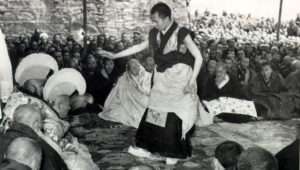
The 14th Dalai Lama during Geshe Lharampa exam
A crowd watches the final day of the Dalai Lama's months-long exams. Mar. 2, 1959. (Wikimedia Commons, https://commons.wikimedia.org/wiki/File:The_14th_Dalai_Lama_during_Geshe_Lharampa_exam_1959_in_Lhasa_inTibet.jpg)

The Dalai Lama was busy studying for the final exams for his Geshe Lharampa degree—the highest theological degree conferred in Tibet, equivalent to a Ph.D. Chinese officials began demanding that the Dalai Lama attend a theater performance at the PLA camp outside Lhasa on the afternoon of March 10. According to the invitation, he could not bring his customary armed bodyguards, nor could he tell the public about the visit. The Dalai Lama told the Chinese that he accepted.

The news spread rapidly in Lhasa when the Dalai Lama's officials announced special traffic restrictions for the road from Lhasa to the PLA camp. On the morning of March 10, thousands of Tibetans spontaneously assembled around the Dalai Lama's Norbulingka palace, "armed and indifferent to personal safety." Dunham at 269. About half the crowd were Khampas, Amdowas, or Goloks (Tibetan ethnic groups from well east of Lhasa). "[F]or the first time, Lhasans and Eastern Tibetans were acting as one." Id. Lhasans who did not have firearms or swords brought their axes, picks, and shovels, or whatever else they could use as a weapon.

Read More

Free Speech

"Denounce Putin, or Be Blacklisted"

"The classical music establishment demands that Russian musicians condemn their nation’s invasion of Ukraine in order to retain jobs and engagements in the West."

|

From Heather MacDonald (City Journal), a detailed article; here's an excerpt:

Russian musicians are being asked to condemn President Vladimir Putin's invasion of Ukraine to retain jobs and performing engagements in the West. Staying above the fray is not an option, and denouncing the war will not ward off cancellation. Russian musicians must criticize Putin by name or be blacklisted….

The most recent casualty of the compelled-speech norm is 20-year-old pianist Alexander Malofeev…. Malofeev has no known ties to Putin and has not defended Putin or the Ukrainian invasion. Nevertheless, the Vancouver Recital Society cancelled his contract for an August 2022 recital. Artistic director Leila Getz explained in a written statement that she could not "in good conscience present a concert by any Russian artist at this moment in time unless they are prepared to speak out publicly against this war."

In a subsequent interview, Getz claimed to have been looking out for Malofeev's well-being. "The first things that came to my mind were, why would I want to bring a 20-year-old Russian pianist to Vancouver and have him faced with protests and people misbehaving inside the concert hall and hooting and screaming and hollering?" she said. Such professions of paternalism have become standard among cancellers. Malofeev could have decided for himself whether he wanted to risk protest.

"Speaking out publicly against this war," as Getz put it, does not, in fact, prevent cancellation. Malofeev explicitly criticized the Ukrainian invasion after the Vancouver termination: "Every Russian will feel guilty for decades because of the terrible and bloody decision that none of us could influence and predict," he wrote on Facebook. Yet he was cancelled again. He had been scheduled to play Sergei Prokofiev's fiery Piano Concerto No. 3 with the Orchestre symphonique de Montréal (OSM) on March 9, 10, and 13. The day before his first performance, OSM pulled the plug. "Considering the serious impact on the civilian population of Ukraine caused by the Russian invasion, the OSM must announce the withdrawal of pianist Alexander Malofeev," the orchestra said. It wanted the public to know, however, that it was not biased against Russians: "We continue … to believe in the importance of maintaining relationships with artists of all nationalities who embrace messages of peace and hope." Why Malofeev fell outside of that category was left unexplained….

Free Speech

"Oklahoma Christian University 'Demands' Free Speech," but Allegedly Fires Prof for Inviting Gay Guest Speaker

who apparently spoke in some measure about his life as a gay man and used the words "dick" and "bitch."

|

From the Foundation for Individual Rights in Education (Alex Morey & Aaron Terr):

What happens when a religious school "committed to the highest ideals of Christian education" also says its mission "demands freedom of inquiry and expression"? Faculty may be blindsided by punishment for speech they had every reason to think was protected.

Case in point: The firing of tenured Oklahoma Christian University professor Michael O'Keefe last week, allegedly for inviting a gay guest speaker who used two swear words while telling a story to O'Keefe's class [apparently "dick" and "bitch" -EV] ….

To quote Prof. O'Keefe's lawyer,

It is our belief Mr. O'Keefe was terminated for having a guest speaker for his senior level class, "The Business of Branding Yourself." One of the topics addressed was the issue of overcoming obstacles and developing resilience and character. One of the speakers was an Oklahoma Christian alumnus and a Oklahoma Christian adjunct professor for nearly 20 years. This speaker is also gay.

While this issue is polarizing within the religious community, it is certainly a reality within our world and nothing to shy away from discussing within the context of an academic institution, especially a one bold enough to call itself a Christian one. Letting students expect a world where you may be different is the message Mr. O'Keefe wanted his students to hear. That's the message this speaker delivered, not an advocacy of gay rights.

Back to the FIRE analysis:

Read More

Free Speech

Scientific Publisher Springer Nature Will Continue to Accept Manuscripts from Russian Scientists

Quite correct, I think.

|

A message sent today:

Let me start by expressing my heartfelt concern for all in Ukraine, and stress our condemnation for the Russian invasion. Our thoughts are with those affected by the unfolding and shocking events.

We are acutely aware of the privileged position we are in and are committed to helping the Ukrainian people and Ukrainian scientists as much as we can. We have made all our research content, books and journals, freely available in Ukraine. For those researchers able to continue with their work we don't want any barriers to be in their way. Given the scale of the mounting humanitarian crisis, Springer Nature, along with our owner Holtzbrinck Publishing Group, have jointly pledged 1.5 million euros to support refugee relief including children profoundly impacted by the war and scientists who are fleeing the region with their families.

A number of you have been in touch to ask whether you should still be accepting manuscripts from Russian researchers. The answer is yes and let me explain why.

Read More

Guns

N.J. Appellate Court Overturns Denial of Handgun Purchase Permit

The applicant had a 5-year-old drunk driving arrest (which led to a conviction on a reduced charge) and a 12-year-old conviction of drinking alcohol by a passenger.

|

From In the Matter of … Andriy Yaremiy, decided yesterday by Judges Richard Hoffman, Mary Gibbons Whipple, and Richard Geiger:

Appellant applied for a FPIC and Handgun Purchase Permit. The application was denied by the Chief of the Borough of Wood-Ridge Police Department. In his letter to appellant notifying him of the denial, the Chief stated that investigation revealed appellant had been arrested for driving while intoxicated (DWI) in 2015…. [At a later court hearing, t]he Chief testified that in 2015, appellant was arrested in New York on a "2C violation," and in 2008, appellant received a summons … for consumption of alcohol by a passenger while the vehicle is being operated, in violation of N.J.S.A. 39:4-51a(a). Appellant was fined $256 and costs for that violation; his license was not suspended, and he was not sentenced to jail time.

On the 2015 offense, defendant pled guilty to a reduced charge of driving while ability impaired (DWAI), in violation of New York Vehicle and Traffic Law (VTL) § 1192.1, and was sentenced to a one-year conditional discharge, no jail time, a ninety-day suspension of driving privileges, and a $500 fine.

The Chief testified that he denied the application because of appellant's history of alcohol, "falsification on the application," and "it not being in the best interest" of the public safety, health, and welfare of our citizens. The Chief related that he had never granted a firearm purchase application to someone with a DWI conviction.

Read More

Fourth Amendment

"Geofence Warrants Are the Future (and That's a Good Thing)"

From Prof. Jane Bambauer (Arizona).

|

Jane Bambauer, a leading information law scholar (both on the First Amendment and the Fourth Amendment side), wrote up these thoughts on the recent geofencing case, on which Orin had also written; I'm delighted to be able to pass them along:

Last week, Judge Lauck of the Eastern District of Virginia handed down the first thorough Fourth Amendment analysis of the police investigation process known as "geofencing."  Judge Lauck found that the geofence warrant at issue in the case was unconstitutional. Moreover, the infirmities she found would be very difficult to cure in most police investigations where geofenced data might be helpful.

Civil liberties organizations have praised the opinion, but like Orin Kerr, I found the opinion confusing and poorly reasoned in its handling of key Fourth Amendment precedent. So I'll take this opportunity to add a few additional doctrinal critiques to Orin's excellent summary. But I'll end with a less wonky, more big picture plea: I hope the courts do not expand the Fourth Amendment to impede technological tools like geofences that help police conduct more accurate, less discretion-based initial investigations. With appropriate constraints, geofences and other "suspectless search" technologies can be an integral part of police modernization and reform.

Quick Summary

U.S. v. Chatrie concerned the investigation of a bank robbery. After investigating a couple leads using traditional policing methods without success, the detective working the case submitted a "geofence warrant" (subpoena) to Google to request deidentified information about the geolocation of any devices that came within 150 meters of the center of the bank during a one hour time span. (Note that the detective had some confidence that Google would have this information because bank surveillance footage showed that the bank robber covered his face using his … wait for it … Android smart phone.)

Read More

Free Speech

"The First Amendment Does Not Permit Schools to Prohibit Students from Engaging in the Factual, Nonthreatening

speech [about a recent school shooting] alleged here."

|

From Starbuck v. Williamsburg James City County School Bd., decided yesterday by the Fourth Circuit (Judge Diana Gribbon Motz, joined by Chief Judge Roger Gregory and Judge James Wynn):

{Because the district court dismissed this case on a Rule 12(b)(6) motion, we relate the facts as set forth in Starbuck's amended complaint.} On February 15, 2018, the day after the horrific mass shooting at Marjory Stoneman Douglas High School in Parkland, Florida, Jonathan Starbuck engaged in a conversation with his classmates about the shooting. Starbuck alleges that "[n]o student within the conversation made any threat" and that the conversation was factual. Starbuck "made remarks questioning the intent of the shooter, stating that the shooter would be capable of more harm had he wanted to, noting [the shooter's] possession of explosives and considering the time the shooter was left alone within the building unchallenged by local law enforcement." A teacher overheard the conversation and reported it to the local police and school administration.

As a result, the school removed Starbuck from classes for the remainder of the school day. During that time, which Starbuck refers to as an "in-school suspension," he alleges that various school officials "interrogat[ed]" him. The "[s]chool [p]olice officer … investigated and cleared the [teacher's] report as unfounded" because the officer concluded "there was no threat made and no criminal offense … occurred."

Read More

More