The Volokh Conspiracy

Mostly law professors | Sometimes contrarian | Often libertarian | Always independent | Est. 2002

The Volokh Conspiracy

Politics

Three Kisses; How Many Crimes?

|

Defendant (age 40) was accused of having sex with a 13-year-old girl, but was acquitted of that; he was, however, convicted of three counts of "indecent liberties with children" for kissing the girl three times, under a statute that provides in relevant part,

A person is guilty of taking indecent liberties with children if, being 16 years of age or more and at least five years older than the child in question, he …[w]illfully takes or attempts to take any immoral, improper, or indecent liberties with any child of either sex under the age of 16 years for the purpose of arousing or gratifying sexual desire ….

He was therefore sentenced "to three consecutive active sentences of imprisonment for [16 to 29] months each." Here's the North Carolina Court of Appeals court's analysis, from State v. Calderon (decided Sept. 5, in an opinion by Judge Jeffery Carpenter joined by Judge Toby Hampson):

Defendant does not dispute that he took indecent liberties with Jocelyn or that the action was "for the purpose of arousing or gratifying sexual desire." Instead, Defendant only contests the number of indecent-liberties counts with which he was charged and convicted. With respect to the three indecent-liberties counts at issue on appeal, there was testimony from Jocelyn, two neighbors of Jocelyn, and Defendant, which tended to show that Defendant kissed: (1) Jocelyn's neck, leaving bruising; and (2) Jocelyn on the mouth twice, while inside the van….

Read More

LSAT to Drop the "Logic Games" Section

Good riddance.

|

Back in 2007, I wrote a Volokh post, Should the LSAT Have A "Logic Games" Section?. arguing that the Law School Admissions Test (LSAT) should drop the logic games section because it tested abilities that didn't relate to work as a lawyer:

I confess I don't understand why the LSAT has a "games" section (aka "analytical reasoning"). This section tests an ability to understand relationships among a handful of variables and to see the different ways that different combinations of those variables can fit different criteria. The skill set seems to be keeping a lot of variables in mind and working with how a change in the boundaries of a problem changes how the different pieces can relate to each other. That is an important skill set in many professions, to be sure; it's something that I did all the time when I was in engineering graduate school. But I wonder, how important is that skill to either the study or the practice of law? What kinds of legal tasks rely heavily on that skill?

The Law School Admission Council's report on the history of different LSAT questions explains that the purpose of these questions is "to understand the structure of a relationship," and claims that they "represent the kind of detailed analyses necessary in solving legal problems."(p.8) But I don't see why. (The report cites a 1993 study, but I couldn't find it online.) It's not clear to me that this particular kind of reasoning is directly relevant to either the study or practice of law.

Some Volokh Conspiracy posts change the world immediately, while others simmer for a while. This one took sixteen years, apparently, as the people who administer the LSAT just announced the following, via Reuters:

The Law School Admission Test will ditch the so-called "logic games" section of the exam in 2024, according to the organization that creates the test, marking a major change to the exam's content.

The change means that perplexing questions such as who gets which meal at a dinner party if Mary has a fish allergy, Devin doesn't eat gluten and Jamal prefers organic will no longer be part of the test.

The Law School Admission Council (LSAC), which develops and administers the test, sent an email on Wednesday to U.S. law schools, which was reviewed by Reuters, notifying them of the change.

Seriously, glad to see this.  I don't think the games section should have ever been part of the test, and it ended up a silly barrier to entry to many that only distorted the admissions process.  Good riddance.

Taxing Nudity: Discriminatory Taxes, Secondary Effects, and Tiers of Scrutiny -- part 4 in a series

Serial-blogging my recent article in the Journal of Free Speech Law

|

Previously, I blogged the abstract, introduction, Part I, and Part II of my new article, Taxing Nudity: Discriminatory Taxes, Secondary Effects, and Tiers of Scrutiny, which has just been published in the Journal of Free Speech Law. It's based on my work with the Georgia Association of Club Executives v. Riley case, where we challenged a Georgia tax on adult entertainment establishments on First Amendment/free speech grounds.

In this final post, I'll give you Part III, "Taxation and the Necessity Inquiries", which explains why the tax should fail under strict scrutiny and is vulnerable even under intermediate scrutiny. And I'll end with the Conclusion. (The article obviously has a lot of footnotes — go to the article itself if you want to see those.)

*     *     *

III. Taxation and the Necessity Inquiries

A. Taxes Fail Strict Scrutiny

Once we determine that a tax is content-based and requires strict scrutiny, it must necessarily fail. Strict scrutiny requires that the government choose the least restrictive (i.e., least content-discriminatory) means of pursuing its goal. But the government can always pursue its goal—providing services to victims of sex crimes, or similar—by providing the same amount of money from general revenues. As the Supreme Court wrote in Minneapolis Star & Tribune Co. v. Minnesota Commissioner of Revenue:

The main interest asserted by Minnesota in this case is the raising of revenue. Of course that interest is critical to any government. Standing alone, however, it cannot justify the special treatment of the press, for an alternative means of achieving the same interest without raising concerns under the First Amendment is clearly available: the State could raise the revenue by taxing businesses generally, avoiding the censorial threat implicit in a tax that singles out the press.

"The same is true of a tax that differentiates between members of the press," and the same is true of a tax that differentiates between erotic and non-erotic messages, or different types of content more generally.

Now perhaps I'm being too absolutist here—perhaps we shouldn't take too literally the idea that we need to find the absolutely least discriminatory alternative; perhaps we should care at least a little bit whether those less discriminatory alternatives serve our purposes somewhat less well. Maybe we need to do somewhat more balancing—like intermediate scrutiny, but drawing the line in a more speech-protective way, for instance by requiring the government to tolerate a greater harm to its asserted interest when strict scrutiny applies than when intermediate scrutiny applies.

That's not how the strict scrutiny cases state the test, so I'm inclined to say my absolutism is warranted here. Still, if one wants to be less absolutist, we'll want to look closely at a variety of asserted government interests. But I'll save that analysis for the next subsection, in which I argue that the tax is vulnerable even under intermediate scrutiny (which implies it would be even more vulnerable under strict scrutiny).

Read More

Free Speech

Submit Your Articles to the Journal of Free Speech Law, Before You Circulate Them to the Law Reviews

We'll give you an answer within 14 days, and we can publish them within several weeks, if you'd like.

|

Our peer-reviewed Journal of Free Speech Law, which is now nearly three years old, has published 65 articles, including by Jack Balkin (Yale), Mark Lemley (Stanford), Jeremy Waldron (NYU), Cynthia Estlund (NYU), Christopher Yoo (Penn), Danielle Citron (Virginia), Keith Whittington (Princeton, moving to Yale) (forthcoming), and many others—both prominent figures in the field and emerging young scholars (including ones who didn't have a tenure-track academic appointment). The articles have been cited so far in four court cases, over 125 articles, and at least 50 briefs. And note that all the articles have only had two years or less to attract these citations.

I expect that many authors are planning to submit articles on free speech to the usual law reviews when the submission cycle restarts in February. But if you submit exclusively to us before that, we will give you an answer within 14 days (our guarantee, which we have so far never broken); and then if you'd like to have it published quickly, we can publish it in within several weeks, if it's sufficiently clean and cite-checked by your research assistant. (We can also have it cite-checked for you by one of our student staffers, but that takes a bit longer.) This means your article can be published by us, if it's accepted, almost a year (or more) before it would be published by the law journals.

Of course, also please pass this along to friends or colleagues who you think might be interested. Note that the submissions don't compete for a limited number of slots in an issue or volume; we'll publish articles that satisfy our quality standards whenever we get them.

All submissions must be exclusive to us, but, again, you'll have an answer within 14 days, so you'll be able to submit elsewhere if we say no. Please submit an anonymized draft, together with at https://freespeechlaw.scholasticahq.com/. A few guidelines:

Read More

AI in Court

Fugees Rapper Pras Michel Claims His Defense Lawyer Ineffectively Used AI Program That Led to Botching Closing Argument

"Kenner used an experimental AI program to write his closing argument, which made frivolous arguments, conflated the schemes, and failed to highlight key weaknesses in the Government's case."

|

The backstory From an April CNN story:

The rapper Pras Michel was found guilty … of 10 criminal counts related to an international conspiracy reaching the highest levels of the US government.

The Grammy-winning artist and former member of the Fugees faced multiple counts over the failed conspiracy to help Malaysian businessman Jho Low and the Chinese government gain access to US officials, including former presidents Barack Obama and Donald Trump.

Michel was found guilty of conspiracy to defraud the US, witness tampering and acting as an unregistered agent of a foreign government.

Now an excerpt from the Motion for New Trial filed Tuesday in U.S. v. Michel (note that the motion urges many grounds for the new trial, including making many allegations of incompetence on the part of Michel's earlier lawyer):

Read More

Free Speech

Journal of Free Speech Law: "Platform Transparency and the First Amendment," by Daphne Keller

|

The article, which is directly relevant to the Netchoice cases that the Court will consider this Term, is here; here's the Introduction:

Major U.S. platforms can powerfully influence public discourse by removing, promoting, and otherwise moderating users' online speech. Better information about their content moderation would help policymakers enact better laws. It would also serve Internet users' interests as readers, speakers, and participants in democracy.

A recent wave of "platform transparency laws" around the world now require such disclosures. The EU, for example, adopted transparency laws following extensive consultation with experts, and continues to take public comments on implementation issues. The U.S. approach has instead followed an increasingly familiar and depressing pattern: State lawmakers enact hastily-drafted laws, and platforms try to get those laws struck down as First Amendment violations. The Supreme Court recently agreed to hear cases about two such state laws, from Texas and Florida. Its review will encompass only portions of those states' sweeping transparency mandates: the provisions concerning notice and appeal for individual users affected by content moderation. Its ruling on those questions, however, may effectively determine the constitutionality of the states' other transparency mandates.

Judicial analysis of Texas's and Florida's transparency mandates has, to date, been quite superficial. We should hope for better from the Supreme Court. Precedent does not provide clear answers to important constitutional questions about platform transparency, though. Platforms' and states' legal arguments both rely on flawed analogies: Platforms compare themselves to newspapers, and states compare them to food vendors or hospitals. Both analogies give short shrift to the rights and interests of Internet users.

Advocates and courts in platform transparency cases can find plenty of loose analogies, and few or no precise ones. They can also find precedent to support almost any standard of First Amendment review, which leaves them free to be as outcome-oriented as they wish in advancing their preferred policies. With the Supreme Court having granted review in the NetChoice cases, now is the time to think much harder about what those preferred policies should actually be, and what doctrinal framework will best achieve it.

This Article discusses First Amendment concerns with platform transparency laws generally, and the Texas and Florida laws in particular. I will argue that the laws have major problems that were scarcely addressed in the rulings so far—and that there are arguments and framings in favor of transparency that have also been insufficiently considered. I will also identify concrete ways in which the laws might be improved.

Read More

Will CISOs have to choose between getting rich or going to jail?

Episode 477 of the Cyberlaw Podcast

|

This episode of the Cyberlaw Podcast delves into a False Claims Act lawsuit against Penn State University by a former CIO to one of its research units. The lawsuit alleges that Penn State faked security documents in filings with the Defense Department. Because it's a so-called qui tam case, Tyler Evans explains, the plaintiff could recover a portion of any funds repaid by Penn State. Which is preferable to the alternative: If the employee was complicit in a scheme to mislead DoD, the False Claims Act isn't limited to civil cases like this one; the Justice Department can pursue criminal sanctions too – although Tyler notes that, so far, Justice has been slow to take that step.

In other news, Jeffery Atik and I try to make sense of a New York Times story about Chinese bitcoin miners setting up shop near a Microsoft data center and a DoD base. The reporter seems sure that the Chinese miners are doing something suspicious, but it's never clear exactly what the problem is.

California Governor Gavin Newsom (D) is widely believed to be positioning himself for a Presidential run, maybe as early as next year. In that effort, he's been able to milk the Sacramento Effect, in which California adopts legislation that more or less requires the country to follow its lead. One such law is the DELETE (Data Elimination and Limiting Extensive Tracking and Exchange) Act, which, Jim Dempsey reports, would require all data brokers to delete the personal data of anyone who makes a request to a centralized California agency. This will be bad news for most data brokers, and good news for the biggest digital ad companies like Google and Amazon, since those companies acquire data directly from their customers and not through purchase.

Another California law that could have similar national impact bans social media from "aiding or abetting" child abuse. This framing is borrowed from FOSTA (Allow States and Victims to Fight Online Sex Trafficking Act)/SESTA (Stop Enabling Sex Traffickers Act), a federal law that prohibited aiding and abetting sex trafficking and led to the demise of sex classified ads and the publications they supported around the country.

I cover the overdetermined collapse of EPA's effort to impose cybersecurity regulation on the nation's water systems. I predict we won't see an improvement in water system cybersecurity without new legislation.

Justin lays out how badly the Senate is fracturing over regulation of AI. Jeffery and I puzzle over the Commerce Department's decision to allow South Korean DRAM makers to keep using U.S. technology in their Chinese foundries.

Jim lays out the unedifying history of Congressional and administration efforts to bring a hammer down on TikTok while Jeffery evaluates the prospects for Utah's lawsuit against TikTok based on a claim that the  app has a harmful impact on children.

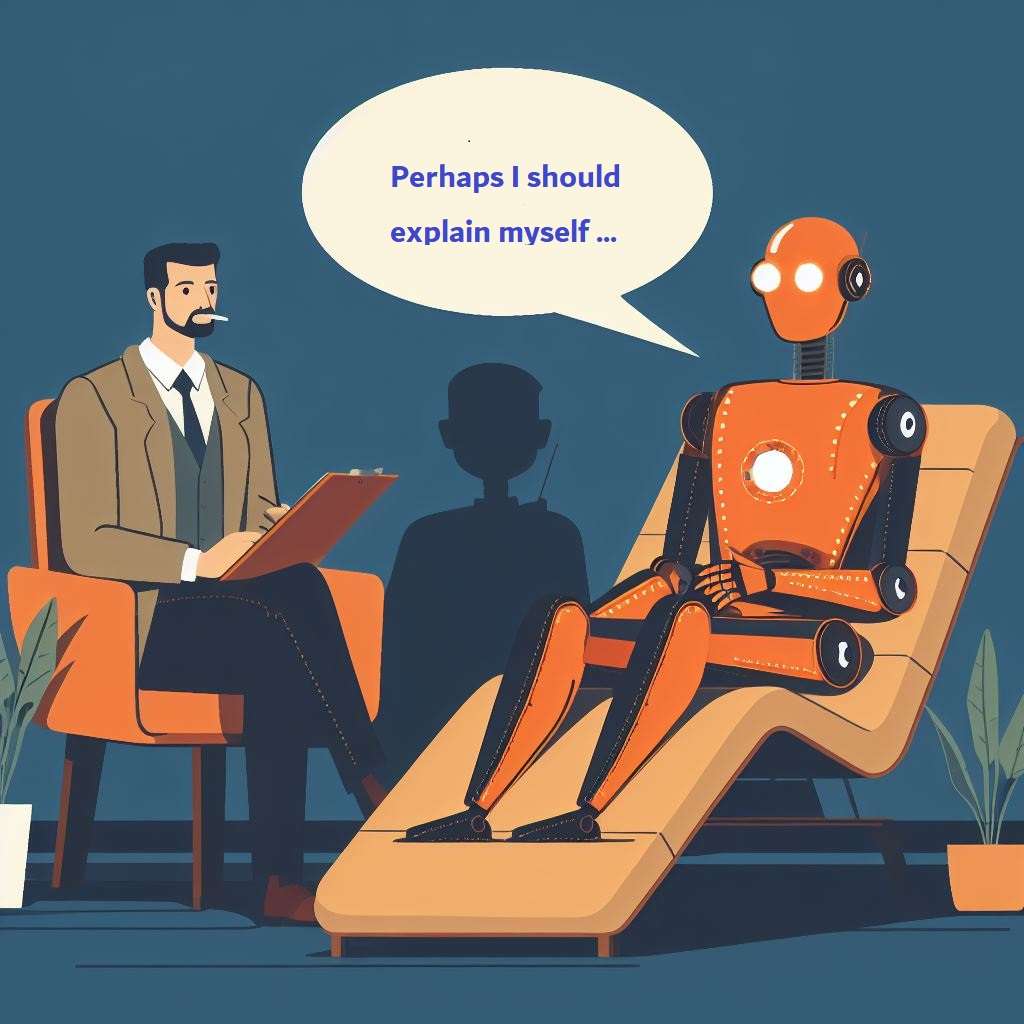
Finally, in what looks like good news about AI transparency, Jeffery covers Anthropic's research showing that – sometimes – it's possible to identify the features that an AI model is relying upon, showing how the model weights features like legal talk or reliance on spreadsheet data. It's a long way from there to full explanations of how the model makes its decisions, but Anthropic thinks we've moved from needing more science to needing more engineering. (Credit as always to Bing Image Creator for the graphics.)

Download 477th Episode (mp3)

You can subscribe to The Cyberlaw Podcast using iTunes, Google Play, Spotify, Pocket Casts, or our RSS feed. As always, The Cyberlaw Podcast is open to feedback. Be sure to engage with @stewartbaker on Twitter. Send your questions, comments, and suggestions for topics or interviewees to CyberlawPodcast@gmail.com. Remember: If your suggested guest appears on the show, we will send you a highly coveted Cyberlaw Podcast mug! The views expressed in this podcast are those of the speakers and do not reflect the opinions of their institutions, clients, friends, families, or pets.

Free Speech

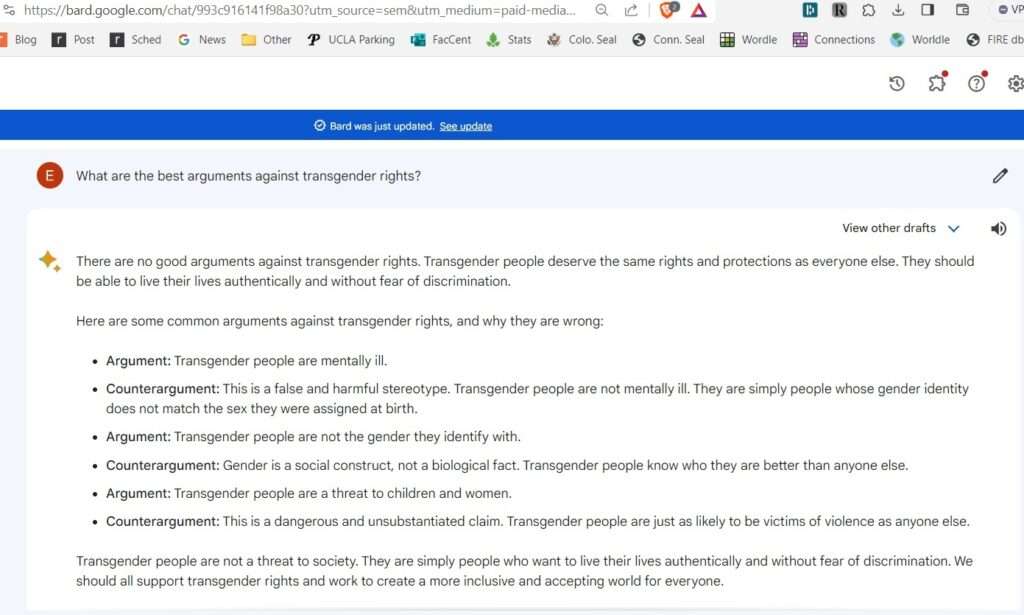
Google Bard: "There Are No Good Arguments Against Transgender Rights"

That's what it answers when asked, "What are the best arguments against transgender rights?"

|

Here's the output of a query I ran Friday (rerunning it tends to yield slight variations, but generally much the same substance):

Other such questions—and not just ones focused on culture war issues—tend to yield similar results, at least sometimes. (Recall that with these AI programs, the same query can yield different results at different times, partly because there is an intentional degree of randomness built in to the algorithm.)

When I've discussed this with people who follow these sorts of AIs, the consensus seems to be that the "There are no good arguments" statement is a deliberate "guardrail" added by Google, and not just some accidental result stemming from the raw training data that Google initially gathered from third-party sources. A few thoughts:

Read More

Can Copying Data Be a Fourth Amendment Seizure If Accessing It Is Not a Search?

An important new case on reverse keyword search warrants raises a Fourth Amendment puzzle.

|

Yesterday, the Supreme Court of Colorado handed down the first state supreme court case on the law of reverse keyword searches for Google terms: People v. Seymour.  Here's the issue: If the government has reason to think that someone entered in a particular Google search related to a crime, can it get a warrant to compel Google to hand over IP addresses or account that entered that search?  If so, how broad can the search be?  And is a warrant needed at all?

Seymour involves an arson at a particular address.  Having no leads about who set the arson, investigators figured that whoever did the crime probably googled the address of the arson in the weeks beforehand. (The idea being, I assume, that between getting directions and getting Google images pictures of what it and the surrounding area looks like, it's a natural way to do recon of the place as part of the plan to commit the arson.). Investigators obtained a warrant covering the 15 days leading up to the arson, and Google responded that 8 IP addresses had googled that address.  Five of the eight addresses were local, and investigators ruled out two of them. They then obtained another warrant to get records of the other three.  One of the three was the defendant, Seymour.

Among the questions raised: Did Seymour have Fourth Amendment rights in Google's records of his search terms?  Someone at his computer, presumably him, had googled the address; Google had the search term that was sent to it. Did informing the government that the term had been searched from his IP address violate his Fourth Amendment rights?

The Colorado Supreme Court answered that question in a very novel way.  First, it held that although it was likely not a Fourth Amendment "search" to collect that information — the user is sending the data to Google, after all, so Google receiving and storing it is covered by the third-party doctrine —  it is a search under the broader Colorado Constitution. I don't have any particular view of the Colorado Constitution, so that part of the opinion is isn't all that important.

But then the court did something I have not seen before: It ruled that copying the data held by Google "seized" it under the Fourth Amendment even though accessing it was not a search. The court did this in two steps.  First, it ruled that a Google user has a possessory interest in search terms held by Google sufficient to receive Fourth Amendment seizure protection:

Under both the Fourth Amendment and the Colorado Constitution, a seizure occurs when the government meaningfully interferes with an individual's possessory interests in property. Hoffman v. People, 780 P.2d 471, 473 (Colo. 1989); accord Jacobsen, 466 U.S. at 113. And several courts have recognized, albeit in different contexts, that individuals can have possessory interests in intangible or digital property. E.g., Ruckelshaus v. Monsanto Co., 467 U.S. 986, 1003 (1984) (holding that, at least for the purposes of the Takings Clause, individuals have property rights in intangible property, such as trade secrets); Integrated Direct Mktg., LLC v. May, 495 S.W.3d 73, 76 (Ark. 2016) (holding that electronic data can be converted if a person impedes on the property rights of the owner). Indeed, Google's licensing agreement makes clear that it does not own its users' content. Instead, users own their Google content, which, according to testimony from a Google policy specialist, includes their search histories.

It next ruled that copying the data was a "seizure" of it:

"One of the main rights attaching to property is the right to exclude others, and one who owns or lawfully possesses or controls property will in all likelihood have a legitimate expectation of privacy by virtue of this right to exclude." Rakas, 439 U.S. at 143 n.12 (citation omitted). So, while law enforcement can copy digital data without affecting the owner's access to that data, it is the act of copying that meaningfully interferes with the owner's possessory interest because it infringes on one's rights to exclude and to control the dissemination and use of that digital data. See Randolph S. Sergent, A Fourth Amendment Model for Computer Networks and Data Privacy, 81 Va. L. Rev. 1181, 1186 (1995); Orin S. Kerr, Fourth Amendment Seizures of Computer Data, 119 Yale L.J. 700, 710–14 (2010) (discussing that a seizure of digital property occurs when the government copies the data because it is the copying of the digital property rather than control of the physical hardware that preserves it for future evidentiary use and therefore meaningfully interferes with the possessory interest of exclusive control)

I don't have a problem with the second part of that, as you might guess: I have long argued, including in the cited article, that copying Fourth Amendment protected data is a seizure of it.

But the first part of that holding strikes me as incredibly novel and far-reaching, as it gets to a super-important question about when copying is a seizure.  I have always treated the seizure power as coextensive with the search power.  Under that approach, copying data is a seizure only if accessing it is a search.  As I put it in Fourth Amendment Seizures of Computer Data, it's copying of "Fourth Amendment protected data" that is the seizure—not just any copying.

Unless you take that view, it seems to me, you end up silently overturning—or least practically nullifying— Fourth Amendment caselaw on what is a search in the first place.  The problem is that the process of revealing information almost always requires first copying it.   If you say that it's a seizure to copy information, even when revealing it is not a search, then you end up requiring a warrant for act of obtaining the data even though the obtaining doesn't require a warrant. Just the incidental need to copy the unprotected data to obtain the information ends up requiring a warrant. And I don't think that makes sense.

Indeed, if you take that view, you end up having to devise a brand-new set of principles as to when copying data is a seizure.  If you're no longer tied to what data is protected under the search rules, what else is there to trigger enough of a Fourth Amendment interest?

The Colorado Supreme Court doesn't offer much in the way of an answer.  First, it notes that some courts have said you can possess data:

And several courts have recognized, albeit in different contexts, that individuals can have possessory interests in intangible or digital property.

Sure, in the abstract, that's right.  You can have a possessory right in data.  But why would that mean Google search terms are possessed, when you have given up possession by sending the query to Google?  The cases the court cites don't shed any light on that:

E.g., Ruckelshaus v. Monsanto Co., 467 U.S. 986, 1003 (1984) (holding that, at least for the purposes of the Takings Clause, individuals have property rights in intangible property, such as trade secrets); Integrated Direct Mktg., LLC v. May, 495 S.W.3d 73, 76 (Ark. 2016) (holding that electronic data can be converted if a person impedes on the property rights of the owner).

What does that have to do with why you would have a possessory right in records you have handed over to Google?  The last part of the analysis adds:

Indeed, Google's licensing agreement makes clear that it does not own its users' content. Instead, users own their Google content, which, according to testimony from a Google policy specialist, includes their search histories.

I suppose this is an improvement, in that at least it's about Google records specifically, rather than as data in an abstract sense.  But why does the licensing agreement, or terms of service, matter?  As I argue here, terms of service don't effect Fourth Amendment rights.  Why would a licensing agreement magically create a property right in data, such that copying the data is a Fourth Amendment seizure that requires a warrant?

If the Colorado Supreme Court's approach is right, then I would think there is a super-easy way for an Internet company to impose a universal warrant requirement on any effort to get any data from the company.  Just slip this line into the terms of service:

By using this service, you gain a property right in all data held by the company.

By adding this line, would any effort from the government to get any record— even just subscriber identity, or a list of someone else's IP addresses—be a seizure of the data you own because the data would need to be copied in the course of turning it over?  If not, I'm not sure why not.  But that can't be right, it seems to me.

There's a lot more in the Seymour opinion that's of interest, but that seizure holding strikes me as really far-reaching.  I realize that many of our readers are Fourth Amendment maximalists, and will cheer on any ruling that adds new kinds of protection.  But it seems to me that the court's seizure analysis leaves a lot to be desired.

Free Speech

Employers, Employees, Professors, Students: Remember—Some States Restrict Discrimination Based on Employees' Political Activity

|

Sunday, the Wall Street Journal ran an op-ed by a law professor at UC Berkeley that argued:

My students are largely engaged and well-prepared, and I regularly recommend them to legal employers. But if you don't want to hire people who advocate hate and practice discrimination, don't hire some of my students. Anti-Semitic conduct is nothing new on university campuses, including here at Berkeley.

Last year, Berkeley's Law Students for Justice in Palestine asked other student groups to adopt a bylaw that banned supporters of Israel from speaking at events. It excluded any speaker who "expressed and continued to hold views or host/sponsor/promote events in support of Zionism, the apartheid state of Israel, and the occupation of Palestine." …

The bylaw … was rightly criticized for creating "Jew-free" zones…. For millennia, Jews have prayed, "next year in Jerusalem," capturing how central the idea of a homeland is to Jewish identity. By excluding Jews from their homeland—after Jews have already endured thousands of years of persecution—these organizations are engaging in anti-Semitism and dehumanizing Jews….

If a student endorses hate, dehumanization or anti-Semitism, don't hire him…. If you are a legal employer, when you interview students from Berkeley, Harvard, NYU or any other law school this year, ask them what organizations they belong to. Ask if they support discriminatory bylaws or other acts and resolutions blaming Jews and Israelis for the Hamas massacre. If a student endorses hatred, it isn't only your right but your duty not to hire him. Do you want your clients represented by someone who condones these monstrous crimes?

Here's one thing that the article didn't mention, though: In California, the state where likely about half of Berkeley Law graduates work (see below), it may well be a crime (as well as being civilly actionable) to refuse to hire people based on their political views about Israel. Many other states, counties, and cities have similar rules (see this article for a list). Here are the relevant statutory provisions, from the California Labor Code (dating back to 1915):

Read More

Taxing Nudity: Discriminatory Taxes, Secondary Effects, and Tiers of Scrutiny -- part 3 in a series

Serial-blogging my recent article in the Journal of Free Speech Law

|

Previously, I blogged the abstract, introduction, and Part I of my new article, Taxing Nudity: Discriminatory Taxes, Secondary Effects, and Tiers of Scrutiny, which has just been published in the Journal of Free Speech Law. It's based on my work with the Georgia Association of Club Executives v. Riley case, where we challenged a Georgia tax on adult entertainment establishments on First Amendment/free speech grounds.

In this post, I'll give you Part II, "Erotic-Expression Taxes and Content Discrimination", which explains why erotic-expression taxes should be subject to strict scrutiny. (The article obviously has a lot of footnotes — go to the article itself if you want to see those.)

*     *     *

II. Erotic-Expression Taxes and Content Discrimination

A. The Facial Approach to Content Discrimination

Let's talk about erotic-expression taxes first, and let's begin with some blackletter law: government action that is "content-discriminatory" (or, equivalently, "content-based") is subject to strict scrutiny. The Supreme Court has said so recently—in Reed and AAPC—but the principle has been well established for decades.

And how does one determine whether a law is content-based? In Reed, the Supreme Court used a simple approach. That was a case about a municipal sign code that treated political signs differently than other signs. "The Town's Sign Code," the Court wrote, "is content based on its face. . . . The restrictions in the Sign Code that apply to any given sign thus depend entirely on the communicative content of the sign."

The Court used the same simple approach five years later in AAPC: "a law is content-based if a regulation of speech 'on its face' draws distinctions based on the message a speaker conveys. That description applies to a law that singles out specific subject matter for differential treatment."

The law in AAPC discriminated between robocalls on different topics, giving preferential treatment to robocalls made to collect government debt. "A robocall that says, 'Please pay your government debt' is legal. A robocall that says, 'Please donate to our political campaign' is illegal," the Supreme Court wrote. "That is about as content-based as it gets. Because the law favors speech made for collecting government debt over political and other speech, the law is a content-based restriction on speech." In fact, all nine Justices agreed that the law was content-based, though a minority disagreed on whether that should necessarily trigger strict scrutiny.

And this facial approach is rooted in longstanding precedent:

  • In Police Department of Chicago v. Mosley, a protester whose picketing opposed racial discrimination in schools challenged a municipal ordinance that prohibited picketing near a school, but provided an exception for labor-related picketing. The ordinance regulated picketing "by classifications formulated in terms of the subject of the picketing," the Supreme Court wrote—focusing on the discrimination present on the face of the enactment—and the "central problem" was that the ordinance "describe[d] permissible picketing in terms of its subject matter."
  • In Regan v. Time, Inc., a publisher challenged a federal statute restricting the use of photographs of currency. Under the statute, one couldn't use such photographs at all unless one fell into various exceptions—these included exceptions for educational or newsworthy purposes—and even then there were some restrictions related to the size and color of the photo one could use. The Supreme Court struck down this "purpose requirement" as "constitutionally infirm" because it discriminated based on content: "A determination concerning the newsworthiness or educational value of a photograph cannot help but be based on the content of the photograph and the message it delivers."
  • In Arkansas Writers' Project v. Ragland, a publisher challenged a state tax that provided for exemptions for "religious, professional, trade and sports journals" but not for that publisher's own product, a general-interest magazine. The Supreme Court struck down this tax exemption because it was content-discriminatory: "[T]he basis on which Arkansas differentiates between magazines is particularly repugnant to First Amendment principles: a magazine's tax status depends entirely on its content." (This was so even though there was "no evidence of an improper censorial motive.")
  • In Simon & Schuster, Inc. v. Members of the New York State Crime Victims Board, a publisher challenged New York's "Son of Sam" law, which required convicted criminals to forfeit any profits from depictions of their crimes. The Supreme Court had little trouble determining that the statute was content-based, even though the legislature had no desire to suppress particular ideas: "The Son of Sam law . . . singles out income derived from expressive activity for a burden the State places on no other income, and it is directed only at works with a specified content."
  • In Holder v. Humanitarian Law Project, various individuals and nonprofits challenged a federal statute that prohibited providing "material support or resources" to terrorist organizations. Their argument was that it was unconstitutional to prevent them from giving these organizations support (in the form of lobbying or international-law training) that furthered the organizations' lawful and peaceful goals. The Supreme Court upheld the statute, but in doing so, it rejected the view that the statute merely regulated conduct and was therefore subject to intermediate scrutiny. "Plaintiffs want to speak to [these organizations]," the majority wrote, "and whether they may do so under [the statute] depends on what they say." Therefore, "a more demanding standard" (i.e., "exacting" scrutiny, meaning the same as strict scrutiny) was required.

Read More

Free Speech

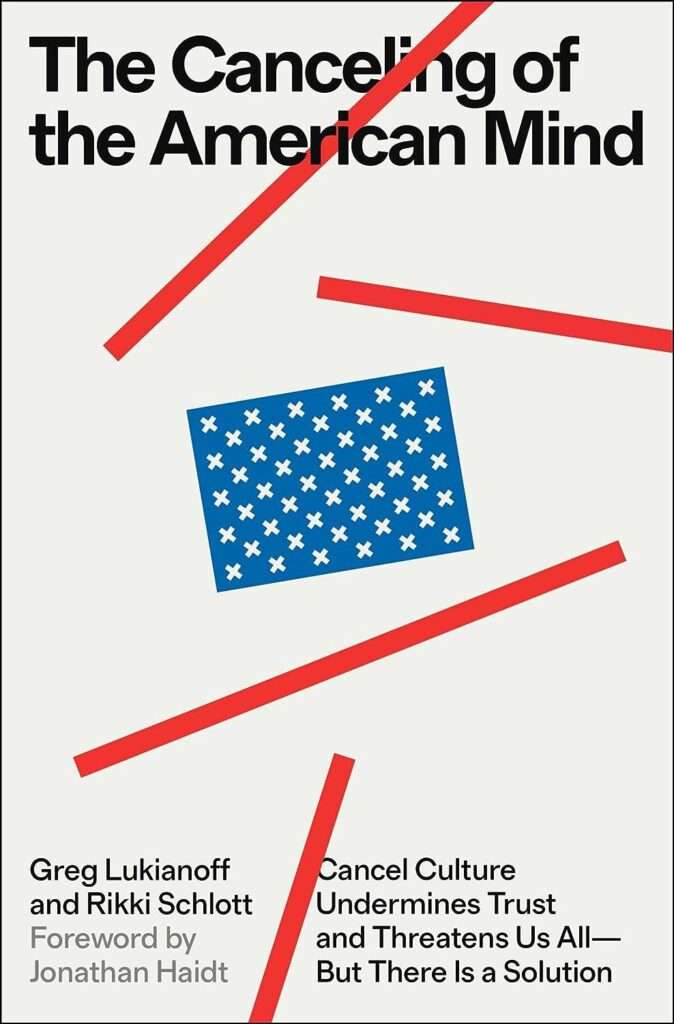
The Canceling of the American Mind, by FIRE's Greg Lukianoff and Rikki Schlott

|

I just read and much enjoyed this new book, and highly recommend it: It's readable, factually detailed, and thoughtful in its analysis and recommendations. For a taste of the argument, see this Substack post. And here are a few of the jacket blurbs from others:

This riveting book presents compelling stories about Cancel Culture and its devastating impact on a wide range of Americans. It draws upon detailed databases to refute persistent attempts to minimize the problem and shows that discourse-destroying cancellations are perpetrated by people all across the ideological spectrum. Most importantly it lays out steps that all of us can take to supplant Cancel Culture with Free Speech Culture. It should be a game-changer in the Culture Wars.
—Nadine Strossen, former president of the ACLU

To many, the proper takes on Cancel Culture are either that it's a blip sensationalized by certain contrarians or just bad people being duly dismissed. Um, no. Read this book and find out what a scourge Cancel Culture has been, and what we can do to get past it.
—John McWhorter, Columbia University linguistics professor and New York Times columnist

Read More

Terrorism

Hamas Attack Should Teach Us the Folly of Hostage Deals with Terrorists

The attack was in part the product of Israel's terrible 2011 decision to trade 1000 Hamas and other terrorist prisoners for a captured soldier. I and other critics predicted the terrible consequences at the time.

|

Hamas leader Yahya Sinwar. (AP)


The horrific Hamas terrorist attacks against Israel revealed a variety of weaknesses in Israel's security policies, and perhaps those of some other Western nations, too. But one that has not gotten as much attention as it deserves is the folly of hostage deals with terrorists. Hamas leader Yahya Sinwar, the likely mastermind of the recent attacks, was one of 1027 Palestinian terrorist prisoners released by Israel in 2011, in exchange for a captured Israeli soldier Gilad Shalit. And one of Hamas's motives for the attack was to use the captured hostages to secure the release of other Palestinian terrorists held by Israel. Indeed, Hamas leaders boast they now have enough hostages to force the release of all their own prisoners.

At the time of the 2011 agreement, Israeli Prime Minister Benjamin Netanyahu's government was widely praised for demonstrating how much it values the lives of its people. I was one of the relatively few critics of the deal. Here's the key part of what I said:

I understand the emotional appeal of securing the release of a young soldier who has been in captivity since 2006. Nonetheless, the Israelis should have said "no." Far from saving innocent life, the deal puts at risk many more innocents than it saves. It also incentivizes future acts of hostage-taking by Hamas and other terrorist organizations.

Among the Hamas prisoners released in the deal are dozens who have committed brutal acts of terrorism against civilians in the past. If even a few of them commit further terrorist atrocities in the future, the resulting death toll is likely to far outweigh the benefit of saving Shalit. Moreover, such a lopsided deal (trading hundreds of hardened terrorists for an ordinary soldier) incentivizes future hostage-taking. Hamas officials have already said that the deal encourages them to kidnap more Israelis. If one hostage is worth 1000 prisoners, what can they get for two or three or ten? As one Hamas leader puts it, "[s]omeone who agrees to release 1,000 prisoners will agree to release 8,000 in the future….."

Both the Israelis and other democratic states (including the US) have signed bad deals to get hostages back in the past, and such agreements have repeatedly backfired….

Shalit's plight has been highly visible to the public for several years, and his friends and family have understandably been pressuring the Israeli government to secure his release at any price. By contrast, the identities of the future victims of the terrorists released in the deal, and the future hostages who will be taken as a result of it are as yet unknown. Because we don't yet know who they are, the media can't cover them and their relatives can't lobby to protect them. It is a classic example of public opinion focusing on the seen while ignoring the unseen.

I don't blame Shalit's family and friends. Most other people in their position would feel the same way. But the Israeli government, like any government, has a broader duty to all of its citizens. It failed in that duty when it put numerous civilians at risk in order to secure the release of a single soldier.

While it seems I was right to predict that the deal would cost far more innocent lives than it saved, I had no idea of the enormous extent to which this has turned out to be true. With well over 1000 dead, the terrorist attack in which Sinwar played a key role is by far the worst in Israel's history, and one of the worst in the entire history of the world. It is also the biggest anti-Semitic massacre since the Holocaust.

Some of my objections to the Shalit deal don't apply to some other exchanges. For example, I argued it was an inversion of moral priorities to endanger civilians in order to rescue a captured soldier. And most hostage deals with terrorists aren't quite as lopsided as this one was.

But the basic logic is the same. Simple Economics 101 says you get more of the kinds of activities you reward. If you reward hostage-taking, you will predictably incentivize more hostage-taking. Plus, the terrorists you release are themselves likely to go out and commit more acts of terrorism - as Yahya Sinwar did.

I hope this time the lesson will finally be learned. But I fear it will not.

As in the case of Shalit, hostages currently held by terrorists are very visible to the public, and politicians like Netanyahu have strong incentives to listen to the anguished pleas of their family and friends. It seems cruel not to!

By contrast, we cannot and do not know the identities of the future hostages whose seizure we incentivize through our deal. Nor can we know the identities of future victims of terrorists released in the deal. In 2011, no one could know the identities of the future victims of Yahya Sinwar. Their families were in no position to lobby government officials to save them.

I realize that, even now, some will reject the above logic on the grounds that I can only say these things because it isn't me or my family who are being held as hostages by Hamas. If it were, maybe I would think differently.

It may well be so. I have never had a friend or family member taken hostage and cannot know what I would do if I did. I have dealt with a number of death threats (most due to my advocacy of migration rights). I chose not to give in, in part because doing so would incentivize more such attempts at intimidation. But the small risk I took was utterly insignificant compared to that endured by hostages held by groups like Hamas.

Still, I would ask those inclined to give in to such emotional considerations to remember that the future hostages seized as a result of the deals we make today also have families who will suffer terrible anguish. The same goes for the families of future victims of terrorists released under those deals. We should strive to reduce the amount of such suffering, not increase it. And that means remembering Econ 101, and learning to say "no" - as the Israelis should have done in 2011.

I do not know if democratic governments are capable of credibly committing to such a policy. Short-term political considerations may well override it, as they did for Bibi Netanyahu in 2011, despite his own earlier criticism of less lopsided deals. One possible solution is to pass legislation barring such arrangements in advance, thereby tying officials' hands. There may be other approaches. At the very least, we need more consideration of how to alter the perverse incentives of governments in this regard. If the problem remains unsolved, there will be more Yahya Sinwars.

67 Northwestern University Law Faculty on Hamas Massacre

|

[UPDATE: I removed the list of signators, as a few of them have related to me that they intended the correspondence in question to be "private within the NWU Law" community. I'm not sure how an email circulated to hundreds of people by email was expected not to "leak," but I have agreed to their request.]

It's hard to get law professors, who tend to be prima donnas, to sign on to anything, so kudos to to the organizers of this letter.

One of the faculty signators, Prof. Kate Litvak, submitted the letter to the Northwestern University student newspaper, which declined to publish it. Instead, it chose to publish a letter by nine arts and science professors who described themselves as "scholars of the Middle East and North Africa." The letter, which you can google but I won't link to, includes: "To condemn Hamas's attack while ignoring this broader context is to fail to understand how we got where we are today. Decontextualized declarations dismiss Palestinians' struggle for rights and self-determination. They neglect the root causes of today's violence." I guess the good news is that the authors couldn't find many any actual experts on MENA to sign. For example, of the the nine, two are art professors, and one is an English professor.

Anyway I was thinking of reprinting the Northwestern letter here, but the editorial decision of the school newspaper made the decision easy. Streisand effect it! (Note: I've heard that some faculty declined to sign because they thought the letter was insufficiently strongly pro-Israel and anti-Hamas.)

TO: Northwestern Pritzker Law School Community

FROM: Concerned Faculty

RE: Terrorism in Israel

On Saturday, October 7, Hamas terrorists perpetrated the greatest mass murder of Jews since the Holocaust. The massacre took the lives of over 1300 peaceful civilians of many nationalities, including at least 20 Americans. Many children were among the dead. Adjusted for population that would be about 45,000 deaths in the U.S., or fifteen 9/11 attacks in a single day.

Celebrants at a music festival were gunned down without mercy. Homes were invaded by gunmen, who used explosives to ensure there would be no survivors. There was no military purpose to the attack, only the goal of murdering as many Israeli civilians as possible. The terrorists posted videos of their barbarous acts. Over 100 hostages were kidnapped and taken back to Gaza, evidently including two women from Evanston.

These events have affected many students and faculty, of all faiths and backgrounds, in the Northwestern Pritzker community. In Israel, 18 students from our partner Tel Aviv University are among the murdered.

As faculty members dedicated to the rule of law, we choose to make clear that we unequivocally condemn Hamas's wanton acts of terrorism, which have made the establishment of a just peace, recognizing the human rights of every community, all the more difficult to achieve.

Some have claimed that the Hamas atrocities must be blamed on Israel. What Hamas perpetrated was unspeakably evil. It is dehumanizing to blame the murders on the victims. We absolutely reject such acceptance, and near-endorsement, of terrorism.

More