
Monday Open Thread
What's on your mind?

Mostly law professors | Sometimes contrarian | Often libertarian | Always independent | Est. 2002
What's on your mind?
[UPDATE: In retrospect I buried the lede here. On motion to dismiss, the court found that social media postings regarding a synagogue event did not violate the FACE act because they do not constitute a "true threat," because using the phrase "no Justice no peace" was not alleged to lead to violence.
As I point out at end of the post, the operative question under the FACE act at the motion to dismiss stage, at least arguably, is whether the posting in question sufficiently threatening to intimidate synagogue goers, and that seems a much closer question. The court did not address the First Amendment at all in its opinion, so the issue of "true threat," which is a First Amendment, not a FACE act doctrine, was not obviously present at this stage of the litigation.]
As Eugene noted previously, a federal district court dismissed a FACE act claim for threatening synagogue attendees against the Palestinian Youth Movement based on the following social post:
The PYM social media posts call on their supports to "STAND AGAINST SETTLER EXPANSION AT SUNDAY'S REAL ESTATE EVENT SELLING HOMES TO BUILD 'ANGLO NEIGHBORHOODS' IN PALESTINE." The post continues by describing the Aliyah Event as a "blatant example of land theft" perpetrated by "[r]acist settler expansionists." The posts finish with "FROM THE BELLY OF THE BEAST NO JUSTICE, NO PEACE." Plaintiffs allege, "upon information and belief," that the phrase "belly of the beast" refers to a synagogue.
The court stated that the wording of this posting was too vague to constitute a true threat: "there are no allegations that phrases like 'no justice, no peace' or 'belly of the beast' have led to violence. Without that kind of context or history, there is no basis to infer that these posts are true threats."
I don't know what was alleged in the complaint, but I wonder if the relationship between the phrase "no justice, no peace" and violence is sufficiently attenuated that this issue was proper for disposal on the a motion to dismiss, where all factual allegations alleged by plaintiffs are presumed to be true.
On the one hand, "no justice, no peace" is often chanted at entirely peaceful rallies and in such contexts serves, as the court concluded, as advocacy of protest. On the other hand, the "no peace" half of the phrase does literally seem to call for violence, not merely protest, and it's not hard to find examples where this phrase was chanted just before or during violent riots. That's why you get headlines such as, 'No justice, no peace': 7 people shot amid downtown Louisville protests for Breonna Taylor.
Of course, the court is correct that it's likely that this slogan does not lead to violence, as opposed to being chanted by those already poised for violence.
The FACE Act makes it illegal "by force or threat of force or by physical obstruction, intentionally injures, intimidates or interferes with or attempts to injure, intimidate or interfere with any person lawfully exercising or seeking to exercise the First Amendment right of religious freedom at a place of religious worship."
So the right question, it seems to me, is not whether using the phrase "no justice, no peace," will likely lead to violence, but whether it constitutes a threat of force sufficient to intimidate reasonable worshippers.
Originally posted at Balkinization for a symposium on John Witt, The Radical Fund: How a Band of Visionaries and a Million Dollars Upended America (Simon and Schuster, 2025).
John Fabian Witt's The Radical Fund masterfully reconstructs the history of the American Fund for Public Service, better known as the Garland Fund. The Fund embodied both the promise and the peril of radical philanthropy in the United States between World War I and World War II. Conceived by Roger Baldwin and financed by Charles Garland's relatively modest inheritance, the fund set out to support "pioneering enterprises" capable of advancing democracy and social justice (105–109). Yet the very inclusiveness that defined its mission proved to be its undoing. Its openness blurred essential distinctions between liberal reform and revolutionary activism, particularly the illiberal strains of the latter promoted by American Communists who followed secret directives from the USSR.
Witt portrays the fund's dual identity with care. Its experimental commitment to supporting every left-leaning cause was both its greatest strength and its central weakness. Baldwin, a founder of the ACLU and self-described "philosophical anarchist," viewed the fund as a "gamble in human nature," a bold experiment in social change. He and Garland believed that existing institutions were malleable and that private wealth could be redirected to benefit the working class and expand civil liberties (1–4).
Baldwin assembled an extraordinary and eclectic board that included jurists such as Felix Frankfurter, journalists like Freda Kirchwey, labor organizers such as Sidney Hillman and Elizabeth Gurley Flynn, and one Communist, William Z. Foster. The fund's early grants to the ACLU, the NAACP, and Brookwood Labor College reflected its founders' belief that progress could be achieved through education, litigation, and peaceful organizing. Baldwin described this as a "mixture of forces" spanning the full left-liberal spectrum of American politics (4).
The same inclusiveness that initially energized the fund soon produced deep internal tensions. Baldwin, though willing to include a Communist perspective, recognized the Party's tendency to dominate institutions and warned that "one Party member on the board was enough" (234). When Foster tried to send proxies to board meetings, they were turned away. As late as 1926, Baldwin sought to strengthen the anti-Communist faction within the board. In retaliation, the Party derided the fund as "counter-revolutionary" and mocked Baldwin and Socialist leader Norman Thomas as "a terrible bunch" (233–234).
Despite Baldwin's efforts, Communist influence proved difficult to contain. The fund's commitment to pluralism left it vulnerable to what the Party itself described as "boring from within" (234). By the mid-1920s, as liberal unions weakened under employer pressure, Baldwin feared that disciplined Communists might be the only radicals still capable of organizing workers effectively. The situation grew more complicated after Baldwin's 1927 visit to the USSR, where he succumbed to Soviet propaganda and wrote an absurdly glowing book called "Liberty Under the Soviets" before later resuming his criticism of Soviet repression.
Read More
11/2/2010: Brown v. Entertainment Merchants Association argued.
What's on your mind?
The Court installed timers to keep track of how long each Justice speaks for!
Jodi Kantor continues her series of articles with inside scoops about the Supreme Court. In the past, I've been critical that she has focused only on the Court's conservatives. To her credit, Kantor has done a deep dive on the Court's three progressives. Much of what she wrote is consistent with things I've gleaned from listening to oral argument and reading opinions. But there is some new stuff .
First, the Court installed some kind of tracker into the bench to indicate how much time each Justice speaks for.
At oral arguments, she has taken up far more speaking time than her colleagues, even though the court several years ago tucked timers into the justices' imposing wood table to tally each of their ticking minutes, according to several people familiar with the devices.
How did we not know about this?! How does this system even work? My best guess is that the timer starts ticking when a Justice's microphone is being used. Are these digital timers or analog timers? Did the Chief Justice have these installed during the pandemic so the Justices could keep track of time during the seriatim rounds? Its seems obvious enough that the Justices have zero impact whatsoever on how long the Justice speak for. I want a picture of these devices!
Second, we learn that Justice Jackson apparently reads prepared statements during the conferences:
Now, in private Supreme Court conference meetings, she tended to go on longer than the other justices, sometimes reading from statements she had prepared in advance. Some of the other justices became annoyed by how much airtime she consumed there and during oral arguments, according to both liberals and conservatives who heard the complaints.
Justice Douglas would complain that Justice Frankfurter made 50-minute long statements at conference, since that was the length of a Harvard Law School class. I do not know if Frankfurter brought prepared statements.
Third, Kantor confirms the compromise in Masterpiece Cakeshop:
In 2018, the court sided with a Colorado baker who had refused to create a wedding cake for a same-sex couple. The result looked like a loss for gay rights. But Justices Kagan and Breyer had helped persuade Justice Kennedy to rule on grounds so narrow they neutered the decision, according to people familiar with the proceedings. The baker won — but the results could not be applied to any other case.
Masterpiece Cakeshop was a 7-2 vote. It seemed clear enough that Justices Kagan and Breyer went along with Justice Kennedy's super-narrow decision on the Free Exercise Clause, to avoid a ruling on the Free Speech Clause. Of course, 303 Creative blew up that narrow holding.
11/1/1961: Planned Parenthood League of Connecticut opens center in New Haven, CT.

The First Circuit says "yes." Really?
Eugene has already blogged about Stand With Us v. MIT, a recent case in which the First Circuit Court of Appeals upheld the dismissal of a hostile environment claim against MIT brought on behalf of Jewish students.
Eugene's post focused on the question of whether a university can be required to suppress speech intensely hostile to Israel and/or Zionists to avoid hostile environment liability. The court said "no," Eugene approves, and as a general matter, I agree.
However, the, court went well beyond that holding, into what I consider bizarre, obviously incorrect legal reasoning. I was particularly struck by this passage:
Our conclusion that plaintiffs have failed to allege actionable racial harassment consists of three parts. To begin, most of the conduct about which plaintiffs complain is speech protected by the First Amendment, and we do not construe Title VI as requiring a university to quash protected speech. Furthermore, by gathering together in groups on campus, disrupting campus tranquility, and impeding travel for many students, the protestors did not render their speech antisemitic, much less unprotected.
Wait, what? Of course, the fact that the students broke MIT rules by, e.g., occupying parts of buildings and building an illicit encampment ("disrupting campus tranquility" and "impeding travel for many students") did not render related protected speech unprotected. But the actions themselves were unprotected, right?
Not according to the court. Here is the key passage:
Here, the student protestors engaged in speech on a matter of public concern -- the conflict in Gaza -- while on the campus of a private university in which they were enrolled. MIT chose to restrict that speech in part and allow it to continue in part. Now, plaintiffs seek to hold MIT liable, under a federal statute, for its failure to curtail that speech even further.
The theory seems to be that if students were breaking campus rules, and the law, on a private campus while engaging in a protest, that their protest nevertheless constituted protected speech activity unless and until the private university, MIT, ordered them to stop.
That doesn't make any sense to me. Let's say a group of protestors converge on the public sidewalk at the corner of my block, engaging in protected speech. Then, a subgroup of them peel off, and camp out in my driveway, and chant slogans there. For whatever reason, I choose not to ask them to leave my property, nor do I call the police--but I also don't tell them they are permitted to stay. The protestors are still breaking the law, and their "speech," i.e., their protest on my lawn, is not protected by the First Amendment. Read More
From today's order in In re Noem (7th Cir.):
After the district court issued a temporary restraining order affecting some aspects of immigration-law enforcement in the Chicago area, the judge on her own motion entered a further order requiring Gregory Bovino, a Chief Patrol Agent at U.S. Customs and Border Protection, to appear in court at 5:45 p.m. every weekday "to report on the use of force activities for each day." The judge justified this order by stating that she had seen videos that led her to question whether the TRO was being obeyed. The order was not, however, a response to any motion by counsel for the plaintiffs (and the videos to which the judge referred apparently do not deal with behavior involving any of the plaintiffs).
The federal defendants seek a writ of mandamus with respect to this aspect (and only this aspect) of the district court's rulings. We issued a stay of the order requiring Chief Bovino to appear and report daily, and we now GRANT the petition for mandamus.
While this litigation presents very challenging circumstances, the district court's order has two principal failings. First, it puts the court in the position of an inquisitor rather than that of a neutral adjudicator of the parties' adversarial presentations. Second, it sets the court up as a supervisor of Chief Bovino's activities, intruding into personnel management decisions of the Executive Branch.
These two problems are related and lead us to conclude that the order infringes on the separation of powers. Review by appeal at the end of the case would not solve the problems created in the interim, which justifies review by a prerogative writ. See In re Commodity Futures Trading Commission, 941 F.3d 869 (7th Cir. 2019). Cf. Cheney v. United States District Court, 542 U.S. 367 (2004).
Thanks to Glenn Reynolds (Instapundit) for the pointer.
Pill-pushing predictions, off-campus speech, and a crude insurrection.
Please enjoy the latest edition of Short Circuit, a weekly feature written by a bunch of people at the Institute for Justice.
At SCOTUSblog, IJ's John Wrench tells a tale of white coats and black robes: How a 1927 eugenics-era decision warns against swapping judicial scrutiny for "medical consensus"—and how that lesson could shape a free speech case at the Supreme Court.
If you were to break into the National Archives, these days you'd see a sad, though sadly inevitable sight: While portions of the Constitution are still bold and easy to read, the words of the Declaration are fading. Anyhoo, over at the Home of the Brave, IJ's Anya Bidwell and Patrick Jaicomo say that our Founding ideals are under threat.
New on the Short Circuit podcast: Is sharing your password at work a federal crime?
From Helmann v. Codepink Women for Peace, decided June 13 by Judge Stephen Wilson (C.D. Cal.), but just posted on Westlaw; I blogged earlier today about a different facet of the case, which allowed a threats claim to go forward against CodePink for its social media posts, but the court also rejected the claim against the Palestinian Youth Movement for its posts. First, the background:
This case arises out of the events that took place at the Adas Torah [Orthodox] Synagogue … on June 23, 2024 … in Los Angeles's Pico-Robertson neighborhood.
On June 23, 2024, the Synagogue held its usual religious services: a morning, afternoon, and evening prayer. That same day, the Synagogue also hosted a special "Aliyah Event," where a real estate company presented opportunities to purchase homes in Israel. According to the complaint, this event held religious significance for many attendees, who view moving to Israel as a fulfillment of a religious commandment. Similar events often include prayer or Torah study and are generally understood by the community as religious in nature.
{Defendants contest the religious nature of the Aliyah Event, largely because Plaintiffs' claims depend in part on whether they were attempting to enter the Synagogue to exercise their First Amendment rights. The complaint contains detailed allegations regarding the religious nature of the Aliyah Event, e.g. that a common belief among Orthodox Jews is that returning to and dwelling in Israel is a religious commandment. At the motion to dismiss stage, the Court takes Plaintiffs' allegations regarding the religious nature of the Aliyah Event as true and therefore that attempts to enter the Synagogue to attend that event pertained to an exercise of First Amendment rights. In any event, several Plaintiffs allege that they attempted to enter the Synagogue at least in part for a squarely religious purpose, e.g. to attend prayer services.}
Plaintiffs sued various defendants over various roles in what they characterized as "a mob" that assembled outside the Synagogue; some members allegedly engaged in violence against some of the synagogue-goers. Here, I'll focus on claims that certain posts were "threat[s] of force" and thus violated the FACE Act, the Freedom of Access to Clinic Entrances Act of 1994; that law bars interference through obstruction, force, or threat of force not just with reproductive health facilities but also with places of religious worship.
The PYM social media posts call on their supports to "STAND AGAINST SETTLER EXPANSION AT SUNDAY'S REAL ESTATE EVENT SELLING HOMES TO BUILD 'ANGLO NEIGHBORHOODS' IN PALESTINE." The post continues by describing the Aliyah Event as a "blatant example of land theft" perpetrated by "[r]acist settler expansionists." The posts finish with "FROM THE BELLY OF THE BEAST NO JUSTICE, NO PEACE." Plaintiffs allege, "upon information and belief," that the phrase "belly of the beast" refers to a synagogue.
Even if "belly of the beast" refers to the Synagogue, these posts are not true threats. At most, they express a political message: if there is no justice for Palestinians, there will be no peace—even in religious spaces.
From Helmann v. Codepink Women for Peace, decided June 13 by Judge Stephen Wilson (C.D. Cal.), but just posted on Westlaw:
This case arises out of the events that took place at the Adas Torah [Orthodox] Synagogue … on June 23, 2024 … in Los Angeles's Pico-Robertson neighborhood.
On June 23, 2024, the Synagogue held its usual religious services: a morning, afternoon, and evening prayer. That same day, the Synagogue also hosted a special "Aliyah Event," where a real estate company presented opportunities to purchase homes in Israel. According to the complaint, this event held religious significance for many attendees, who view moving to Israel as a fulfillment of a religious commandment. Similar events often include prayer or Torah study and are generally understood by the community as religious in nature.
{Defendants contest the religious nature of the Aliyah Event, largely because Plaintiffs' claims depend in part on whether they were attempting to enter the Synagogue to exercise their First Amendment rights. The complaint contains detailed allegations regarding the religious nature of the Aliyah Event, e.g. that a common belief among Orthodox Jews is that returning to and dwelling in Israel is a religious commandment. At the motion to dismiss stage, the Court takes Plaintiffs' allegations regarding the religious nature of the Aliyah Event as true and therefore that attempts to enter the Synagogue to attend that event pertained to an exercise of First Amendment rights. In any event, several Plaintiffs allege that they attempted to enter the Synagogue at least in part for a squarely religious purpose, e.g. to attend prayer services.}
Plaintiffs sued various defendants over various roles in what they characterized as "a mob" that assembled outside the Synagogue; some members allegedly engaged in violence against some of the synagogue-goers. Here, I'll focus on claims that certain posts were "threat[s] of force" and thus violated the FACE Act, the Freedom of Access to Clinic Entrances Act of 1994; that law bars interference through obstruction, force, or threat of force not just with reproductive health facilities but also with places of religious worship.
The CodePink social media post at issue claims that "A MEGA ZIONIST REAL ESTATE EVENT IS IN LA THIS WEEK" and asks CodePink's followers to "HELP US ADVOCATE THE STOP OF HOMES BEING SOLD ON PALESTINIAN LAND!" Neither statement contains a threat on its face.
But CodePink's social media posts are not limited to these innocuous statements. Plaintiffs allege that in the social media posts, CodePink placed the date of the Aliyah Event and the address of the Synagogue inside an inverted red triangle. This inverted triangle, according to Plaintiffs, is used by "Hamas and its supporters (particularly those on social media) … as a symbol for Hamas and to celebrate its use of violence against Jews and Israelis." The inverted triangle also purportedly acts "as a target designator to identify Jews and Jewish targets for extermination." In short, Plaintiffs allege that when CodePink placed the date of the Aliyah Event and the address of the Synagogue inside an inverted red triangle, they were calling on Hamas supporters to take violent action at the synagogue.
10/31/1963: Cleveland Police Detective patted down, and arrested John W. Terry.
What's on your mind?
Heritage Foundation President Kevin Roberts doubled down on the influential conservative group's support for Tucker Carlson, who has been leaning into increasingly explicit antisemitism and opposition to Israel on his podcast, and expressed unwillingness to "cancel" neo-Nazi influencer Nick Fuentes….
He said the group would "always defend our friends against the slander of bad actors who serve someone else's agenda. That includes Tucker Carlson, who remains — and as I have said before — always will be a close friend of the Heritage Foundation."
Roberts rejected those criticizing Carlson as a "venomous coalition" and said that "their attempt to cancel him will fail."
This and related rhetoric is bad enough, but I was especially struck by this:
When it serves the interest of the United States to cooperate with Israel and other allies, we should do so with partnerships on security, intelligence and technology. But when it doesn't, conservatives should feel no obligation to reflexively support any foreign government, no matter how loud the pressure becomes from the globalist class or from their mouthpieces in Washington…
I'm not one who thinks that "globalist" is always, or even often, a code word for Jews. I once did an informal study of the use of globalist in a major Trumpy publication, and I found that the vast majority of people it deemed "globalist" were not Jews.
However… in this particular case, the sort of folks the populist right typically accuses of being "globalist" with regard to foreign policy, the mainstream US foreign policy establishment, is hardly known for arguing that the US should "reflexively" support Israel. Indeed, they will natter on and on about how the US has to pressure, get tough with, crack down on, etc. Israel, and counteract its "intransigence."
So who are these "globalists" who supposedly want the US to reflexively support Israel? It's pretty hard not to read the line as "no matter how loud the pressure becomes from the globalist class [Jews] or from their mouthpieces in Washington [AIPAC]."
I'd be more inclined to give Roberts the benefit of the doubt if he hadn't also tweeted this today: "Thank you, Jon Haidt, for reminding everyone @Heritage yesterday that tech tycoons like Leonid Radvinsky and Solomon Friedman are profiting to the tune of millions by preying on America's young men and women. We are proud to be in this fight with you. It is time to arrest, prosecute, and convict the sick perverts behind OnlyFans and PornHub."
Radvinsky owns Only Fans. Friedman shares ownership and control of PornHub with Rocco Meliambro and Fady Mansour through Ethical Capital Partners. Maybe it's just a coincidence that Roberts only cited the two owners with Jewish-sounding names, and he's not appealing to the common antisemitic trope that the pornography industry is dominated by Jews. Maybe.
I hope the Heritage Foundation Board of Trustees is planning an emergency meeting about this.
If you have access to X, you can watch Roberts' video statement at this link.
Probably not very much.
Way back in 2014, I wrote about a very special clerk tree. A young John Roberts clerked for Chief Justice Rehnquist in 1981 when Dames & Moore v. Regan was decided. And a young William Rehnquist clerked for Justice Jackson in 1952 when Youngstown was decided. The linkage of those Justices, and cases, seemed profound. In Bank Markazi, Chief Justice Roberts corrected Justice Ginsburg's account of Dames & Moore.
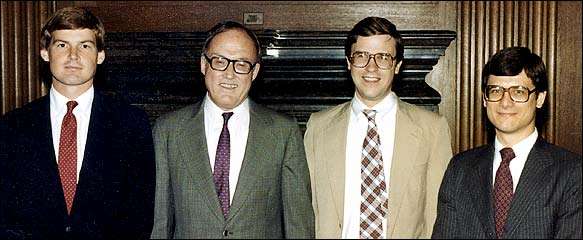
(Roberts's co-clerks were Dean C. Colson and Robert B. Knauss.)
For some time, I wondered what Roberts actually contributed to the Dames & Moore decision.
In 2017, I emailed Lyle Denniston about the drafting of the opinion. He sent back a fairly detailed response, which I have uploaded here. In a follow-up email, Lyle said that Roberts likely had "minimal" input on the opinion in light of the time pressures.
In a new story, Joan Biskupic writes that Roberts "helped produce" the majority opinion in Dames & Moore. She adds, "Working with Roberts and two other clerks, Rehnquist produced the first draft within two days and sent it around to the other justices that Friday."
Is there anything in the papers to show exactly what Roberts did to produce the first draft? I haven't seen it.
Biskupic also focuses on a weird tangent story. She writes that "Roberts himself was in the last frantic days of his clerkship and trying to study for an upcoming bar exam."
The July bar exam is held at the end of the month. (I read that it was July 29, 1981, but I cannot confirm that date.) Were Supreme Court clerks, scrambling to wrap up the end of the Supreme Court term, really studying for the bar in June and early July? Roberts sat for the D.C. Bar exam, which historically was known as one of the easiest in the country. Roberts is also a genius. Would he seriously be distracted from the most important job of his career for a pass-fail exam?
I can guess why Biskupic went down that road:
For his part, Roberts tried to catch up on his studies for the bar exam that month and prepare for a job in the Reagan administration beginning in August.
His study partner for the District of Columbia bar exam happened to be a fellow clerk, from the Brennan chambers that term: [Michael] McConnell, now the lead counsel suing Trump over the tariffs.
Were Michael McConnell and John Roberts really studying together for the bar before the term concluded?
Dames & Moore was argued on June 24. Chief Justice Burger made the assignment to Rehnquist, and circulated this memo:
"To 'get the show on the road' Bill Rehnquist has agreed to get an opinion in our hands by noon Sunday, next – if not before."
Right on schedule, Rehnquist delivered the draft on Sunday, June 28. And the opinion was announced on July 2.
For whatever it is worth, that period was very busy. On June 25, Rehnquist delivered the Court's majority opinion in Rostker v. Goldberg. Haig v. Agee was decided on June 29, 1981. On July 1, the Court decided a pair of CrimPro decisions: Robbins v. California and NY v. Belton. On July 2, the final day of the term, the same day as Dames & Moore, came the fractured decision in Metromedia v. City of San Diego.
The VRA allow Democrats to challenge Republican districts, but does not allow Republicans to challenge Democratic districts.
I have described the Voting Rights Act as asymmetrical. As a practical matter, the law provides a bonus to Democrats, and penalizes Republicans. The VRA is no longer trying to stop actual racial discrimination. In most cases, the VRA operates in the South where Republican legislatures try to create as many Republican districts as possible. But the VRA has little impact in the North where Democratic legislatures try to create as many Democratic districts as possible.
Alas, enter Mark Elias.
The Eleventh Congressional District in New York covers Staten Island (my hometown) and parts of Brooklyn. The Eleventh District is represented by Nicole Malliotakis, the only Republican member in New York City.
The Elias Law Group has filed a state Voting Rights Act challenge, arguing that the Eleventh District "provides Black and Latino Staten Islanders less opportunity than other members of the electorate to elect a representative of their choice." The upshot here is clear: Democrat voters are asking the court to eliminate a Republican district in New York City. There is no credible allegation that the overwhelmingly-Democratic New York legislature drew this map to dilute the votes of Black and Hispanic voters. Rather, this district was drawn as part of a series of messy political compromises. And even after those compromises, in which Republicans were almost gerrymandered out of the existence, the VRA can empower a court to eliminate that sole district to further help Democrats.
This is where the law is: in a district where Democratic voters cannot elect a Democrat, they can bring a VRA claim, even in an overwhelmingly democratic state where there is not even a scintilla of evidence of racial discrimination. But in a district where Republican voters cannot elect a Republican in an overwhelmingly republican state, they cannot bring a VRA claim.
This sort of asymmetry should not stand. Callais, hopefully, will put an end to this madness for the federal VRA. And as Rick Hasen pointed out, a ruling for Louisiana would also impact state VRAs.
So argues a concurring opinion in today's Second Circuit decision in Leroy v. Livingston Manor Central School Dist., also speaking about speech that "callously cheer[s] on or condone[s]" "police brutality, ... religiously-motivated attacks on their houses of worship, sexual or gender-based violence, or any other type of targeted state or private violence."
I wrote earlier today about Judge Barrington Parker's majority opinion in this case (disclosure: I argued in the case on behalf of amici Center for Individual Rights and myself); here's a short excerpt from Judge Myrna Pérez's long opinion concurring in the judgment:
The common thread running through threats, bullying, and harassment—the types of off-campus speech that all generally agree must be regulable at least some of the time—is that they disrupt student learning by causing students to fear for their safety. While fear is not the only emotion that can disrupt learning, it is uniquely detrimental to students' ability to learn, and it must be within schools' power to protect both their students' physical safety and their feelings of safety…..
Obviously, if students fear their classmates will hurt them, they will be less able to learn. But learning can also be disrupted if students believe their classmates will callously cheer on or condone their being harmed outside of their schools. Students come to school with all kinds of fears about how they and those they love could be harmed inside and outside of school—whether they fear police brutality, forcible family separation by immigration authorities, religiously-motivated attacks on their houses of worship, sexual or gender-based violence, or any other type of targeted state or private violence.


New from Reason: a look into what Javier Milei has accomplished and what it will take to make the most of Argentina’s window for real change. Out now for subscribers.

