The Volokh Conspiracy

Mostly law professors | Sometimes contrarian | Often libertarian | Always independent | Est. 2002

The Volokh Conspiracy

Second Amendment Roundup: How a Fake Citation Misled Courts to Uphold "Sensitive Place" Gun Bans

The Second Circuit’s Misunderstanding of Founding-Era Law on Going Armed

|

My article with the above title has now been published online by the Journal of Law & Civil Governance at Texas A&M.  The following is the Abstract:

This article concerns how a fake citation has misled courts to uphold "sensitive place" gun bans. New York State Rifle & Pistol Ass'n v. Bruen held that the Second Amendment presumptively protects conduct covered by its plain text. A state must justify its restriction by showing it to be consistent with America's historical tradition of firearm regulation. The original public understanding at the Founding is key to that question.

Post-Bruen, courts have sought to uphold restrictions that ban firearms in various "sensitive places" based on a misunderstanding of the Founding-era offense of going armed in a manner that terrorized the public.  Antonyuk v. James upheld New York's place restrictions based on its claim that Founding-era Virginia and North Carolina laws banned going armed per se in fairs and markets. However, it conceded that Virginia only prohibited going armed "in terror of the Country," but maintained that North Carolina had no such element of the offense, adding that place restrictions in the late 19th century followed the North Carolina model. That historical tradition of regulation, the Second Circuit held, justifies New York's current law.

But Antonyuk has constructed a house of cards by ignoring actual North Carolina law and mistaking a privately published book for that law. In 1792, François-Xavier Martin published A Collection of the Statutes of the Parliament of England in Force in the State of North-Carolina, which included the 1328 Statute of Northampton. Bruen commented that the Statute "has little bearing on the Second Amendment adopted in 1791," and in any event it was interpreted to apply only to going armed in a manner to terrorize others.

Antonyuk did not bother to research actual North Carolina law. In 1741, the colony of North Carolina enacted a law directing constables to arrest "all such Persons as, in your Sight, shall ride or go armed offensively"; by contrast, it further provided that "no Slave shall go armed with Gun, Sword, Club, or other Weapon." That same language was approved by an act passed in 1791 and continued to reappear in the statutes at least as late as 1855. Going armed was not a crime unless done so offensively, while going armed per se was a crime if the person was a slave.

Antonyuk further ignored North Carolina precedents. State v. Huntly recognized the common-law offense of going armed to terrify, but said that "the carrying of a gun per se constitutes no offence." That reading of the law was repeated over and over as late as 2024.

Courts have been misled by the citation of Martin's Collection as a "law" at the highest level. Dissenting in Bruen, Justice Breyer cited Martin as the authority for the proposition that "North Carolina enacted a law whose language was lifted from the Statute of Northampton virtually verbatim (vestigial references to the King included)." It boggles the imagination to think that the state would enact a law with several references to "the King" sixteen years after the Declaration of Independence.

It is unclear where the rumor started that Martin's book was a "law," but the Duke Center for Firearms Law includes it in its Repository of Historical Gun Laws under the citation "ch. 3, N.C. Gen. Stat. (Francois X. Martin 1792)." Chapter 3 of N.C. General Statutes in 1792 included no such provision. Another fake citation for this "law" that has been cited is "1792 N.C. Laws 60, 61 ch. 3," which does not exist.

The Ninth Circuit, in Wolford v. Lopez, recognized that Bruen rejected the purported place restrictions in North Carolina law, but upheld them anyway despite no Founding-era tradition of regulation. Yet the Third Circuit swallowed Antonyuk hook, line, and sinker to uphold New Jersey's extensive place bans, including the misrepresentation that Martin's book was a North Carolina "law," in Koons v. Attorney General of New Jersey. And then a different panel of the Second Circuit, in Frey v. City of New York, admitted that "Bruen undermines" Antonyuk's interpretation, but upheld other parts of New York's "sensitive place" bans despite no Founding-era tradition of regulation.

This matter is not about a single, erroneous citation with no consequence. In Antonyuk, the Second Circuit built its entire theory of Founding-era analogs on sand in order to comply with Bruen's directive to find a historical tradition of regulation that supported New York's wide restrictions. That decision has since influenced two other circuits, covering three states, to adopt the same flawed approach—and others may soon follow. These decisions are based on a badly mistaken analysis of America's historical tradition of firearm regulation and should be overturned.

[Note: The Third Circuit has granted rehearing en banc in Koons, thus vacating the panel decision.]
The KBJ Delay in Callais

Who is at fault for the rush to judgment in Louisiana?

|

One of the most explosive claims from Molly Hemmingway's new books concerns Dobbs. As we all recall, after the leak of the Dobbs draft on May 2, 2022, it became apparent that the Justices would face serious security threats. Indeed, a deranged liberal traveled from California to D.C. with weapons and made it to the threshold of Justice Kavanaugh's home. (Sounds familiar, doesn't it?) Yet, after all this happened, the Dobbs opinion was not released early. The Court held onto it until June 24. There was no obvious effort to expedite the release of the opinion. And all told, there were few changes made between the leaked draft and the final published opinion. At the time, some speculated that there might be changes to the opinion. Or perhaps the majority flipped. Yet, the five held strong. What then was the holdup?

Hemmingway reports that Justices Sotomayor, Kagan, and Breyer refused to expedite the release of the opinion. (This vignette comes after the leak but before the assassination attempt):

On Thursday, May 12, the justices gathered in conference to go through the circulating opinions and set the dates for their release. Justices grade the decisions based on when they will be ready for release. An "A" is for those decisions and dissents that are done, "B" for those that are almost done, and "C" for those not near completion. Dobbs was graded a "C."

The majority opinion had been done for more than three months and was waiting only for the dissents. Alito asked the dissenters to make the completion of their dissents their priority because delay of the decision was a security threat. Abortion supporters had an incentive to kill one or more of the justices in the majority to change the outcome. The dissenters demurred. Gorsuch spoke up, asking for a date by which they might be done. They would not give a date.

Following the conference, Justice Elena Kagan visited Justice Stephen Breyer's office. Though he had not said he would accommodate the justices whose lives were at risk by getting out a dissent, he was the member of the liberal bloc most willing to do so. Fiercely liberal in his jurisprudence and in strong disagreement with the majority decision, he nevertheless was a gentleman and a friend to all on the Court. Kagan remonstrated with Breyer not to accommodate the majority, screaming so loudly, observers noted, that the "wall was shaking."

I'm not quite sure how stone walls were shaking, but I get the picture.

After the assassination attempt, the Justices reached something of a compromise:

The dissenting justices eventually agreed to complete their Dobbs dissent by June 1 in return for an extension to June 15 of the deadline for their majority opinions in other cases. When the dissent was finally submitted, however, it cited the decision in the high-profile Second Amendment case New York State Rifle & Pistol Association v. Bruen, which would not be released until the end of the term. The release of the Dobbs decision, therefore, was dragged out until June 24, the day after Bruen was released.

Did Dobbs have to cite Bruen? Was this just another attempt at delay? This is the sort of claim that one day will be revealed in the papers of the Justices. I hope to live long enough to see them.

For now, it seems that Justice Alito may have addressed this situation, perhaps indirectly.

Justice Alito included an unusual footnote in his Callais concurrence:

The dissent would require that the 2026 congressional elections in Louisiana be held under a map that has been held to be unconstitutional.*

*That constitutional question was argued and conferenced nearly seven months ago.

Why would Justice Alito write this? What difference does it make that Callais was argued in October and conferenced shortly thereafter? The implication, I think, is that the Callais dissent was slow-walked. But why would it be slow-walked? As all know, the longer the opinion would take to publish, the harder it would be for Republicans to implement the order for the 2026 midterms. I'm sure Alito's majority opinion was prepared quickly. And as I noted last week, the majority barely responds to Justice Kagan's dissent, so there was not much back-and-forth. The delay, Alito insinuates, was from the Court's liberals. And why would they delay? Perhaps Justice Kagan needed seven months to perfect three consecutive sentences that begin with the words "I dissent because." Or, there was an effort to help Democrats. Who was sacrificing principle for power?

On X, Mike Fragoso asks, "Did Mollie's book excerpt force Kagan's hand in Callais? I guess we'll never know." The Wall Street Journal likewise observes, "The footnote suggests some pique by Justice Alito about the Court's long gestation on Callais, and understandably so since Justice Jackson is accusing the majority of playing politics."

Of course, if Justice Jackson went along with these dilatory tactics, she has some chutzpah for complaining about the effort to issue the mandate forthwith. But for the KBJ delay in Callais, Louisiana could have received the judgment before the election began, an this entire dispute would amount to nothing.

The Laborious KBJ

|

Justice Ginsburg was known as the Notorious RBG. Notoriety was a perfect adjective for Justice Ginsburg. She was famous, but not always in a good way. She was, well, notorious. And Justice Ginsburg leaned into that edgy persona--or did the edgy persona shape Ginsburg?

For some time, I've been thinking of the right nickname for Justice Jackson. It hit me today: the Laborious KBJ. The most salient feature of her tenure is making others do more work. And that work doesn't actually serve any purpose, other than indulging Justice Jackson. She certainly isn't changing any minds on the Court, and it isn't clear she is changing any hearts outside the Court.

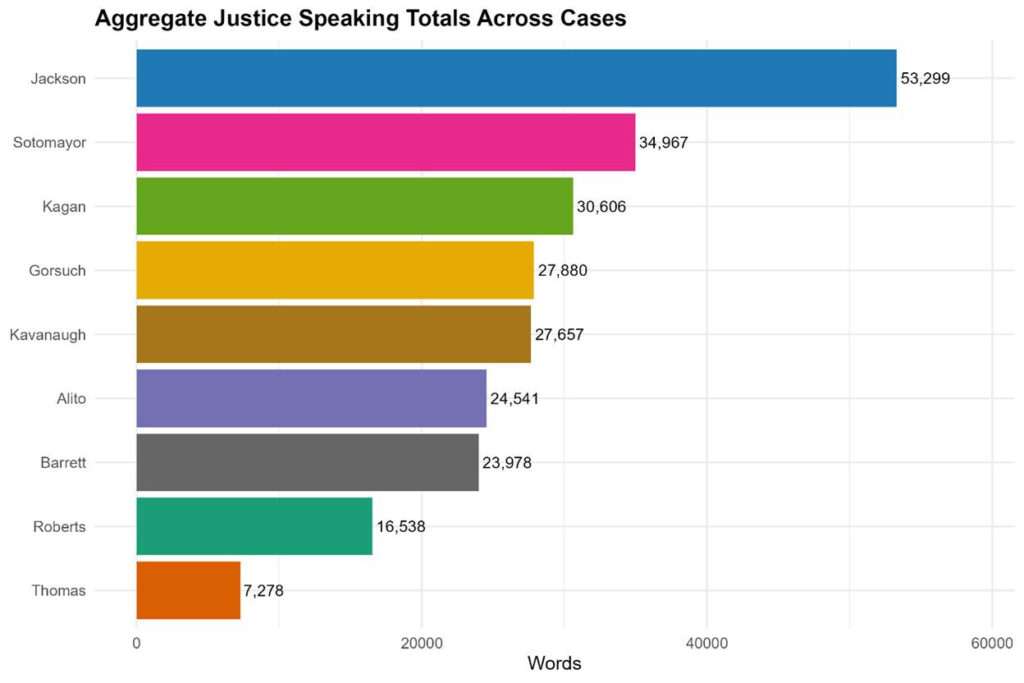
Consider a few data points. During oral argument, she speaks more than any other Justice by a significant number. According to Adam Feldman's analysis from March, Justice Jackson spoke more than 53,000 words from the bench this term.

The next closest totals were Justices Sotomayor and Kagan with 35,000 and 30,000, respectively.  If you total the words spoken by Chief Justice Roberts, and Justices Thomas and Barrett (about 48,000), you still have less than Justice Jackson alone. Or you could total the words spoken by Justices Kavanaugh and Gorsuch (52,198) and it is still less than Justice Jackson.

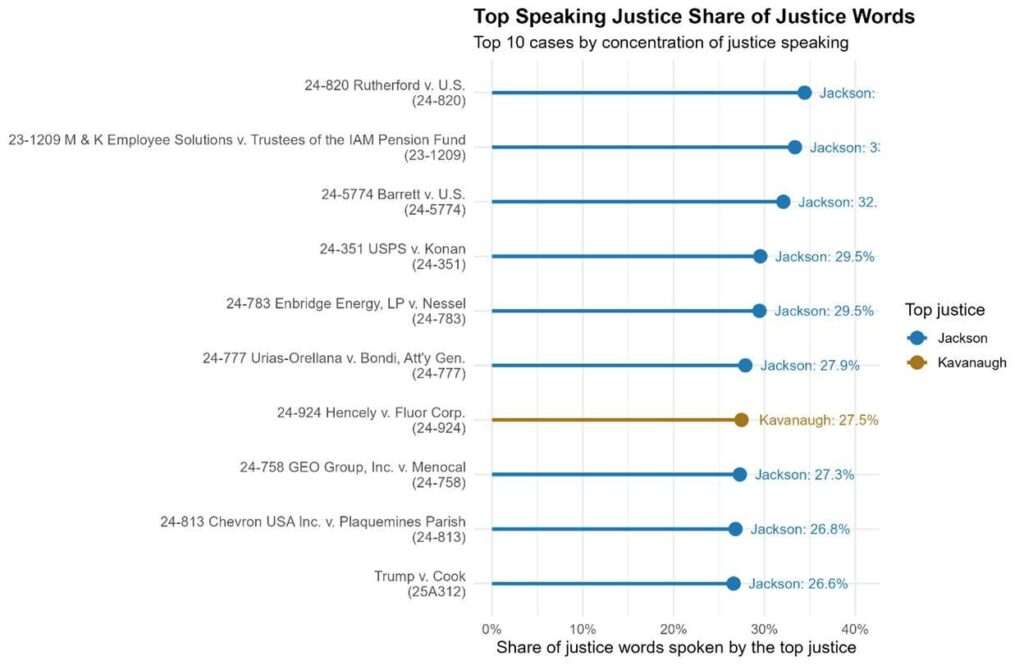
Feldman measures the data in a different way. Justice Jackson had the highest share of words spoken in nine of the top ten longest arguments this term. More than 1 out of every 4 words spoken by a Justice comes from Justice Jackson.

That sort of dominance is not normal.

At least when Justice Breyer would ask questions for pages on end, it was entertaining. I now find myself skipping the audio whenever Justice Jackson starts asking a question. It just is not a good use of my time. The other Justices, alas, lack that luxury. As many reporters have observed, when Justice Jackson begins her lengthy questioning, the other Justices take deep breaths, roll their eyes, and disconnect.

Then there are Justice Jackson's solo dissents. In a number of cases, she takes a position so far to the left that not even Justices Sotomayor and Kagan want to join her. Most recently, Justice Jackson was all alone in charging the majority with partisanship (more on that dissent shortly). And that dissent compelled Justice Alito to write, on very short notice, a concurrence that called her out. Our Circuit Justice has been very busy this week.

Justice Jackson also caused waves by slow-walking emergency petitions from the First Circuit. She took a long time to even call for a response in Libby v. Fectau, where the Justices ultimately granted emergency relief. Contrast this KBJ delay with how quickly Justice Alito granted an administrative stay and called for a response with the Mifepristone case. Like I said, our Circuit Justice is on point.

The Laborious KBJ. There you go.

In the spirit of my friend Ilya Shapiro, could you imagine if Justice Kagan had Justice Srinivasan as a wingman?

Free Speech

Vanderbilt Student's Lawsuit Over Suspension for Alleged False Accusations Can Go Forward

|

From a long opinion today by Judge Waverly Crenshaw (M.D. Tenn.) in Poe v. Lowe:

Poe, a male Vanderbilt student, made social media posts about another male Vanderbilt student, Roe, and his sexual behaviors with females. [Citing court filing] showing posts by Poe's Yik Yak account, including stating that "[Roe] is a rapist" and "[Roe] slipped me a roofie this fall, but I just wasn't able to definitively proove [sic] it. When I brought it up to some of the [] brothers [from Roe's fraternity] they tried to gaslight me about it" ….

Poe was not alone—a number of posts were made about Roe by other people, including other Vanderbilt students. [Citing court filing] containing Yik Yak posts by a female Vanderbilt student, L.N., including stating that she had "personal experience" with Roe and "he is a RAPIST, that is the truth and if you don't believe it after so many girls have said it, there is nothing I can do to convince you" …. Once this came to Vanderbilt's attention, Bourgoin, Vanderbilt's Director of Student Accountability, Community Standards, and Academic Integrity, opened a disciplinary case against Poe, charging him with three violations of the Student Handbook …: disorderly conduct, harassment, and impersonating a University official or any other person….

Poe's appeal was denied by Vanderbilt's Chair of the Appellate Review Board (Lowe), and Poe was suspended for a year. Poe, who had attempted suicide after hearing of his punishment, sued Vanderbilt on various theories.

The court allowed Poe's negligence claim to go forward based on how the disciplinary outcome was reported to him:

There is no dispute that Defendants were on notice of Poe's serious mental health issues. [Citing record document] (Poe's mother emailing Bourgoin and Clapper {[Vanderbilt's] Director of Student Care Network and Student Care Coordination} that Poe "is now talking suicide We are absolutely convinced an adverse decision now will take his life"). Jamerson even testified that he had assessed Poe's suicide risk at "moderate-to-elevated." Defendants did not accommodate Poe's mother's request to move the outcome call one week. Yet, they still chose to engage in care planning with her to mitigate the risk of harm to Poe. [Citing record document] (Jamerson testifying that he "felt it was safe to move forward with adding additional precautions like having [Clapper] available to be on the [outcome] cal1, who is a licensed clinical social worker, also notifying the mom of when the date would be so that the mom was aware of when it was coming out.").

Apparently, Defendants wanted Poe to have his mother with him during the outcome call, as evidenced by the email to his mother with the target date for the meeting. Clapper also testified that when she and Bourgoin began the outcome call with Poe, she asked Poe if his mother was there. Despite Poe telling them he lied to his mother {about the scheduling of the outcome call and [told] her that it was the following day}, Bourgoin and Clapper proceeded with the outcome call.

Read More

NAACP Seek To Recall Callais Judgment So It Can Seek Reconsideration

The time to make this request was when the Plaintiffs moved to issue the judgment forthwith.

|

On April 29, the Supreme Court decided Callais. That same day, the non-African American Plaintiffs asked the Court to issue the judgment immediately. This request should not have been surprising. Louisiana is in the middle of the election, and time is of the essence. Justice Alito called for a response to be filed on April 30. The NAACP filed a response. I suggested that the savvy strategic move would have been to file at the same time a motion for reconsideration. To be sure, the rules provide 25 days to file such a motion, but in a fast moving case it would have been prudent to file immediately. The NAACP did not file such a motion. Instead, the opposition stated that they were thinking about it:

The Robinson Appellants oppose Appellees' Application for expedited issuance of the Court's judgment in this matter (the "Application"). This Court should afford Appellants the opportunity to consider seeking rehearing in the ordinary course. See Supreme Court Rule 44.1 (allowing 25 days for a party to seek rehearing of any judgment of this Court).

What was there to think about? The case is on the emergency docket. There is not time for the usual 25 day period to leisurely consider the matter. Again, I think there was a strategic miscue here. The NAACP lost a race on the shadow docket. And what would the NAACP have argued in such a motion for reconsideration? It would be clear they were (to use Justice Alito's words) trying to "run out the clock." The delay is the point.

Today, the NAACP has formally asked the Court to withdraw the judgment to give the NAACP the full period to file a motion for reconsideration.

The sole basis cited in the Order for granting Appellees' Application and issuing the judgment forthwith was that "[Robinson Appellants] have not expressed any intent to ask this Court to reconsider its judgment." However, in the second sentence of Appellants' opposition to the Application, Appellants requested "the opportunity to consider seeking rehearing." See Robinson Appellants' Response to Appellees' Application for Issuance of a Copy of the Opinion and Certified Copy of the Judgment Forthwith, at 2, No. 25A1197 (Apr. 30, 2026). In support, Appellants cited Rule 44.1, noting that it allows parties twenty-five days to seek rehearing of any judgment of this Court. Appellants intend to request rehearing in this case, and, accordingly, respectfully request that this Court recall the judgment, reconsider its order granting the Application, and deny the Application. Alternatively, Appellants respectfully ask the Court to recall the judgment and provide them fifteen days from the date of its decision in this case, or until May 14, 2026, to seek rehearing.

I think this ship has sailed. Proceedings are already ongoing in the lower court. Justice Jackson made the case for why the judgment should not be issued forthwith. No one joined her. I don't see much ground for reconsideration here.

Politics

The Spirit of the Declaration, Part 1

|

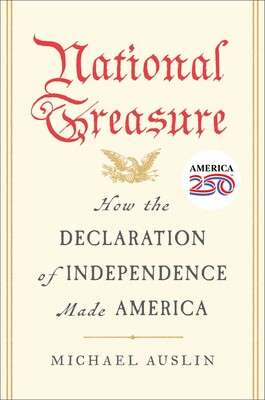
[This post is excerpted from the new book, National Treasure: How the Declaration of Independence Made America (Avid Reader Press/Simon & Schuster).]

Though Thomas Jefferson's phrases in the Declaration of Independence remain among the most famous ever penned, America's founding document remains controversial to some, and unread by many. Famously intended by the young Jefferson to be an "expression of the American mind," the Declaration was primarily of an amalgamation of George Mason's Virginia Bill of Rights, Jefferson's draft Virginia Constitution, and Richard Henry Lee's resolution of June 11 proposing Independence. Though informed by dozens of local declarations and statements, as ably chronicled by the late Pauline Maier in her 1997 American Scripture, one might say that the Declaration grew out of the Virginia soil, seeded by the tempestuous rains of Massachusetts.

The members of the Continental Congress knew that their Declaration left much unsaid and unfinished. They had heavily edited Jefferson's draft, though they refrained from adding new sections. In what Jefferson bemoaned as "mutilations" but were really judicious edits, Congress cut about a quarter of the text before adopting the document on the morning of July 4, 1776. In truth, the Declaration was not seen as the epochal event later generations attributed to it. To the delegates in Philadelphia, that step had been taken two days earlier, on July 2, when Congress voted to separate from Great Britain, King George III, and Parliament. Moreover, the Declaration was important insofar as it paved the way for two more important moves: forming foreign alliances, primarily France and Spain, and forming some kind of confederated government to guide relations among the now sovereign States. No public readings, fireworks, or celebrations occurred on July 4, though they would break out in coming days as America's new citizens listened to the Declaration read on hastily printed broadsheets sent around the country.

By design, the Declaration avoided any discussion, or even suggestion, of the type of government the colonies should establish. Formally, that was the responsibility of Connecticut delegate Roger Sherman's committee to draft articles of confederation, which ultimately created a uniquely weak central government. The more fundamental questions of governance were to be left to the new States, eight of which would draft and adopt constitutions in 1776 alone. Indeed, for many delegates, the business of writing state constitutions was far more important than Congress's declaration. Even Thomas Jefferson would rather have been back in Williamsburg working on a constitution for Virginia, a draft of which he had already composed earlier in the year, and parts of which he now re-purposed for the declaration.

Read More

Free Speech

Elite Panic and the Push to Regulate "Misinformation"

European leaders' warnings of a democratic apocalypse failed to materialize in 2024.

|

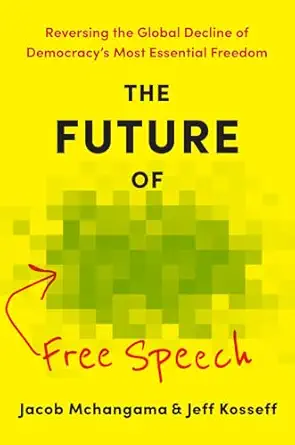
Our book traces the waves of elite panic that drive governments to regulate "misinformation," "disinformation," and other speech that the leaders believe are not in the best interests of the public. One wave of elite panic reached its peak in 2024. It was a pivotal year for the future of global democracy, as some 2 billion voters—about half the adult population of the globe—went to the polls, including voters in the United States, the European Union, France, the United Kingdom, Brazil, Indonesia, South Africa, Taiwan, Mexico, and India.

Despite a record number of eligible voters, the mood among many politicians, commentators, and media institutions was more fearful than celebratory. A New York Times article from January 2024 warned that "false narratives and conspiracy theories have evolved into an increasingly global menace," and that "artificial intelligence has supercharged disinformation efforts and distorted perceptions of reality." Experts cautioned that the combination of online influence campaigns and artificial intelligence had created a "perfect storm of disinformation" that threatened free and fair elections.

The EU-funded European Digital Media Observatory (EDMO) warned that disinformation campaigns had become "a pervasive phenomenon," with more voters exposed than ever before. An anonymous senior EU official highlighted the threat from "tsunami levels" of disinformation: "It's as if we have been infected by this foreign interference. It's a silent killer." Not to be outdone, Věra Jourová, the European Commission's vice president for values and transparency, said AI deepfakes of politicians could create "an atomic bomb … to change the course of voter preferences." To counter this threat, the European Commission sent menacing letters to social media platforms and dispatched crisis units, expecting to deal with attempts to cast doubt on the legitimacy of the election's outcome for weeks after the vote.

At the Copenhagen Democracy Summit in May 2024, just a month before the European Parliamentary elections, Ursula von der Leyen, the president of the European Commission and then a candidate for reelection, made a significant pledge. She promised to prioritize a new "European democracy shield" to combat foreign interference. One aspect of this shield would focus on detecting "malign information or propaganda " and, once identified, ensuring such content is "swiftly removed and blocked" by online platforms. This would build on—and likely expand—new obligations under the Digital Services Act. The shield would essentially normalize the kind of emergency measures the European Union had already adopted to ban and block Russian state-sponsored media in the wake of Putin's attack on Ukraine in February 2022.

Read More

Politics

Today in Supreme Court History: May 5, 1992

|

5/5/1992: The 27th Amendment is ratified. It was initially proposed in 1789.

No law, varying the compensation for the services of the Senators and Representatives, shall take effect, until an election of Representatives shall have intervened.

More
Make a donation today! No thanks
Yes! I want to put my money where your mouth is! Not interested
I’ll donate to Reason right now! No thanks
My donation today will help Reason push back! Not today
Yes, I’ll donate to Reason today! No thanks
Yes, I’ll support Reason today! No thanks
Yes, I’ll donate to Reason today! No thanks