
The Spirit of the Declaration, Part 1
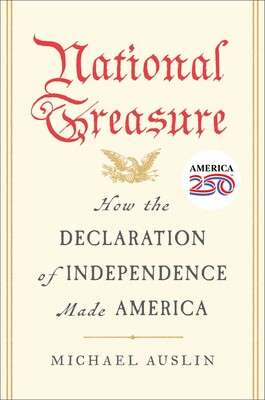
[This post is excerpted from the new book, National Treasure: How the Declaration of Independence Made America (Avid Reader Press/Simon & Schuster).]
Though Thomas Jefferson's phrases in the Declaration of Independence remain among the most famous ever penned, America's founding document remains controversial to some, and unread by many. Famously intended by the young Jefferson to be an "expression of the American mind," the Declaration was primarily of an amalgamation of George Mason's Virginia Bill of Rights, Jefferson's draft Virginia Constitution, and Richard Henry Lee's resolution of June 11 proposing Independence. Though informed by dozens of local declarations and statements, as ably chronicled by the late Pauline Maier in her 1997 American Scripture, one might say that the Declaration grew out of the Virginia soil, seeded by the tempestuous rains of Massachusetts.
The members of the Continental Congress knew that their Declaration left much unsaid and unfinished. They had heavily edited Jefferson's draft, though they refrained from adding new sections. In what Jefferson bemoaned as "mutilations" but were really judicious edits, Congress cut about a quarter of the text before adopting the document on the morning of July 4, 1776. In truth, the Declaration was not seen as the epochal event later generations attributed to it. To the delegates in Philadelphia, that step had been taken two days earlier, on July 2, when Congress voted to separate from Great Britain, King George III, and Parliament. Moreover, the Declaration was important insofar as it paved the way for two more important moves: forming foreign alliances, primarily France and Spain, and forming some kind of confederated government to guide relations among the now sovereign States. No public readings, fireworks, or celebrations occurred on July 4, though they would break out in coming days as America's new citizens listened to the Declaration read on hastily printed broadsheets sent around the country.
By design, the Declaration avoided any discussion, or even suggestion, of the type of government the colonies should establish. Formally, that was the responsibility of Connecticut delegate Roger Sherman's committee to draft articles of confederation, which ultimately created a uniquely weak central government. The more fundamental questions of governance were to be left to the new States, eight of which would draft and adopt constitutions in 1776 alone. Indeed, for many delegates, the business of writing state constitutions was far more important than Congress's declaration. Even Thomas Jefferson would rather have been back in Williamsburg working on a constitution for Virginia, a draft of which he had already composed earlier in the year, and parts of which he now re-purposed for the declaration.
But if Jefferson and his colleagues on the Committee of Five avoided specifying what a national government should look like, in drawing up its list of twenty-eight charges against King George enumerated in the Declaration, the committee and later the Congress as a whole made clear how a just government should not act. Thus, by implication, they revealed how a government justly representing the consent of the governed should act. Only when a new, more centralized government was required would the echoes of Jefferson's charges inform the Constitution and especially the Bill of Rights.
The Declaration defined Americans as one people, but it did not declare a unitary "United States of America." It was issued in the name of thirteen united colonies, who were now "Free and Independent States." How these independent states would act in concert and what kind of nation they would form would consume their energies for the next twelve years, until the Articles of Confederation were set aside and the Constitution was ratified in 1788, giving a final form to the government of the now more fully United-States.
Though the Declaration had not specified which type of government was to be formed, all members assumed that the liberties in whose name they had rebelled could only be guaranteed in a republic. Yet that was an audacious and risky undertaking. History had shown that the unrestrained exercise of liberty by equal men had brought ruin to all republics in the past, whether Athens and Rome or Venice and the Netherlands more recently. Over time, republics fell into corruption, licentiousness, and ultimately civil war. Even the ancient Hebrew commonwealth, mandated by God and the most "perfect republic" of balanced powers, had collapsed into monarchy. Nor had any republic ever been as large as the United States, raising doubts as to its viability.
Jefferson and his colleagues did not envision trusting their liberties to a pure democracy, which John Adams later described as a form of government "arbitrary Tyrannical bloody cruel and intollera[nt]," and (as Aristotle warned) almost always leading to anarchy. If America was to avoid the failures repeated throughout history, then a particular type of republican virtue would be required in its citizens and leaders. This was the virtue of public-spiritedness and service to preserve shared liberties. Ancient writers like Tacitus and Plutarch and the Bible inspired Jefferson and his contemporaries with their lessons on the lives of men both virtuous and immoral.
The Declaration did not call for radical social equality or the leveling of all distinctions, however. Jefferson was a combination of visionary and backroom politician, and his text was similarly complex. Neither he nor his fellow delegates supported social revolution. Instead, they implicitly presumed virtuous leadership by "a few of the most wise and good," as John Adams put it in his January 1776 pamphlet Thoughts on Government, selected freely by their fellow citizens to defend their common liberties. In time, Jefferson would express more clearly his own views on a "natural aristocracy," but even in 1776 he believed in an idea of equality that freed a man from his family's background while assuming that the best and brightest would be the ones to use their talents on behalf of the broader body politic. It was a presumption that would be tested almost immediately.