

The Volokh Conspiracy
Mostly law professors | Sometimes contrarian | Often libertarian | Always independent
"Gossip," "Abusive Language," and "Soft Beta Males" in Public Comments at School Board Meetings
Blanchard v. Augusta Bd. of Ed., decided yesterday by Judge Stacey Neumann (D. Me.), held that the First Amendment was likely violated by school board public commentary policies forbidding
- "gossip,"
- "abusive … language.,"
- "vulgar language," and
- "complaints or allegations … at Board meetings concerning any person employed by the school system or against particular students," also described as "[p]ersonal matters or complaints concerning student or staff issues."
The parties had agreed that the public comment period was a "limited public forum," a place opened up by the government for speech on particular subjects. In a limited public forum, speech restrictions must be viewpoint-neutral and reasonable. The court then held that the four restrictions noted above violated one or both of these elements:
[1.] Gossip:
By its terms, the gossip prohibition turns on what is being said: "rumors or information about the behavior or personal lives of other people." See Gossip, Merriam-Webster. Such a category of speech does not exist solely and definitively outside of that which relates to school or education matters. Comments about the conduct or personal behavior of teachers, administrators, or Board members may indeed bear directly on school operations and policy….
[And] Policy BEDH provides no objective standard to distinguish "gossip" related to school and education matters from other such commentary. That lack of clarity leaves speakers guessing at what is allowed and invites arbitrary enforcement by officials presiding over the meetings. Without a workable line, there is no "sensible basis for distinguishing what may come in from what must stay out." In practice, the rule allows the presiding officer's own sensibilities to determine what counts as "gossip," which "openly invites viewpoint discrimination."
The overbreadth concerns are equally apparent. Defined as "rumors or information about the behavior or personal lives of other people," the term "gossip" can easily encompass speech at the heart of the Board's public comment period—for example, a parent repeating information they have heard about a teacher's behavior in the school that relates to their child's education or a citizen relaying information about an administrator's conduct relevant to policy or budgeting decisions. Such speech may be sharply worded but still fully protected and directly tied to school business. A rule that sweeps this speech broadly into the category of "gossip" risks silencing criticism that the First Amendment protects….
[2.] Abusive language:
Merriam Webster defines "abusive" as "harsh and insulting" or "using harsh and insulting language." At the July 2025 Board meeting, the Chair similarly defined abusive language as "language that is harmful or offensive to a person." Read this way, the policy singles out speech that offends or insults its target. This is classic viewpoint discrimination. See Matal v. Tam (2017) ("Giving offense is a viewpoint."). Other courts evaluating comparable school board policies have reached the same conclusion.
To be sure, the Board is not powerless to regulate all manifestations of abusive speech. A policy that targets narrow, viewpoint-neutral characteristics—such as actual disruption, shouting, threats, or true harassment—or that explicitly and tightly defines the covered category may pass constitutional muster. Rule E, however, does not contain that kind of limiting construction. As applied here, "abusive" functions as a broad bar on offensive speech—an "undercover prohibition" on disfavored viewpoints.
Because the government "may not burden the speech of others in order to tilt public debate in a preferred direction," the Board's prohibition on "abusive" language is facially unconstitutional in this limited public forum. Mr. Blanchard is therefore likely to succeed on his facial challenge to the "abusive language" portion of Rule E.
[3.] Vulgar language:
Merriam-Webster defines "vulgar" in several ways, including "lacking in cultivation, perception, or taste," "offensive in language," and "of or relating to the common people." In the context of Policy BEDH, which prohibits "abusive or vulgar language" without reference to sexual content or obscenity, the most natural reading is "offensive in language." That understanding again steers the analysis toward viewpoint discrimination, because the rule targets speech for its perceived offensiveness rather than for its subject or disruptive effect.
The Supreme Court has recognized that schools may regulate certain vulgar student speech in the school setting. See Bethel Sch. Dist. No. 403 v. Fraser (1986). The Court understands the school board's desire to model respectful public behavior and to encourage civil discourse. Nonetheless, public school board meetings—open to adults and structured as a limited public forum—differ meaningfully from compulsory K–12 classrooms where the First Amendment permits greater regulation. In this setting, courts have instead focused on whether boards may exclude speech that is truly obscene or actually disruptive….
Nor is there a persuasive narrowing construction available on this record that would confine "vulgar" to unprotected obscenity or similar categories. Rule E does not use the word "obscene," does not tie "vulgar" to any requirement of disruption, and does not otherwise limit the term to a recognized class of unprotected speech. Instead, particularly when read alongside "abusive," Rule E leaves policing "vulgar" to turn on the presiding officer's sense of what language is sufficiently "uncultivated" or "offensive in language" to warrant exclusion. Such open-ended discretion raises the same concerns identified in Minnesota Voters Alliance v. Mansky (2018), where the Supreme Court cautioned that standardless rules invite arbitrary enforcement.
For these reasons, the term "vulgar" in Rule E can only be understood as a broad prohibition on offensive language that operates as an additional restriction on offensive viewpoints rather than as a legitimate, viewpoint-neutral decorum rule. In line with the Court's analysis of "abusive" speech, the "vulgar language" prohibition is facially unconstitutional, and Mr. Blanchard is likely to succeed on his facial challenge to that portion of Rule E.
[4.] Complaints, allegations, and personal matters concerning employees or students:
Defendants contend Rule H "restricts speakers from discussing a named or identifiable District employee regardless of whether the comment associated with that individual employee is criticism, praise, or something in between." Read that way, Rule H would operate as a ban on "personnel matters." A content-based restriction that excludes an entire subject—such as personnel matters—may be permissible in a limited public forum if it is viewpoint neutral (for example, barring all personnel-related comments, positive and negative) and reasonable (for example, by providing effective alternative channels for addressing those matters, such as through Policy KE).
Rule H, however, does not use the term "personnel." Instead, it refers to "personal matters or complaints concerning student or staff issues." … The ambiguity in Rule H's actual language drives the constitutional problem. It is not clear what "personal matters" encapsulates. If the phrase is meant to exclude speech related to purely private affairs—thereby removing it from the ambit of speech that relates to education and the school system—that limitation is not evident from the text alone. And in light of the forum's purpose, some purely "private matters" would already reasonably fall outside the permissible scope of discussion. But the definition of "personal" also relates to an individual's "conduct," "character," or "motives," and these words are vague in the context of Policy BEDH. Thus, while the Constitution does not require mathematical exactitude in language, the text of Rule H alone makes it unclear what speech it allows and what it prohibits….
The Board's shifting explanations of Rule H have not cured this uncertainty…. At the April 2025 meeting, the Chair suggested that "negative comments" about Board members were not permitted, even though Defendants later conceded at the hearing that Rule H does not bar speech directed at Board members, only at school employees. At the May 2025 meeting, a Board member stated that "the policy is that we will not speak positively or negatively about any personnel," and the Chair responded, "our current policy is only to not speak negatively." …
The vagueness doctrine "guarantees that ordinary people have 'fair notice' of the conduct a statute proscribes" and "guards against arbitrary or discriminatory law enforcement by insisting that a statute provide standards to govern the actions" of government officials. Rule H, as written, falls short on both fronts. The phrase "personal matters or complaints concerning student or staff issues" is steeped in subjectivity, and the record shows that Board members and the Chair have articulated different understandings of what the rule covers. Because the text does not clearly delineate its boundaries and the interpretive explanations have been inconsistent, Defendants have not shown that Rule H is capable of "reasoned application."
{Notably, Rule H, by its terms, applies only to "complaints or allegations" and "complaints concerning student or staff issues." For the reasons discussed herein, restricting only "complaints" is not viewpoint neutral. However, the Court need not address this issue further because it has enjoined Rule H in its entirety.}
{That is not to say the Board could not draft a public comment policy with a clear definition of "personal matters" that is appropriately prohibitive.}
But the court upheld the prohibition on "defamatory comments," "which the Court construes as limited to unprotected defamatory speech" of the sort that can lead to civil liability.
Some excerpts from the pretty long factual backstory, though the court's analysis generally focused more on the terms of the policies than the particular facts of the plaintiff's comments:
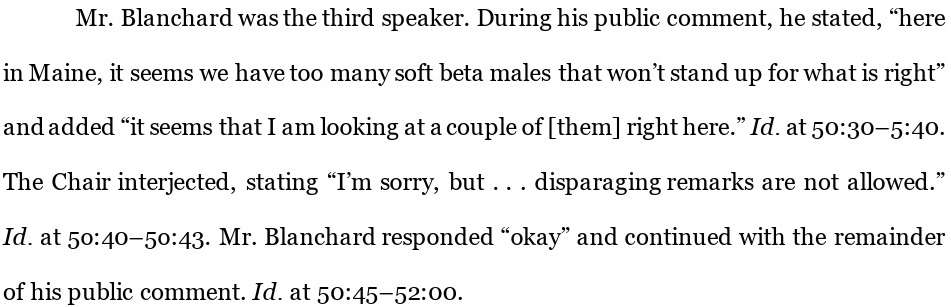
During [Mr. Blanchard's] public comment, he stated, "here in Maine, it seems we have too many soft beta males that won't stand up for what is right" and added "it seems that I am looking at a couple of [them] right here." The Chair interjected, stating "I'm sorry, but … disparaging remarks are not allowed." …
[At a later meeting,] Mr. Blanchard said, "I think we should all acknowledge the president of the Maine Principal Association that's going to cause all of our federal funding to go right out the window," while gesturing toward the Maine Principal Association ("MPA") President, who was present in the meeting room. The Chair interrupted him, stating "excuse me, excuse me … excuse me, no disparaging remarks." Mr. Blanchard asked, "how is that disparaging?" and then continued to express concerns about the potential loss of federal funding for Augusta public schools based on MPA's stance, specifically invoking the MPA President as the reason for the potential funding cuts.
The Chair replied, "those remarks are inappropriate. I'm sorry." Mr. Blanchard asked, "how are they? How is that inappropriate?" and added, "they're true." The Chair asked whether Mr. Blanchard had comments to make that were "not about … personnel," and Mr. Blanchard again asked, "how is that inappropriate?" This back and forth repeated itself. Mr. Blanchard then continued to speak against the purported loss of federal funding. A Board member moved to go into recess; the Board voted to approve the motion and went into a brief recess, effectively ending Mr. Blanchard's time at the podium….
[At another meeting,] Mr. Blanchard approached the podium wearing a t-shirt that displayed the words "YOUR FIRED" and a picture of Principal Kimberly Liscomb on the front. He began by thanking six Board members for their prior vote related to Title IX policies and contrasted their votes with that of the one member who had voted the opposite way; he did not identify any Board member by name. The Chair interrupted part of his commentary, stating the correct spelling is YOU'RE and Mr. Blanchard would be going to grammar jail "negative comments" were not permitted.
The exchange intensified when Mr. Blanchard discussed a petition to fire "Miss Kim" (i.e., Principal Liscomb), prompting the Chair to issue multiple warnings regarding "defamatory remarks about school personnel." Blanchard attempted to continue by referring to Principal Liscomb only by her professional title rather than her name. The Chair ruled it was "close enough" to a violation of Policy BEDH, however, and ordered Mr. Blanchard to leave the podium with approximately three minutes of his allotted speaking time remaining. As he left, Mr. Blanchard remarked, "wow, communist China right here." …
During the June 2025 meeting, Mr. Blanchard criticized what he viewed as the Board's selective enforcement of Policy BEDH and alleged the Board prioritized ideology over academic excellence. He stated that parents were "done watching the alphabet cult shove their propaganda down our throat and in our schools," prompting the Chair to interrupt and ask speakers to refrain from "disparaging remarks." …
David Robert Gordon and Stephen C. Smith (Steve Smith Trial Lawyers) and Brett Robert Nolan and Nathan John Ristuccia (Institute for Free Speech) represent plaintiff.




