


The Volokh Conspiracy

Mostly law professors | Sometimes contrarian | Often libertarian | Always independent | Est. 2002

The Volokh Conspiracy

Free Speech

QAnon "Patriot Reporter" Claims Newspaper Libeled Him by Saying He Had Admitted to "Sexual Relationship" with 15-Year-Old

But he loses: "As a result of Godlewski's guilty plea to 'inappropriate text [m]essages' and 'contact' ..., as set forth in the Affidavit of Probable Cause quoting the offending text messages admitting and memorializing a sexual relationship with a 15-year-old minor, Godlewski is collaterally estopped from denying his participation in [the] sexual relationship ...."

|

From Godlewski v. Kelly, decided last week by Judge Terrence Nealon (Pa. Ct. Common Pleas, Lackawanna County); the opinion is over 13,000 words long, so this is just an excerpt:

A self-proclaimed "patriot reporter," who claims to be "one of the highest Anons" in the QAnon movement and to earn $5,000,000.00 per month from his QAnon broadcasts on social media, has instituted this litigation advancing claims for defamation and false light invasion of privacy against a newspaper and its op-ed columnist based upon an article that they published on February 14, 2021.

The ironic gist of the opinion column at issue was that the QAnon broadcaster, who affirmatively states in his published videos on social media that certain high-ranking elected and public officials are satanic, cannibalistic pedophiles sexually abusing children and drinking their blood to ingest the life-extending chemical adrenochrome, previously pled guilty in this county to corruption of a minor resulting from a sexual relationship with a 15-year-old girl while he was a 27-year-old baseball coach at her school….

Godlewski contends that the article of February 14, 2021, contains three factual statements that are false and defamatory. First, he alleges that the article falsely stated that he "had a sexual relationship" with Ms. DuBorgel when she was a minor. Second, Godlewski asserts that by using the word "Unreal-tor" to describe him, the article falsely made an "imputation that [he] was not fit to be a realtor." Third, he avers that Kelly's article falsely tied "Godlewski to the criminal insurrection at the Capitol on January 6" where there "were criminal acts for which people have been criminally prosecuted and criminally convicted." {Godlewski does not allege that Kelly's representations relating to Godlewski's active involvement with and support of the QAnon movement are untrue or defamatory.} …

Read More

Guns

Prof. Robert Leider (GMU): Are Parents Responsible for School Shootings Committed by their Children?

|

I'm delighted to be able to pass along this item by Prof. Leider, who is an expert on criminal law:

On Wednesday, an all-too-familiar tragic scene played out, when a student at a Georgia high school opened fire on his teachers and classmates. The student killed four and injured nine others with a semiautomatic rifle. He stands charged with murder. But police also promptly arrested his father and charged him with four counts of involuntary manslaughter and eight counts of cruelty to children. Police have alleged that the father "knowingly allowed him to possess" the rifle. Although police have not released the full details of the case against the father, this case has the potential to drastically expand criminal liability against parents for the criminal acts of their children.

The law traditionally has not imposed a general duty upon parents to protect third parties against the criminal acts of their children. And for good reasons. Parents are not in a position to control their children's behavior at all times. Although parents may choose to have children, they do not choose the children that they get. Unlike the employer-employee relationship, parents cannot terminate a child who exhibits problematic behavior.

But there are some exceptions where parents may violate duties of their own. A parent can become liable when he fails to exercise control over the child and the child's wrongful act is reasonably foreseeable. Even here, however, courts (usually in the tort context—criminal cases are rare) have imposed a strict standard for what qualifies as reasonably foreseeable. To quote the Alaska Supreme Court:

A plaintiff must show more than a parent's general notice of a child's dangerous propensity. A plaintiff must also show that the parent had reason to know with some specificity of a present opportunity and need to restrain the child to prevent some imminently foreseeable harm.

Read More

Politics

Short Circuit: A Roundup of Recent Federal Court Decisions

Pizza wiretapping, free books, and a search during childbirth.

|

Please enjoy the latest edition of Short Circuit, a weekly feature written by a bunch of people at the Institute for Justice.

Law students! We haven't met you, and this is crazy, but maybe come join us at one of our upcoming Legal Intensives, which feature interactive sessions on constitutional and public-interest law led by experts at IJ. You'll gain practical skills, learn practical strategies, and connect with like-minded peers and pros. Click here to learn more about the intensive in Malibu, Calif. on Nov. 9, 2024, which will focus on First Amendment Retaliation. And click here to learn more about our event in Arlington, Va. on Jan. 25, 2025, on Unconstitutional Zoning. Space is limited and competitive. Read More

Free Speech

Journal of Free Speech Law: "The NIH's Genomic Data Sharing Policy and the First Amendment," by Prof. Adam Candeub

An article from the Information as Medicine symposium.

|

Here's the Abstract; the full article is here:

Genome-wide association studies (GWAS) use DNA statistical analy­ses to examine the relationship between genotypic differences and phenotypic traits. Revolutionizing genetics, these studies have discovered more than 50,000 associations of genome-wide significance between genetic variants and common diseases and traits. GWAS also have transformed the study of physical anthropology, establishing the relatedness of modern and proto-humans and other primates as well as modern humans' ancient migration patterns.

The NIH's 2014 Genomic Data Sharing Policy (GDSP) governs collecting, storing, and accessing the databases upon which most GWAS research in this country relies. Many data repositories refuse access to those who pursue what the NIH categorizes as "stigmatizing" or "sensitive" research.

The GDSP does not comply with the Administrative Procedure Act (APA). The policy's "sensitive" and "stigmatizing" standard lacks any statutory basis and is perforce arbitrary and capricious.

And even assuming that the GDSP is consistent with administrative law, the policy is best viewed as a condition to obtain a government benefit or as a viewpoint-based restriction of generally available government information. So characterized, the GDSP violates the First Amendment.

The Suggest-to-Me State

|

I just learned that, in the Missouri dialect of legalese, the arguments supporting or opposing motions are called "suggestions," e.g.,

A party filing any motion, except motions for new trial, motions for trial settings, or motions which require proof by introduction of evidence (as distinguished from proof by affidavit pursuant to Supreme Court Rules), shall serve and file at the same time brief written suggestions in support thereof, together with authorities relied upon.

The terms aren't unheard of outside Missouri, but Missouri is definitely the heartland of suggestions.

Free Speech

Claim That Someone Is "Racist" or "White Supremacist" Is Opinion and Thus Not Libel, Though …

claims that someone has engaged in specific conduct may be factual assertions and therefore potentially libelous.

|

From Richards v. Union Leader Corp., decided Wednesday by the N.H. Supreme Court, in an opinion by Justice James Bassett, joined by Chief Justice Gordon MacDonald and Justice Patrick Donovan (for more on the general legal principle here, which emerges from mid-1900s concluding similarly as to allegation of Communist sympathies, see this post):

The plaintiff is the father of two children enrolled in the Hanover School District …. In 2021, the district "began sending parents an increasing number of communications about [its] increasing focus on 'equity' and 'anti-racism.'" The communications indicated that the district was planning "significant curricular changes around these issues." The plaintiff was "concerned by materials that he learned were in use in the school district." While he believed the curricular changes were "well-intentioned," the plaintiff believed that the changed curriculum was "deeply divisive and ultimately harmful to the goal of a quality education and a society where everyone is treated equally."

As a result of his concerns about the district's proposed curriculum changes, the plaintiff supported "legislation that prohibits New Hampshire schools from teaching children that they are 'inherently racist, sexist, or oppressive, whether consciously or unconsciously.'" The parties agree that this legislation was House Bill 544 (HB 544). The plaintiff submitted public testimony in favor of the bill.

The Union Leader published an op-ed written by defendant Azzi, titled "White supremacists reveal content of their character," and saying, among other things (I'm excerpting the allegedly defamatory statements here),

Desperate to stay bonded to America's original sins of slavery and genocide of indigenous peoples, Gingrich, Frank Edelblut, Dan Richards, Mike Moffett, Joseph Mendola, and others have disseminated, across multiple media platforms, white supremacist ideology ….

Those who favor whitewashing history—favor suppressing the grievances and rights of Americans unlike themselves—favor suppressing the franchise of citizens who don't look like them—have shown they'll lie … to protect their privilege and power ….

Plaintiff sued for defamation, but the court said that, in context, these statements would be understood by reasonable readers as statement of opinion, not of provable fact:

Read More

Free Speech

No, Not That David Sackler; No, Not That State Law

Law students: Take that Choice of Law (often called Conflicts of Laws) course your law school offers; it can be tremendously important.

|

From Sackler v. ABC, Inc., decided Wednesday by N.Y. trial judge Franc Perry:

[This defamation] action is based on the defendants' mistaken use of a photograph and sketch of the plaintiff, David Sackler, while reporting on the OxyContin endemic. The plaintiff is not the David Sackler of the Sackler family and Purdue Pharma. The defendant, NYP HOLDINGS, INC., publishes the "N.Y. Post" which is a daily publication that is available worldwide in hard copy and online editions….

Plaintiff alleges that the N.Y. Post used a photo of him instead of the David Sackler of Purdue Pharma in an online article about the Sackler family of Purdue Pharma published on May 12, 2019. Mr. Sackler notes that the photograph utilized by the Post he is holding a bottle of Trimwater, a beverage distributed by his company, Lifestyles Beverages, Inc. The Post's story also ran in its printed edition which featured the same photograph but had been cropped and did not show the beverage from the plaintiff's company. Mr. Sackler also alleges reputational harm when the NY. Post published a different picture of him again holding a bottle of Trimwater in a [different] online article entitled "Met to reject gifts from the Sacklers amid the fury over the opioid crisis." …

Mr. Sackler cites specific examples of reputational harm that occurred in California, Florida, New Jersey and New York due to the defendant's use of his photograph when reporting on the opioid crisis. Mr. Sackler also points to phone calls and a Facebook message received from people in Maryland, Michigan and Texas regarding the use of his image in articles reporting on the David Sackler of Purdue Pharma. In addition, Mr. Sackler alleges multiple incidents of harm and steps taken to avoid additional harm. For example, being asked in business meetings about the publications or needing to make restaurant reservations under a different name or changing his appearance to avoid being accosted or attacked and that such a fear was especially heightened when out with his family.

The question is whether the court should apply New York law, or the law of New Jersey, where Sackler resides. Under New York law that existed as of the time of the publication, private figure plaintiffs could recover demonstrated compensatory damages based on a finding of gross negligence. New Jersey, however, has long required a showing of "actual malice"—i.e., knowing or reckless falsehood—for all plaintiffs, so long as the statement was on a matter of public concern. (New York has recently joined New Jersey on this, by statute, but that statute has been held not to be retroactively applicable.) The First Amendment requirement in such situations is a showing of negligence, but states can impose higher requirements.

Read More

Politics

Seizure of Russian Assets

|

I've been a bit skeptical about seizure of Russian assets, mostly on pragmatic grounds: Seizing a sovereign's money when one is not yet actually at war with the sovereign strikes me as a perilous matter, not quite as much as seizing the sovereign's territory but still a big deal. I was also unsure that this sort of thing is even allowed under generally accepted international law principles.

I personally don't view such principles as binding, when we're talking about disputes among adversaries. (Among friends or at least generally peaceful trading partners, I think they are extremely important, because there are huge practical benefits from everyone knowing the rules and following them.) But I do think that even when dealing with adversaries, there are practical reasons to at least pay some attention to them.

When this came up in conversation last week with my colleague here at Hoover, Philip Zelikow, he told me that such seizure is indeed consistent with international law, though of course that doesn't resolve the pragmatic question of whether it's wise. There's a report on the subject on which he is one of the authors, "On Proposed Countermeasures Against Russia to Compensate Injured States for Losses Caused by Russia's War of Aggression Against Ukraine" (May 20, 2024), which I thought I'd pass along for those of our readers who are interested; naturally, I'll be glad to post serious arguments on the other side as well. An excerpt:

Read More

Politics

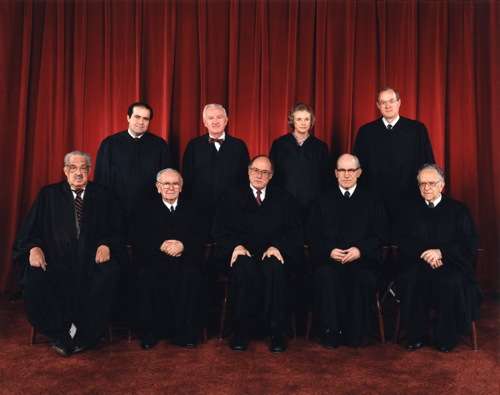
Today in Supreme Court History: September 6, 1983

|

9/6/1983: The City of Richmond solicited bids for installing plumbing fixtures at the city jail. The J.A. Croson Company's bid was denied because it did not meet the "set-aside requirement" for minority contractors. The Supreme Court declared this decision unconstitutional in City of Richmond v. J.A. Croson Co. (1989).

The Rehnquist Court (1989)
More


