

New York Wants To Force Social Media Apps To Display Mental Health Warnings. Critics Are Suing.
A new lawsuit says the state can’t force platforms to display the government's opinion.
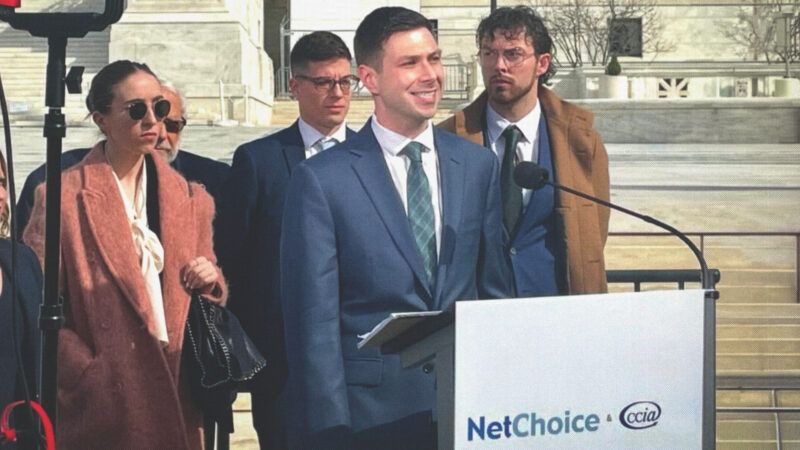
New York is being sued over its law requiring social media apps to display a warning message of the "mental health harms" their features pose.
Starting January 1, New Yorkers will be subjected to a 10-second warning message when they open social media apps that can't be skipped and reads: "The Surgeon General has warned that while social media may have benefits for some young users, excessive use may be associated with significant mental health harms."
The message would appear the first time a user 17 years old or younger opens the app each day and again for 30 seconds after three hours of use. Any social media platform that has an "addictive feed, autoplay, and/or infinite scroll" would have to display it, according to a lawsuit filed by NetChoice—a trade association that represents tech firms—on Friday. Users can only be exempt if the platform has "reasonably determined that the user is over seventeen years of age."
NetChoice argues that the law interferes with people's access to information and compels private actors to spout the state's opinion. "The First Amendment forbids New York from forcing private speakers to serve as government mouthpieces, and that includes compelled state-scripted warnings on speech," said Paul Taske, director of the NetChoice Litigation Center.
While it's not uncommon for products to have warning labels—cigarettes, over-the-counter drugs, and even Lego do—NetChoice argues that requiring one for social media is a different issue. "Unlike a static warning on a product label, these warnings repeatedly interrupt users and block access to protected speech," the complaint states. The group also reasons that the product being hindered here is others' speech, not a physical product and that the warning message doesn't accurately reflect the surgeon general's findings. Instead, they argue, it is more accurate to classify the warnings as the government's opinion—rather than established fact— since research on the harms of social media isn't conclusive.
NetChoice is challenging similar laws in California, Minnesota, and Colorado, the last of which was recently blocked after a federal judge found that it compels protected speech and likely violates the First Amendment.
Under Zauderer v. Office of Disc. Counsel (1985), the government can require businesses to add disclosures to commercial speech (speech that proposes a sale) as long as the information is "purely factual and uncontroversial" and tied to a legitimate government interest. Disclosures on noncommercial speech face strict scrutiny, and in these cases, the government must prove the law uses the least restrictive means possible to serve a compelling public interest. In Colorado, the judge ruled that social media content is noncommercial speech and that although the state had a "laudable goal," it didn't have the justification to compel noncommercial speech.
Several countries worldwide have imposed their own restrictions on social media apps. Australia's under-16 ban went into effect last December, and France passed an under-15 ban in July. Denmark, Spain, the U.K., and others have announced plans to follow.
A sharp rise in mental illness diagnoses among young people over the past couple of decades, which prominent social scientists attribute to social media, has brought on these bans. However, the evidence that social media is causing these problems is far from conclusive. In some cases, social media use has been linked to better health outcomes in teens. In any case, lawmakers have seized on this sentiment to justify restrictive measures. New York's law, for example, cites that from 2011 to 2018, the suicide rates among 10- to 14-year-old girls doubled, and the instances of major depressive episodes among 12- to 17-year-old girls increased by 52 percent. While this is a troubling trend, bans have largely failed to keep teens off social media.
In Australia, for example, reports from the Molly Rose Foundation found that "three fifths (61%) of 12–15 year-olds who previously held accounts on restricted platforms continue to have access to one or more active accounts" and "70% of children still using restricted sites say that it was 'easy' to circumvent the ban." The ban has also caused security issues. Last year, hackers stole at least 70,000 government ID photos from Discord, which users had provided in the age authentication process to use the site.
It seems intuitive that kids' chronically online nature is contributing to an increase in their mental health problems. But issues like depression and anxiety stem from a complex interaction of factors, and social media is just one part of this generation's changed environment. Even if it were possible to weed out social media from kids' lives, there's no guarantee that it would curb the lack of in-person socialization that social scientists believe is fueling today's mental health crisis.
The decline in kids' mental health is worrisome, but the state's finding that social media use "may be associated" with harm doesn't justify infringing on people's right to free speech.



