Washington, D.C.'s Proposed Foie Gras Ban Is Built on a Lie
I spent an evening at the city's final stand for foie gras before voters decide Initiative 86, which would outlaw its sale. I came away wondering whether ducks and geese are the ones who need saving.
Fatty liver disease is what doctors call a "silent killer," like sipping on a yearslong arsenic cocktail. The way you get there, unfortunately, can be fun. Too much to eat, too much to drink. Or too much of both.
There are a few animals that court this ailment. Instead of threatening their survival, it is key to it. Ducks and geese gorge themselves in the wild, biologically programmed to fill up their livers like fuel tanks before migration. This avian overindulgence paved the way for a human indulgence: foie gras, the ancient, velvety dish made from the fattened livers of ducks and geese.
Voters will soon determine whether restaurants in Washington, D.C., can legally continue to sell it. A proposed ban, Initiative 86, is on Tuesday's ballot menu. The fight primarily centers on the notion that extracting those enlarged livers involves a uniquely vicious process. "Ducks and geese are still being force-fed until their livers become diseased, all for an expensive dish served at fancy restaurants," Pro-Animal DC, an advocacy group helping push the initiative in the District, notes on its website. "It's time to end this inhumane practice."
Even many opponents of such bans seem to have accepted this cost-benefit analysis—they just come to a different conclusion. The suffering may be significant, but the payoff is worth it. That may be a legitimate calculus.
Yet the premise beneath it ultimately crumbles in a way that foie gras could never.
"I've been on foie gras farms before in which the ducks see the tube and run towards it because they're excited," Bart Hutchins, chef and part-owner of the D.C. restaurant Butterworth's, told me. "Because this is a natural biological process."
I had come to Butterworth's for what felt like a foie gras final stand, a silky middle finger to the activists who are working to outlaw the very sort of tasting menu I paid to sample that evening. There was salad topped with a flurry of foie gras snow. There was foie gras soup made famous by Jean-Louis Palladin, the French chef who smuggled livers into the U.S. for his Watergate restaurant after arriving in 1979, when it was illegal to import fresh poultry products from Europe. There was dry-aged duck in foie gras jus. And there was, as a closing act, a foie gras twinkie, which sounds like an unfortunate shotgun wedding between Hostess and haute cuisine, yet was somehow the best dish of the evening (a high bar).
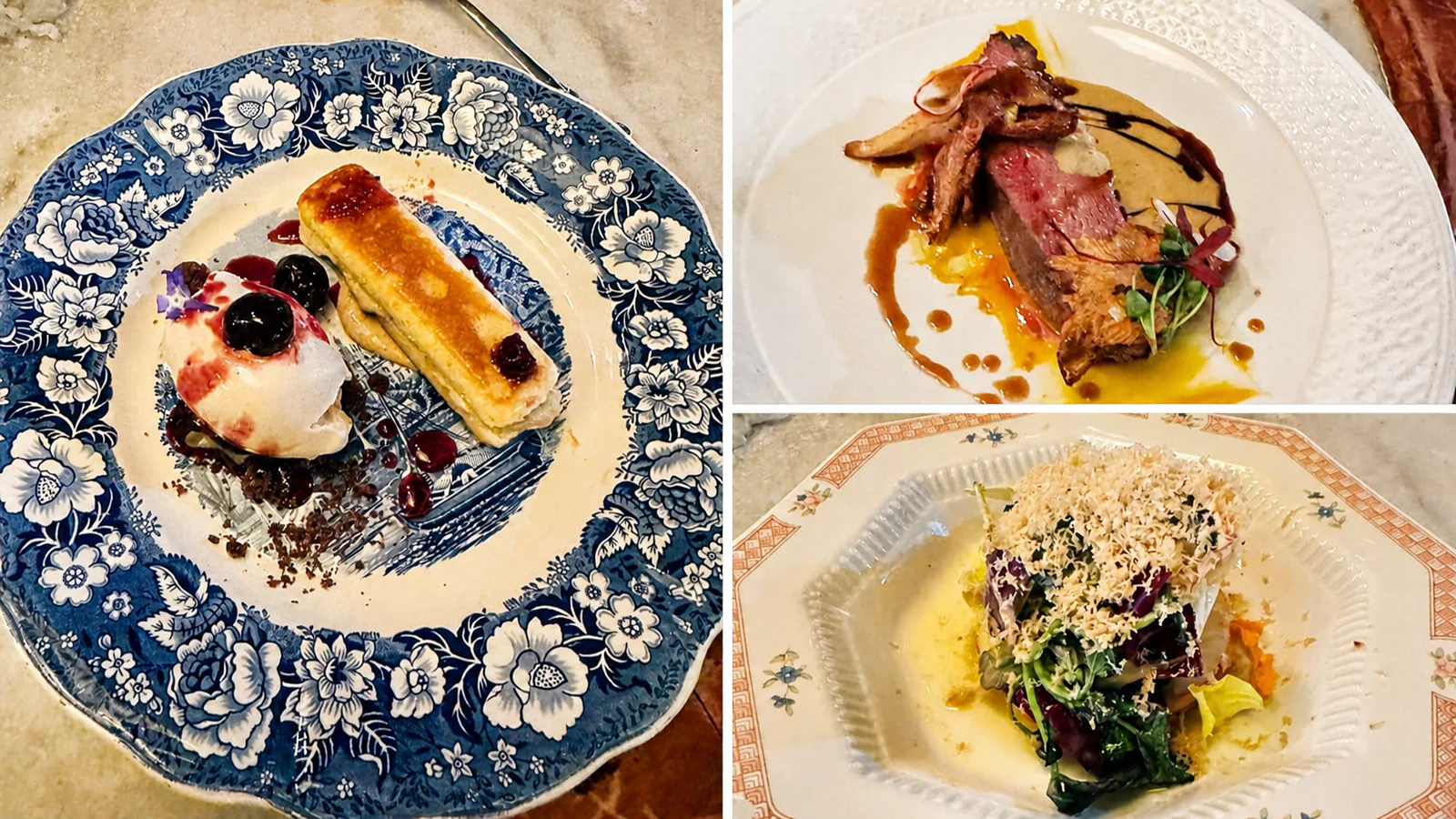
The meal was delicious. It was prepared in the kitchen but cooked up in a lab, practically engineered to draw the ire of the pâté patrol.
How D.C. would pay for this enforcement, if it evolves officially from private activism to a legitimate government job, has not been ironed out. The city's chief financial officer estimated the legislation would cost $314,000 over the next four fiscal years, though that does not factor in potential litigation challenging the measure. Which raises a question: What pot of money should D.C. drain funds from in order to ensure it can police foie gras?
Still, some see this as a worthy investment. "DC residents have shown we're ready for a cruelty-free DC and that compassion isn't separate from the fights over housing, health-care, and statehood," said Oye Owolewa, the shadow representative for D.C. in the U.S. House and the Democratic nominee for at-large councilmember on the D.C. Council, in a statement. (It's worth noting that well over $350,000 of funding for the campaign came in from out of state, so much so that Mayor Muriel Bowser, a Democrat, has intimated she will vote against the measure on principle.)
Foie gras had been disappearing steadily from the District before voters got the chance to consider Initiative 86. At a recent meal at Le Diplomate—the Stephen Starr restaurant that is arguably D.C.'s most iconic French brasserie—I saw it was already gone from the menu. A longtime server told me it simply was not worth it anymore. There had been protests, and they had been "not peaceful." General manager Charlie Smedile did not respond to a request for comment confirming when the restaurant yanked it, but it was relatively recently—I ordered it there in 2025, and an article in The 51st from November of the same year drops a line about Le Diplomate's foie gras parfait.
Hutchins is unaware of this change. When I tell him, he is visibly irritated. There are saints and heretics in the culinary world. Wolfgang Puck, for example, "might as well be one of the popes." But something strange happened when Hutchins read Anthony Bourdain's 2010 book. In it, the author outlines his "heroes" and "villains." Puck, Hutchins says, would be considered "a hero of all of ours," a lock for the canon. Bourdain instead places him among the villains for his 2007 decision to ban foie gras across all of his restaurants, something Hutchins says had natural downstream effects on less powerful chefs with fewer resources to counter activists.
Hutchins sees a theme. "I get death threats and stuff. I get all kinds of shit. I get letters to the restaurant, I get letters to my house, I get people following me to my car," he says. "Stephen Starr, he runs around in Armani suits and really nice cars and has infinite money. And so for him to cower on that is honestly disgusting, and I hope he's embarrassed of himself, and I hope it's kind of hard to sleep at night."
Animal farming is not without suffering. Some specimens are bred to reach a market weight of 6.6 pounds in around 48 days; about 100 years ago, it took 112 days to reach just 2.5 pounds. They are typically held in extreme confinement with lights blaring—how else would they stay awake and eat far more than they otherwise would? As a result, those chickens sometimes suffer broken limbs and develop deformities. Should we ban the sale of chicken parmesan?
This is not to say that animal welfare advocates are thrilled about broken hen legs. But there has been a special fixation on foie gras, the implication being that ducks and geese are assigned especially grisly fates. But you can make the argument that the opposite is true.
How could that be? The birds are, after all, subject to gavage—the force-feeding technique with an ominous French title that sees a tube inserted directly into the esophagus. Essentially everything about it is a marketing catastrophe: the vision it conjures, even the word "force-feed." I initially pictured birds strapped in pens, beaks open, choking for hours. In reality, the process lasts a few seconds with an automatic pump and is performed over the course of about 12 to 15 days when the animals reach a certain age; a duck or goose being primed for foie gras may experience less than a minute of force-feeding in total over its entire life. Prior to that, the animals generally have freedom of movement and access to outdoor grazing.
That they have superior living conditions before the feedathon is one thing. That the feedathon is relatively quick is another. But just how gruesome are those few seconds? "Neural activation indicating the presence of pain signals [was] never detected in the sensory visceral brain centers of force-fed ducks," notes a review of the scientific literature by researchers affiliated with France's National Institute for Agricultural Research.
That is not surprising, they say, when accounting for the anatomy of ducks and geese. The upper esophagus is much larger than its mammalian counterpart and is unusually elastic and expandable. The opening of the trachea, meanwhile, lies farther forward than in humans—a position, they argue, that helps prevent choking during feeding. More strikingly, "degenerative events such as necrosis or cirrhosis never occur" in the liver tissue, the researchers add. "Unlike human fatty liver, foie gras does not exhibit any macroscopic lesions."
Unlike humans. That should be the tagline for this debate. Much of the back-and-forth has rested on the assumption, often unspoken, that an appropriate baseline for evaluating animal welfare is the human experience. However well-intentioned, this misses a few things. It does not consider the physiological differences—humans do not swallow meals whole, as ducks and geese do in nature, because our throats are not built to balloon like defensive blowfish. We do not aspire to temporarily induce fatty liver disease, at least not without expecting a primary care physician to slap us upside the head. And we are not raised for the purpose of being killed. Even a staunch vegan can look to the animal kingdom and recognize a difference between a leopard mauling its prey and a human committing murder.
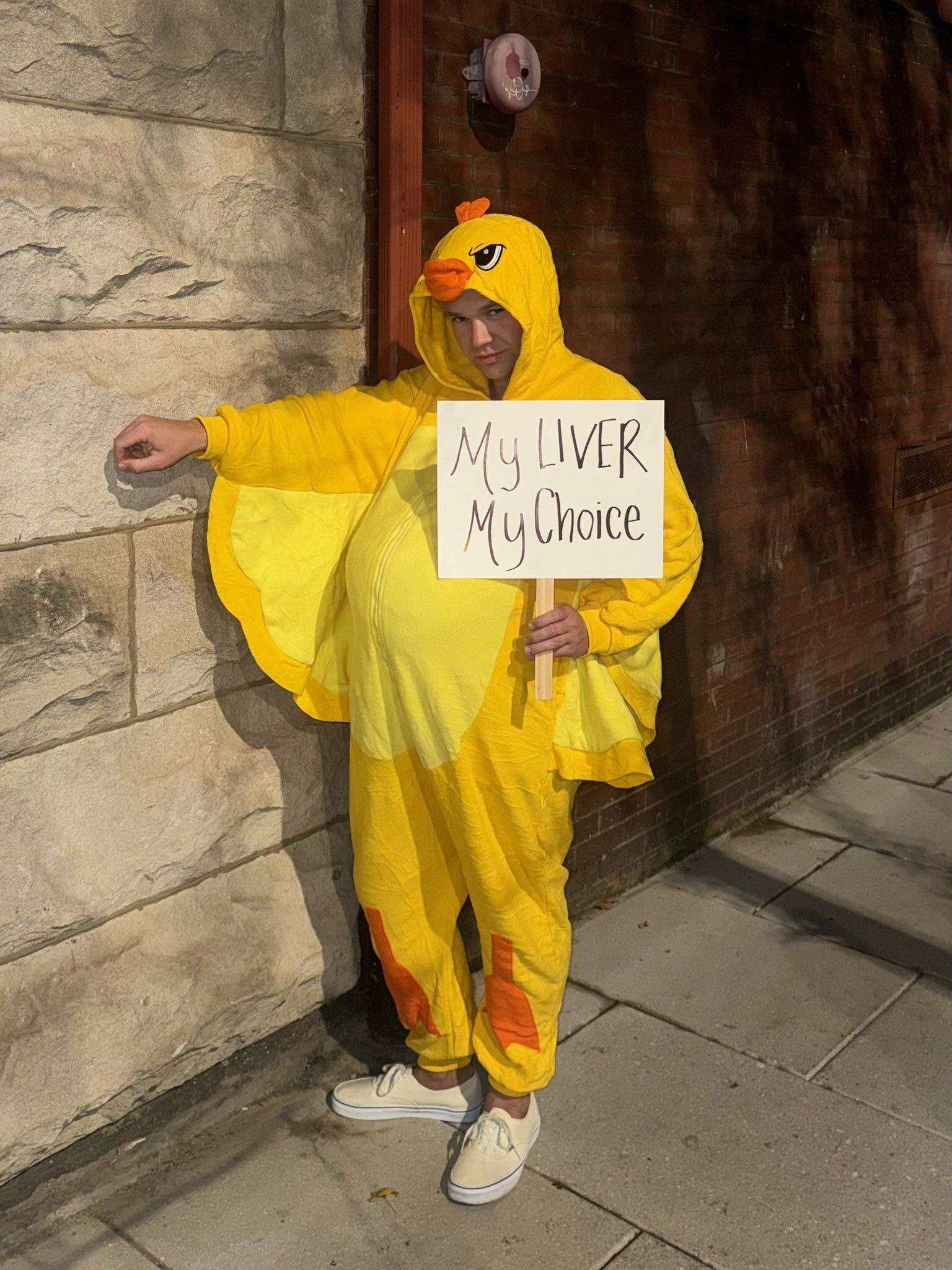
At a recent Halloween party, perhaps the one hosted by this magazine, I donned a duck onesie with a dumpy gut and toted a sign: "My Liver My Choice." A couple of people remarked that this could be construed as a message in favor of the ban. Little did they know that ducks relish a chance to expand their livers. Who am I to deprive them of that?