

For Libertarians, Election Day Is the Cruelest Day of the Year
There is rarely anyone worth voting for who might actually win in most races. That's got to change.
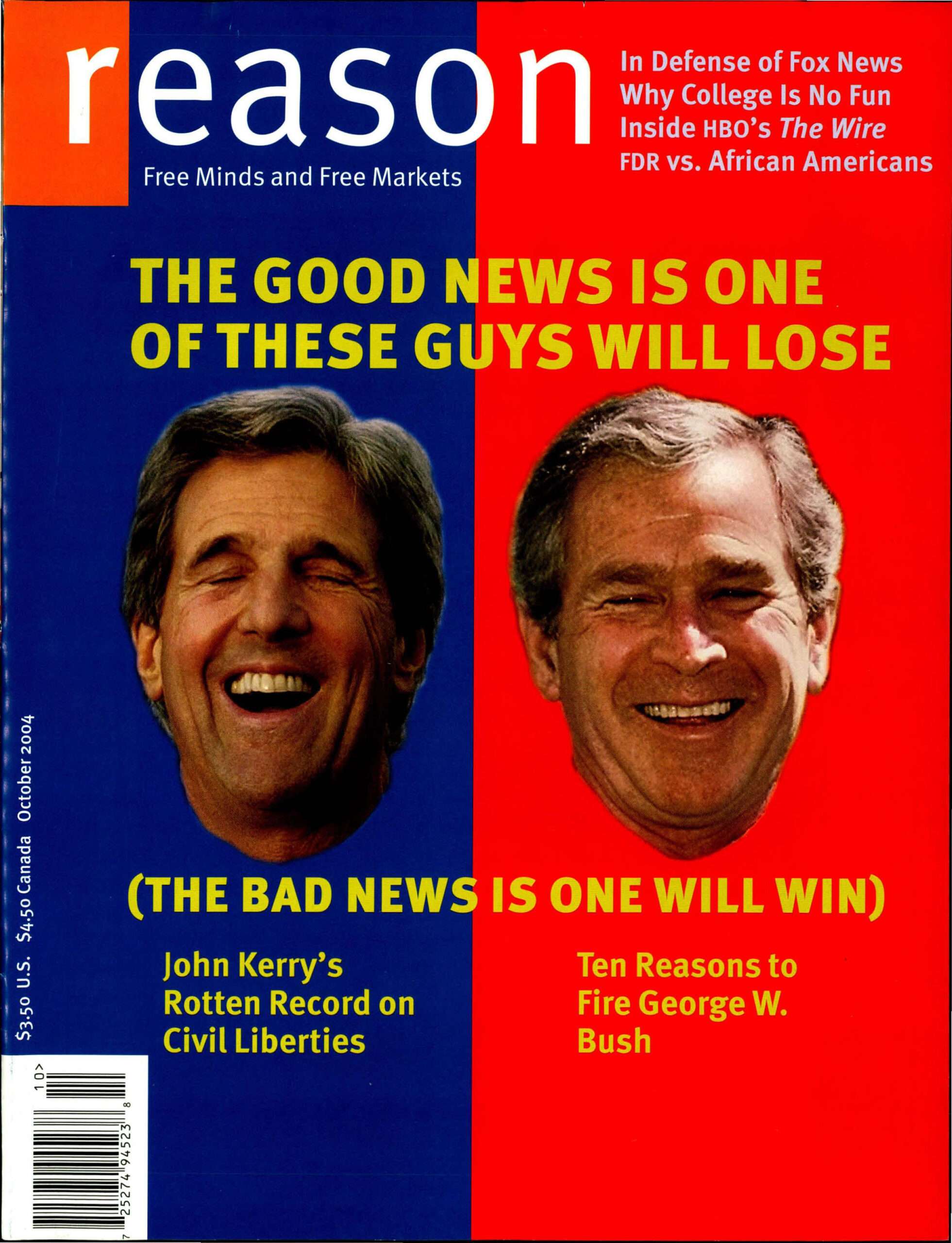
Over 20 years ago, back when I was editor in chief of the print edition of Reason, I commissioned a cover that pretty much summed up my attitude toward elections. This was for the October 2004 issue, which would run a bit before John Kerry squared off against George Bush in the presidential election. It prominently featured head shots of both major-party nominees wearing what might charitably be called shit-eating grins. Above them ran the all-caps headline "THE GOOD NEWS IS ONE OF THESE GUYS WILL LOSE." Below them ran the parenthetical phrase, also in all caps, "THE BAD NEWS IS ONE WILL WIN."
The cases against Bush and Kerry were made in two feature stories (which still hold up; read them here). God, they were both terrible candidates, weren't they? The Bush administration was funding the War on Terror through all sorts of budget fakes, had stupidly invaded Iraq, and was credibly accused of goosing the old color-coded threat assessment system to secure re-election. Kerry not only resembled Frankenstein's monster, he campaigned about as effectively, scaring villagers with his unconvincing flip-flops on issues big and small. He offered at best "an echo, not a choice" at a time when America deserved better.
That cover and stories weren't simply some exercise in above-it-all virtue signaling, a show of libertarian purity over the grubbiness of retail politics. They were and are a reflection of how I feel about elections, which I vote in reliably every two years (and sometimes more). As someone who has never voted for a winning candidate at any level, nothing would please me more than to be able to cast a ballot for a major party politician who might actually have a chance at victory. I'm a principled small "l" libertarian, but that doesn't mean I'm a tough vote to win. All you have to do is be in favor of limiting the size, scope, and spending of government. But it turns out that neither major party ever seems to nominate politicians at any level who come close to following that groove. Which is depressing as hell.
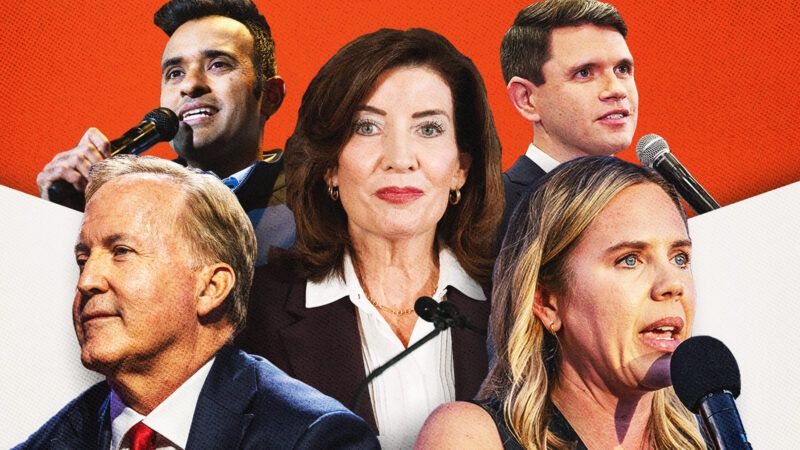
But things can always get worse, right? I live in New York City, which means my major-party choices for governor are the Democratic incumbent Kathy Hochul and Republican challenger Bruce Blakeman. Hochul recently won the honor of being ranked as the absolute worst governor in America by the Cato Institute in its new edition of "Freedom in the 50 States," which "grades governors on how well or poorly they have advanced both economic and personal liberty in their states." Blakeman, the current Nassau county executive, boasts an unimpressive political record and has never been within 10 percentage points of Hochul. I would like to vote for the Libertarian candidate but there isn't one, partly because the legislature in 2020 made it virtually impossible for a minor party to gain access. Per the Libertarian Party's suggestion, I will write in "none of the above" as a protest.
It's not simply the Empire State that consistently creates elections that are either foregone conclusions (as of this writing, the prediction-market Kalshi has Hochul with a 96 percent likelihood of winning) or that pit two crummy candidates against one another. For 20 years, I lived in Ohio, where the governor's race is a dog's breakfast buffet of terrible, rotten choices. Democrat Amy Acton, whose record as Ohio's health director during COVID inspired the nickname "Dr. Lockdown," is likely to win because she is running against Republican Vivek Ramaswamy, a uniquely unlikeable and underqualified candidate. Ramaswamy, who have never held elective office, was already flailing before he released an ad featuring Acton's estranged mother that virtually all commentators agree is a new low in political campaigning. However bad the ad itself is was, Ramaswamy's initial doubling down on it and then further vocal support from President Trump and Vice President Vance have all but killed his chances. At least if I still lived in Ohio, I'd be able to vote for Libertarian candidates.
The same would be true in Texas, another state I lived in. The Republican Senate candidate is current Attorney General Ken Paxton. He was handpicked by Donald Trump, who used his influence to force out the incumbent Jon Cornyn, who would have also certainly sailed easily onto victory. Instead, James Talarico is likely to notch the first statewide win for a Democrat in Texas in over 30 years. If I still lived in Texas, at least I could cast a ballot for Libertarian Ted Brown, who might cover the spread.
Yet that is small beer, isn't it, especially in a country as vast and varied as America? It shouldn't be this hard to find candidates who support "free minds and free markets" and who might actually win their races for local, state, and federal office. Democrats and Republicans started this year at extremely low levels of voter appeal. According to Gallup, 27 percent of us identified as Republican and 27 percent identified as Democratic, with a record high 45 percent identifying as independent.
The midterms, which are looking extremely good for the Democrats, might kickstart a movement among Republicans to shift course toward a more libertarian position, especially since Trump's second administration has made government corruption the single-biggest issue on voters' minds. Combine that with longstanding, negative attitudes toward big government and the libertarian turn makes even more sense.
I've been voting since the early '80s and despite decades of frustration, I'm looking forward to voting for a winner one of these years.



