

Hasan Piker's Defamation Suit Against Scott Jennings Isn't As Simple as It Seems
Proving that Jennings acted with "actual malice" might be difficult.
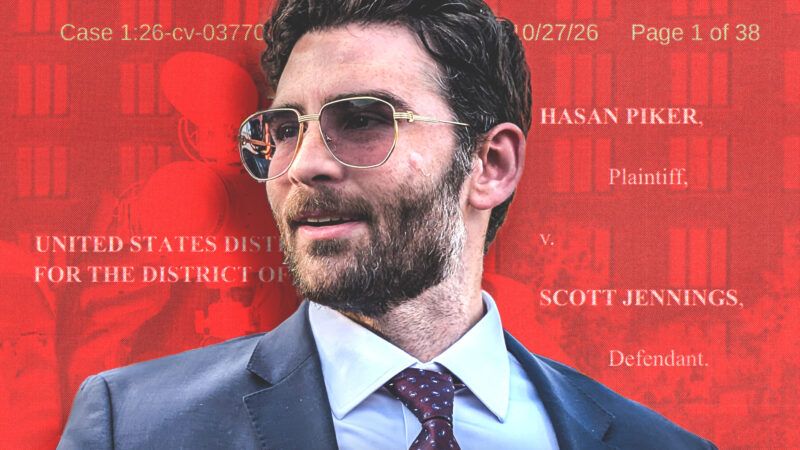
A lesson from this lawsuit filed by lefty streamer Hasan Piker against podcaster and CNN contributor Scott Jennings: Never be sarcastic. Never use hyperbole. It will always come back to bite you.
I happen to like hyperbole and sarcasm, though. So, I'm sympathetic to Piker's plight. Still, I'm not 100 percent certain he will—or should—win this case.
Two years ago, Piker, reacting to a debate in which a black conservative commentator complained about "woke" district attorneys, sarcastically summarized the commentator's argument during a Twitch broadcast:
He said, "We need more Klansmen, okay? Can we go back to a better time when lynchings were happening? This is what I like as a Black man. Also, there's no real racism in America." My man said, "woke DAs," dude. What are you saying?
That doesn't seem like the most charitable way to describe the dude's comments. Perhaps Piker has some problems with overreaction. But in any event, it's clear that Piker himself was not professing a yearning to don a white robe.
But context collapse is the internet's love language. And so we got this.
How does Abdul El-Sayed's campaign surrogate Hasan Piker feel about Black Americans?
Watch for yourself. pic.twitter.com/icGiXek7Ok
— Senate Republicans (@NRSC) August 6, 2026
Weaving together fragments of Piker's above comments and several other out-of-context clips, the National Republican Senatorial Committee (NRSC) made it appear as if Piker was himself advocating in favor of the lynching of black people.
Later, Scott Jennings aired the clip on his podcast/syndicated radio show, saying that Piker was "out there calling for Black voters to be lynched." A caption on the video said "PIKER: 'LET'S GO BACK TO A BETTER TIME WHEN LYNCHINGS WERE HAPPENING,'" per Piker's complaint.
Piker certainly has justification to be outraged and to push back against this false characterization. But…is it defamation?
Legally speaking, maybe not. To prove defamation against a public figure, you have to show not only that a harm-causing false statement was publicized but that it was done with "actual malice."
In this case, showing that Jennings acted with actual malice could prove a hard task. To have acted with actual malice, he would have to have had "knowledge that [his statement] was false" or to have acted with "reckless disregard of whether it was false or not."
Even if Jennings did deliberately lie from the get-go, good luck proving that. The clip was circulating already when Jennings aired it, shared by not just some random account but the NRSC. It features real footage of Piker, not an AI-generated deepfake. And it features real statements that Piker made, albeit taken out of context. There's plenty of room for plausible deniability.
But whether Jennings was "reckless" in running with the story will be a thornier question. Given the video's source and it actually featuring Piker talking, Jennings might have good grounds to argue that in the beginning he was not. But Snopes did a debunking, and Piker's people emailed Jennings explaining the true context. Still, Jennings left it up.
That complicates things. Even if Jennings didn't understand originally that the clip was misleading, the full clips should have helped him wise up. And if Jennings was pointed to them and didn't watch them, that would seem to at least constitute recklessness—though of course we haven't heard Jennings' side of the story yet.
Whatever happens, the case highlights how tricky defamation law is. People will always argue that it should be easier to win defamation cases, at least when the defamed party is on their side. But the upshot of that is that journalists and news outlets—and perhaps everyone who ever got fooled by and shared a misleading video clip—would be screwed.
The same rationale that could possibly protect Jennings in this case also allows journalists to publish important stories about people in power even if the people in power dispute the facts or the interpretation of them. It also helps ensure that making honest mistakes won't mean their financial downfall.
In this case, Piker is seeking $72.5 million in damages. "You have to remember, this is not just about Scott Jennings, although he certainly messed up," Piker told his audience on Twitch Tuesday. "This is about truth in the media, OK? I think for far too long we have allowed Republicans to get away with saying whatever they want."
But while defamation law that errs in favor of free speech can seem unfair when it lets someone falsely portray someone else as pro-lynching, the underlying structure actually shields press, podcasters, Twitch streamers, and anyone else who wants to write and talk publicly about politicians, celebrities, and other public figures. That's not to say Jennings shouldn't have, at bare minimum, been more careful. Or that Piker won't win—who knows? But if he loses, believers in free press and free speech should think twice before using this as a jumping-off point to call for changes to defamation law.



