

Trump's Latest Attempt To Salvage the Midterms: Bribe and Extort the Voters
As the election approaches, it is more clear than ever that the president values loyalty over all else.
The midterm elections are just days away, and while anything can happen, the broad consensus among pollsters suggests a bad night for Republicans.
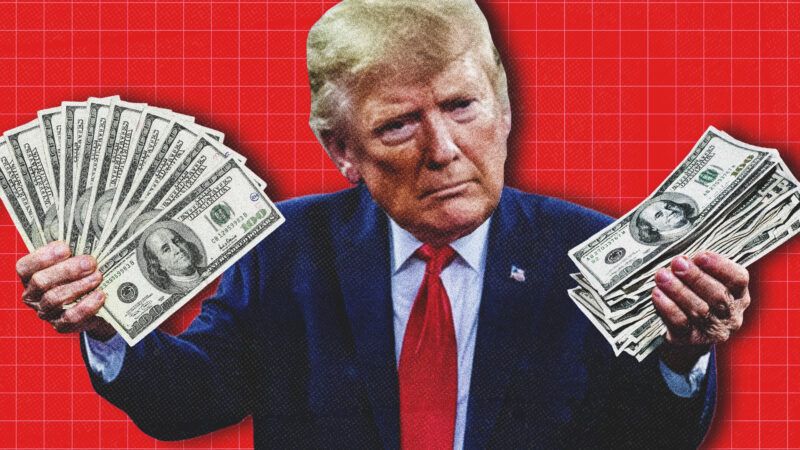
Hoping to shore up a victory for his party, President Donald Trump seized upon an idea: bribe the voters.
"If the Republicans win the House of Representatives and the United States Senate, both of them," Trump pledged in September, "I will issue a dividend to every adult citizen in the United States of America for $5,000."
According to Vice President J.D. Vance, this "dividend"—which would cost more than $1.3 trillion—would come from the "extraordinary amount of revenue" generated by Trump's tariffs. Of course, that math doesn't work: According to the Penn Wharton Budget Model, the U.S. took in just under $300 billion in tariff revenue between January 2025 and July 2026, not counting the amount it has had to refund after the Supreme Court found they were illegally imposed.
At that rate, it would take years of tariffs just to pay for Trump's dividend. Adding insult to injury, of course, is the fact that tariffs are paid by Americans, meaning we would be taxing ourselves to pay for our own disbursement.
But in the campaign season's closing days, Trump has made a number of other threats and offers, contingent on his party's success—a completely risible use of government power.
In September, three Ohio Republicans—Rep. Mike Turner and Sens. Bernie Moreno and Jon Husted—petitioned the president to build a planned Space Force training academy in their state.
"Every other state wants it," Trump said this month at an Ohio campaign rally. "If we win the midterms, Ohio will be very, very strongly considered."
Some of his pledges have been much more explicitly transactional.
On October 17, the Department of Defense—which Trump calls by its original name, the Department of War—announced a conditional $80 billion loan to pharmaceutical manufacturer Antheia. That same day, at a campaign rally in Kentucky, Trump made a pledge to the state's voters.
"If the Republicans win, the Department of War will be investing $100 million in the pharmaceutical company Antheia to revitalize a gigantic drug manufacturing facility in Winchester, Kentucky," he said. But he prefaced it by telling Rep. Andy Barr, the Republican running for the state's open Senate seat, "you have to win, Andy. Otherwise, forget it."
Days later in both Kansas and Iowa, Trump brought up E15, a gasoline blend that contains up to 15 percent ethanol derived from corn. It has advantages and disadvantages as an alternative to traditional gasoline, but it's a boon for corn-growing states.
"Normally, E15 is not allowed during the summer because warmer temperatures increase fuel evaporation and thus the formulation of ground ozone ('smog')," writes Benjamin Zycher of the American Enterprise Institute.
The government can waive that restriction to address disruptions in the fuel supply, which it did in March amid gas price shocks related to Trump's war in Iran. The House passed a bill in May to make the waiver permanent and allow E15 to be sold year-round, which Trump backed in June; the Senate version of the Farm Bill includes a year-round E15 amendment, but Democrats have held up its passage.
"With Roger Marshall in the Senate," Trump told Kansans last week, "we will make year-round E15 permanent. But if [Democratic candidate] Adam Hamilton is in, I'm not doing it."
He then made the same pledge in Iowa, where Rep. Ashley Hinson is the Republican Senate nominee. "With Ashley in the Senate, we will make it year-round E15," Trump said. "We'll make it permanent."
Of course, it's nothing new for politicians to make big promises in exchange for your votes. Typically, they're all hollow to at least some degree.
And Trump's pledges do reflect some version of reality: Keeping the Senate in Republican hands will make it easier for him to do certain things. But some of his others have been downright indefensible, less like typical political bribery than outright extortion.
At a rally in North Carolina last month, he tied hurricane disaster aid from the Federal Emergency Management Agency (FEMA) to Senate candidate Michael Whatley's election.
"We spent more than $2 billion [in] FEMA funding," he told attendees. "You're waiting for some additional money…and I'm gonna get that to you, Michael. Now if Michael loses, I'm not sending it." He added right after, "I'm only kidding, you're gonna get it."
Other times, he didn't take it back: Trump appeared at a campaign rally in Georgia this week, stumping for Rep. Mike Collins to unseat Sen. Jon Ossoff, and part of his sales pitch was that if Ossoff wins, he may just ignore the state.
"President has a lot of power," he said, and there's "a big difference when he likes the people representing a state. Collins could call me anytime he wants." But if Ossoff wins, he added, he won't take the call, and he even narrated a hypothetical conversation to make his point: "'Tell him I'm not in.' 'But he needs money for Georgia.' 'I don't give a damn what he wants!'"
Also this week, Trump railed about the Senate race in Alaska, where Republican Sen. Dan Sullivan faces not only former Rep. Mary Peltola but a retired teacher also named Dan Sullivan. The New York Times reported this week that the Peltola campaign actively recruited the second Sullivan to run explicitly as a spoiler, to siphon votes away from the senator.
"I have delivered for Alaska at Historic Levels," Trump wrote on Truth Social. "The Democrats are trying to steal this important Republican Seat and, if that happens, everything we've done for Alaska will come to an immediate hault [sic]."
It's one thing to say the federal government shouldn't provide aid to states—and since taking office, the administration has cut or paused such disbursements by $177 billion. Last week, the FEMA administrator indicated that going forward, states should expect to shoulder more of their own disaster aid.
But this goes much further, with the president explicitly conditioning aid on whether or not the state's voters have displeased him.
Perhaps, as in North Carolina, Trump was simply joking; the White House did not respond to Reason's request for clarification.
But there's certainly precedent to suggest he was serious.
"Last September, the Department of Energy (DOE) recommended cancellation of 624 grants for clean energy projects that had been approved by the Biden administration," Reason's Jacob Sullum wrote in July. The government then "winnowed it down to 284 grants, all but one of which had been awarded to projects in states that were represented by Democrats in the U.S. Senate and had voted for Kamala Harris in the 2024 presidential election."
In March, Politico reported that Trump had approved 89 percent of disaster aid requests from states with a Republican governor and two Republican senators but only 23 percent of requests from states with Democrats in those offices.
According to the Idle Rambling Substack, the trend continues: Trump has rejected nearly half of aid requests from Democrat-led states in this term while only rejecting 18 percent from Republican-led states.
But perhaps worst of all, he threatened not to pay out damages to people who suffered harm.
Between 1953 and 1987, the water at Camp Lejeune in North Carolina was contaminated by leaks of fuel and dry cleaning chemicals. The government estimates that as many as 1 million people, both service members and their families, were exposed to toxic chemicals. The Department of Veterans Affairs officially recognizes eight diseases stemming from exposure, including multiple cancers and Parkinson's disease.
In 2022, Congress passed the Camp Lejeune Justice Act, which waived any federal government claims of immunity and allowed veterans to sue over exposure to tainted water. As of September 2026, the Department of Justice says it has paid out more than $879 million, out of more than $1.1 billion in settlement offers.
"We're also fighting for our great veterans, and taking care of those veterans who brought claims related to water contamination at Camp Lejeune," Trump told North Carolina rallygoers last week. "And if we win the House and the Senate, I am directing the Department of Justice to settle all remaining legitimate claims as soon as possible." But "if we don't win, there's no money. If we do win, you're getting it."
It should be clear by now that Trump values personal loyalty over all else. To that end, there is nothing he finds more disreputable than failing to do what he says.
In the closing days of this campaign season, he is making that more explicit than ever, tying his party's success in a state to whether the state is entitled to equal treatment under the law.
Trump was right that presidents have "a lot of power." He's also a living example of why they shouldn't.



