

Trump's Claims About Noncitizen Voting Are 'Not Credible,' a Federal Judge Says in a Scathing Decision
U.S. District Judge David O. Carter rejected the Justice Department's demand that California officials segregate ballots from 20,000 voters it describes as "likely noncitizens."
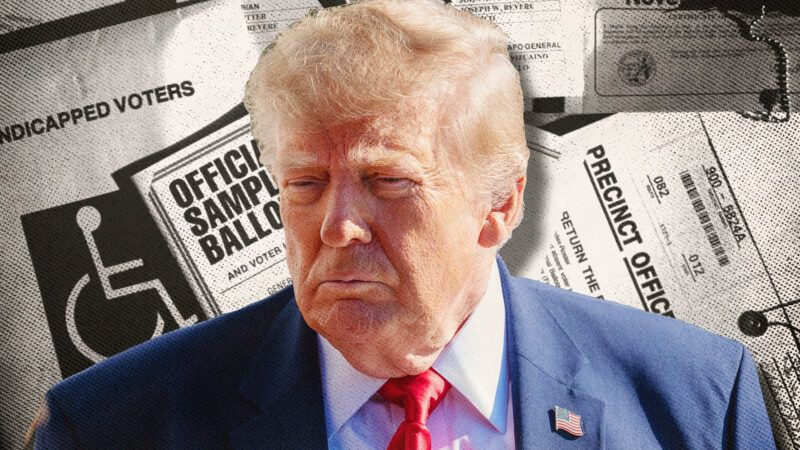
In a July 16 letter to California Secretary of State Shirley Weber, the Department of Homeland Security (DHS) said a "preliminary review" suggested there "may be as many as 190,832 non-citizens registered to vote" in her state. Weber was skeptical—for good reason, it turned out. Three months later, the Trump administration reduced that estimate by nearly 90 percent, saying about 20,000 "likely noncitizens" had received California vote-by-mail ballots.
The Justice Department gave Weber and Dean Logan, Los Angeles County's top election official, 48 hours to determine whether any of the people on the government's list were in fact citizens. Otherwise, it said, Weber and Logan should segregate those ballots and refrain from processing them until citizenship could be verified. After Weber and Logan declined to comply with the Justice Department's demands, it asked a federal judge for a temporary restraining order (TRO) requiring them to do so—a request that he rejected in a scathing opinion on Wednesday.
"Never before in American history has the federal government, on the eve of an election, sought to coerce a state and local government to abandon their own Constitutional elections procedures and bend to the will of the Executive Branch," writes U.S. District Judge David O. Carter, a Bill Clinton appointee. "This request violates longstanding constitutional principles mandating that states have control over their elections. If Plaintiff's last-minute request for relief were granted, either party could create chaos for their own political purposes to disrupt the election process. Over 20,000 registered Californians would potentially lose the right that generations of Americans have fought to preserve."
The Justice Department delivered its list of "likely noncitizens" to Logan three weeks before Election Day. At that point, Los Angeles County already had sent ballots to 5.9 million voters and processed 331,000 of them. Logan said he was "legally prohibited" from doing what the Justice Department wanted because it had failed to explain the methodology used to compile the list, raising the possibility that citizens would be denied their voting rights.
There was ample reason for that concern. On July 17, DHS Secretary Markwayne Mullin averred that "as many as" 15,903 noncitizens were registered to vote in Nevada. The following month, when the DHS submitted a list of allegedly illegal voters to Nevada election officials, the number had fallen to 185—99 percent lower than Mullin's original figure. It turned out that every one of those 185 voters was a U.S. citizen.
"DHS has identified over 250,000 potential non-citizens illegally registered to vote" in California, New Jersey, Nevada, and Pennsylvania, Mullin said in July. He was echoing President Donald Trump, who for years has grossly exaggerated the extent of illegal voting by noncitizens, often in service of his own vanity.
Trump has repeatedly claimed, for example, that he would have won the popular vote in 2016 but for "the millions of people who voted illegally," and in January 2024 he warned that noncitizen voters "could very well affect the next election." In a speech the night before Mullin's announcement, Trump asserted that the DHS had "identified approximately 278,000 non-citizens who are registered to vote in federal elections."
Judging from Nevada's experience, the actual number may be closer to zero. It is hard to say, because the methods used by the DHS remain hazy.
In the California case, Carter says, the DHS "purchased a voter file that appeared to reflect 'the actual voter rolls in California, that as of August 2025, may be used for the 2026 federal election.'" It "then 'enhance[d]' the voter data through a 'reliable third-party data analytics'" and used records maintained by U.S. Citizenship and Immigration Services (USCIS) to find "an internal USCIS immigration number" that "may" correspond to each registered voter. "The matches are scored," Carter notes, "because 'the resulting data may be incomplete, outdated, or mismatched.'"
The DHS "then compared the potential identity matches to Department of State and Social Security Administration data to screen out U.S. citizens," Carter adds. "In the next step, a confidence level was assigned (where a high score supported a 'strong identity link') and a manual review was conducted for each match to 'determine which registered voters'" were "likely to be aliens." Then came "a 'quality review' to identify issues such as 'duplicate entries' and 'incomplete records,'" followed by "an 'enrichment process' that utilized 'additional unique identifiers' to 'improv[e]' the matching process."
The government did not initially specify the source of the "reliable third-party data analytics." But it later revealed that "the third-party platform it relied on was
Lexis Nexis," Carter notes. "It remains unknown how Lexis Nexis performed its analysis, such as how it 'linked names to Social Security numbers not available on the California public voter file.' Plaintiff likewise did not explain what its 'enrichment process' entailed or how it occurred. Plaintiff also provided 'no error rates' or 'validation against a reliable benchmark' that would enable a determination of the accuracy of its findings. Omissions of this critical information prevent an evaluation of Plaintiff's procedure, including how Plaintiff reduced its initial claim of nearly 200,000 alleged noncitizens to 20,000 individuals."
Potential sources of error include conflating people with similar or identical names and outdated records that do not reflect recent naturalization. Because it is unclear how the DHS tried to address such problems, it is not surprising that Weber and Logan did not want to rely on the Trump administration's list, especially given its pattern of dramatically reducing the putative number of illegally registered voters.
"It is well-documented that matching voter registration records with data from other
administrative databases 'presents numerous challenges,'" Carter writes. And given the potential for error, he says, "Plaintiff's allegations are not credible." He adds that the TRO sought by the Justice Department "would likely lead to voter disenfranchisement" and "would create a significant administrative burden for Defendants, leading to chaos and upending the election."
In any event, Carter says, the Trump administration does not have legal standing to seek such an order. The government's main argument was that California officials, by refusing to segregate ballots from people on its list, were interfering with its enforcement of 18 USC 611, which makes it a misdemeanor for "any alien to vote" in a federal election.
"Defendants do not 'interfere' with the United States' ability to enforce Section 611 by
administering an ongoing election in accordance with established State and Federal law, rather than assuming new obligations pursuant to a federal criminal law they are not responsible for enforcing," Carter writes. It is well established that state officials have no obligation to enforce federal law, he notes, and that they cannot be "commandeered" to do so.
Nor does the federal government need such assistance to enforce Section 611. "The very same day the United States filed its TRO [application] in this Court, the Department of Justice brought charges against 28 individuals" in California under that law, Carter notes. It is not clear how many of those defendants, who represent 0.0001 percent of California's 23 million registered voters, actually cast ballots. But "if fraudulent voting occurs," Carter says, "the United States should uphold the law and bring additional Section 611 indictments against those non-citizens it believes actually voted illegally in the current—or a prior—election."
The Constitution gives states the primary responsibility for conducting elections, subject to explicit limits imposed by Congress. But the Justice Department's actions in this case "are indicative of a broad, ongoing pattern of attempted election interference by federal officials," Carter writes. The department "has filed at least thirty-one lawsuits in federal district courts across the country seeking complete voter rolls from the States. Out of the twenty-six decided cases, the DOJ has prevailed in precisely zero."
In addition to "its failed attempt to seek State voter rolls," Carter notes, "the United States has also requested that States act based on the Executive's own lists." But "sister district courts across the country have cast doubt" on the reliability of those lists for the same reasons that Carter cites in this case.
On October 23, the Justice Department "sent letters to every county in California requiring them to set aside the votes of alleged non-citizens," Carter notes. "The letters stated that election officials 'risk significant federal scrutiny' if they failed to comply with the Government's demands. The government reiterated its threat in open court yesterday, stating that State and County election officials who do not comply with their letter risk federal charges under 18 U.S.C. § 2, which criminalizes aiding and abetting the commission of a criminal offense. The court reiterates what it said yesterday: these threats must stop."



