

Justice Department Targets Alaska Senate Election
The Trump administration says the state should not certify the election if the incumbent loses too narrowly.
Alaska's U.S. Senate race features four candidates. Two are named Dan Sullivan: the Republican incumbent, and a political neophyte.
Republicans say the presence of two Dan Sullivans on the ballot is an illegal act of election interference. The federal government is now suing to keep Alaska from certifying the election results, but only if their guy loses.
"One of the biggest election scandals in history has been the Democrats' installation of a fake Dan Sullivan (not the US Senator) to deceive voters in Alaska," White House advisor Stephen Miller wrote on X. President Donald Trump called it "a disgrace."
"Democrats pulled a dirty trick by enlisting a decoy, Daniel J. Sullivan, to run against Republican Alaska Sen. Dan S. Sullivan," The Wall Street Journal editorialized. "Please spare us the lectures about election interference."
Last week, the Department of Justice (DOJ) sued the state of Alaska and its election authorities.
"Should Alaska certify any electoral results tainted by the inclusion on the
ballot of Daniel J. Sullivan," the filing warns, "the State and its officers will fail in its obligation to protect the integrity of its election. The United States accordingly brings this lawsuit to protect the integrity of the 2026 Senate election in Alaska."
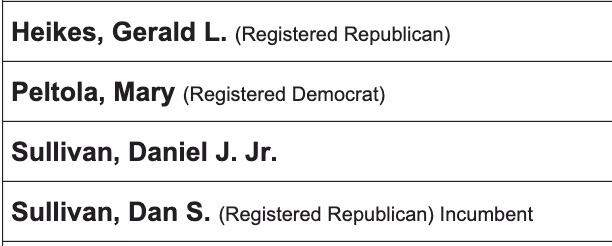
Alaska uses a ranked choice ballot, in which voters are given four candidates and rank each one in order of preference. Along with the Sullivans, the candidates are Mary Peltola, a Democrat who is polling narrowly ahead, and Gerald Heikes.
The Justice Department lawsuit says Republican voters would be too confused by the presence of two Dan Sullivans to properly fill out their ballot: "Some supporters of Senator Sullivan likely will inadvertently vote for Daniel J. Sullivan. Other supporters of Senator Sullivan likely will be confused as to how to rank the three Republican candidates as to defeat Peltola."
Given this, "there is a substantial likelihood that a certification of the election will reflect an electoral process that lacked integrity," the lawsuit proclaims. "To guard against this danger, it is vital that [Alaska] not certify any election result" in which "(1) Senator Sullivan does not win the election; and (2) had all votes cast for Daniel J. Sullivan been cast instead for Senator Sullivan and Alaska's rank-choice process played out accordingly, Senator Sullivan would have won the election."
In other words, the state of Alaska should only certify the election if Sullivan wins; if Peltola wins, but it's close, then that could suggest it "lacked integrity," and the state must instead conduct "an investigation to determine whether votes cast for Daniel J. Sullivan were meant to be cast for Senator Sullivan."
The lawsuit has a number of problems. First and foremost, it's completely inappropriate to treat an election as fair only if your candidate wins, even if it is what Trump believes.
It's also too late to bring an action of this kind: The state elections division decided in June to bar Daniel J. Sullivan from the ballot, but a state superior court reversed and the Alaska Supreme Court upheld the reversal before the end of that month.
And yet the feds waited until less than two weeks before Election Day—when ballots have been printed and tens of thousands of Alaskans have already voted—to bring this suit.
If the Justice Department was truly concerned about voter confusion, it should have brought a lawsuit months ago. But even then, it's not clear what it could have done: "DOJ has no power to decide which candidates can appear on the ballot," writes UCLA School of Law professor Richard L. Hasen.
Besides, it's not illegal to mislead or even outright lie to voters. "If 'voter confusion' were a legitimate reason to overturn election results, that would imperil a great many election winners, as voter ignorance—and exploitation thereof by candidates—is a widespread and longstanding problem," writes George Mason University law professor Ilya Somin.
It does seem more likely than not that Daniel J. Sullivan is indeed running just to pull votes from the senator with the same name.
But as I pointed out earlier this month, the ranked-choice ballot itself can take care of this problem: Republican voters who wish to reelect Sullivan can simply rank both Dan Sullivans first and second; if and when Daniel J. Sullivan fails to capture more than 50 percent of all votes, he will be eliminated, and his votes will transfer to all their second choices.
The ballot itself makes it clear which Sullivan is which: The sitting senator is labeled as both Registered Republican and incumbent.
Despite Miller's claim that letting two Dan Sullivans on the ballot "reveals pure contempt for voters," it's the objecting Republicans who appear to lack faith in their voters.
"People are totally confused," Trump told reporters. "A lot of people don't know what 'incumbent' means."
When CNN's Dana Bash asked Attorney General Todd Blanche what crime is being alleged, he replied that "it depends." He elaborated: "There could be a crime, but the real wrong here is that Alaskans are going to be confused and will not have their vote heard."
This isn't even Alaska's most complicated election in recent memory. In 2010, after Sen. Lisa Murkowski lost the Republican primary to Joe Miller, she announced that she would still run as a write-in candidate—requiring voters to not just know about her ahead of time but to add her name by hand.
Improbably, Murkowski prevailed, defeating Miller by more than 10,000 votes.
If Trump, Blanche, Miller, and others are truly concerned that the ballot will be too confusing for Alaska Republicans, they could expend some energy showing them how to use the ranked choice ballot.
In fact, Sullivan has done just that, posting a video on X explaining how to rank all candidates except Peltola.
What they can't do is force a state to reject the results if their guy loses.
"Alaskans don't need any help voting for their preferred candidates, and the State of Alaska has already handled this by clearly distinguishing the candidates on this year's ballot," Murkowski wrote on X. "The Department of Justice should never have filed this lawsuit."
"I believe that this lawsuit is abusive in its intentions and borders on frivolous in its arguments, and that it is destined for defeat in the courts should it reach the merits," Cato Institute senior fellow Walter Olson noted in a statement. "This lawsuit is an assault on the constitutional design by which states, not the federal government, run elections. The issue in question is one for the Alaska Supreme Court to decide under Alaska law, and the Alaska court did just that."



