

These Minnesota Parents Were Censored at a Public Meeting for Saying School Employees' Job Titles
"You can't talk about the superintendent," a Foley Public School Board official told Blake and Katy DeMarais when they tried to advocate for their disabled and nonverbal son.
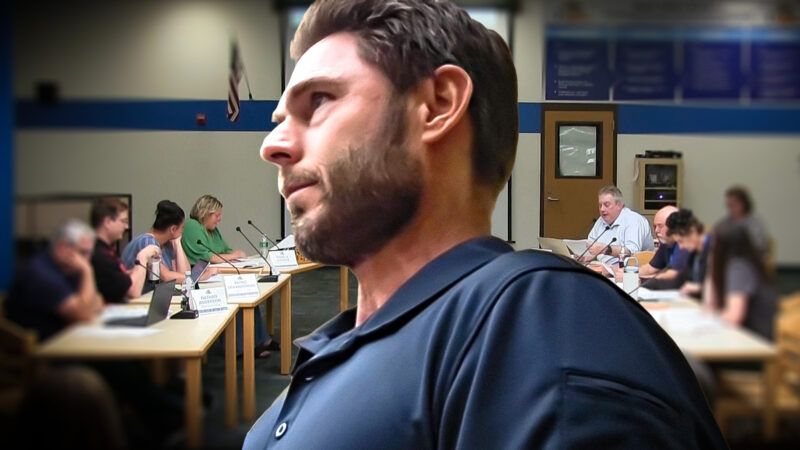
A local school board in Minnesota has taken censorship to absurd heights.
During the public comment period at Foley Public School Board meetings, concerned citizens are forbidden from saying not only the names of school staff and officials but even their titles. These revelations come from Blake and Katy DeMarais, concerned parents of a disabled and nonverbal special education student in the district. Over the summer, the parents complained that the district was failing to provide educational services to their son, only to be censored in a public meeting.
During the board's June 22 meeting, Katy DeMarais opened her comment by stating she would like to speak about her family's "experience with the special education director and district leadership." According to a video posted by the DeMaraises, a board member's voice then interrupts, telling Katy DeMarais that "I'll have to stop you…because we're not allowed to speak about people in the public meeting." When Katy DeMarais proceeded to finish her public comment, she would verbally say "blank" when referencing the special education director.
Later in the same meeting, Blake DeMarais gave his own public comment, which was also recorded. In the video, Blake DeMarais begins reading an email sent to them by the district's superintendent, but when he says nothing more than "superintendent," he gets shut down too. "Blake," the voice intones, "you're done. You can't talk about the superintendent. We already addressed this."
Nearly two months later, it happened again at an August 17 meeting. Visibly upset, Blake DeMarais reads an email from the district's lawyer. Quoting the email, he mentions "Superintendent Posthumus" and is immediately silenced. "Blake, I need you to stop at this point," a voice interrupts. "When you start talking about staff members, that's when we have to stop."
"Do you know what viewpoint discrimination is?" Blake DeMarais asks. "That's what you're doing to me right now."
He's right, of course, but the absurdity only gets worse: The board is also violating its own policy and state law. According to the policy adopted by the board in August 2024, personnel data that is public information includes both the name of the employee and their job title. It also includes a slew of other information, such as "actual gross salary" and "the existence and status of any complaints or charges against the employee, regardless of whether the complaint or charge resulted in a disciplinary action." The district's own policy tracks Minnesota law, which also states that a government employee's name and job title are public data.
Regardless of what district policy or Minnesota law says, the Foley school board trampled on the DeMaraises' First Amendment rights. When a school board opens a meeting to public comment, it can't censor its constituents for criticizing school staff, much less simply naming them or mentioning their titles. A government body can constitutionally restrict some speech during a public comment period, such as limiting comment to a maximum allotted time or ensuring it's on topic, but all those restrictions must be reasonable and viewpoint neutral. In its treatment of the DeMaraises, the Foley Public School Board has hit the trifecta, violating its own policy, state law, and the First Amendment.
There's a good reason that school staff names and titles are public. The community has the right to know how their tax dollars are being spent and whether the public servants they pay are doing their jobs effectively, ethically, and constitutionally. How can parents in Foley public schools know if the adults in charge of their kids' education are doing their jobs if nobody can criticize them by name or even mention their titles?
The DeMaraises won't be silenced. During the last school board meeting in September, Katy DeMarais stepped up to the microphone once again to advocate for her son and reminded the board members of their duty to the families they serve.
"Parents have a right to speak about their experiences—the good, the bad, and everything in between," she said. "Advocacy is not harassment."




