Sam Altman Says 'Some Bad Things' Will Happen With AI. That Doesn't Mean We Should Stop It.
Progress has always required accepting risk.
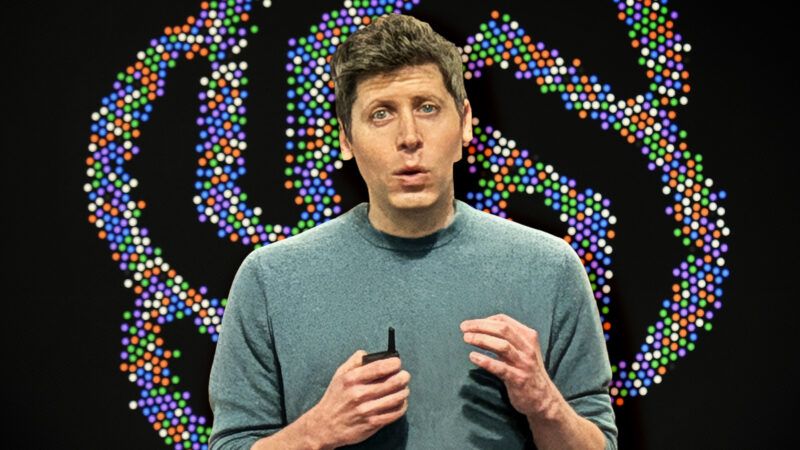
OpenAI CEO Sam Altman has drawn scrutiny from across the political spectrum for his take on the future of AI.
On a recent podcast, Altman attempted to distance himself from more pro-regulation AI companies, such as Anthropic, arguing that society must think about the tradeoffs associated with slowing down AI advancement. "I think one of the biggest differences between us and some of the stricter, let's say, AI safety people, is we believe that the world should accept some bad things happening for the benefits of this technology," he said.
This comment in particular drew criticism from the likes of Florida Republican Gov. Ron DeSantis, who said, "And a handful of tech oligarchs get to make that decision for the rest of us? No dice." New York University professor and AI skeptic Gary Marcus joined in, saying that Altman was "saying the quiet part out loud: suck it up, so you can make us rich and powerful," and former diplomat Patrick Gaspard called it "freaking insane." Some commentators resorted to describing Altman's comments as "sociopathic bullshit."
The argument Altman is making is one of tradeoffs. He rightfully points out that no technology is 100 percent safe, that "some bad things are going to happen," and that we ought to still have a "lighter-touch" regulatory approach. There's no way to guarantee a risk-free environment, that there will not be major hacks, scams, or negative consequences of AI, Altman says. Notably, the OpenAI CEO said that giving "a single lab in San Francisco" unchecked power is "a completely unacceptable trade-off from a perspective of liberty and human agency and people self-determining the future."
The basic principle of Altman's argument is relatively ordinary: Society tolerates risk from virtually every transformative technology because zero-risk societies don't innovate. Cars, for example, killed over 36,000 people last year in the U.S., and yet there is a consensus that the benefits of cars far outweigh the risks—which are declining thanks to innovations like autonomous vehicles, which are far safer than human drivers and may eliminate car deaths (if the government allows them to operate).
The internet itself has enabled fraud, bullying, child exploitation, and countless other horrible crimes. Medicines have side effects, and even electricity itself electrocutes hundreds of people every year.
The relevant question is not to ask whether something bad can happen, but whether the expected benefits outweigh the expected harms, and whether companies can mitigate those harms without destroying the benefits.
So far, AI has already proven to have an enormous number of benefits. In medicine, AI has helped discover a new antibiotic, accelerate the drug discovery process, identify potential Alzheimer's disease causes, make strides in breast cancer treatments, and a whole host of other lifesaving advancements.
AI has improved forecasts for hurricanes, floods, and earthquakes, giving communities more time to prepare for disasters. Of course, none of this means that harms should be ignored. The point is that every technology involves tradeoffs, and the task is to reduce risks without regulating away the benefits.
President Donald Trump has, at least so far, largely rejected the notion that government regulation is necessary in the case of AI. The administration's approach is reportedly going to focus on liability, meaning that companies can self-regulate but are directly liable for any harms they pose.
As this discourse around AI continues, Altman's broader point is certainly worth remembering. Progress requires tradeoffs. In trying to eliminate every possible risk, we should be careful not to eliminate the benefits too.