

The Case for Good Faith
Why bona fides matters
I've never been sure how to pronounce it. Bo-nah feed-ays? Bah-nah fieds? The term bona fides trips me up every time. But it's an important concept, so I try my best. You might even say I make…a good faith effort.
To argue in good faith—the literal translation of the Latin—means assuming that the person on the other side is saying what he actually believes and that disagreement is not itself evidence of corruption, cowardice, or deceit. And vice versa.
The assumption and practice of good faith makes intellectual debate possible. And yet it feels increasingly rare.
Tell someone you favor free trade and you will quickly learn you are really serving the interests of multinational corporations. Defend immigration and you are importing voters. Oppose a war and you are carrying water for the enemy.
Politics, in particular, seems to bring out this line of reasoning. Money is a popular explanation for everything. A politician takes a position because donors paid him to. A writer believes something because subscribers reward her for believing it. A think tanker arrives at precisely the conclusion her funders desired.
Certainly this happens. But more often this gets the direction of causation wrong. Money tends to follow views rather than producing them. People give money to politicians because they agree with them. Readers subscribe to writers whose ideas they find compelling. Foundations fund organizations whose pre-existing missions they support. An existing conviction can become financially rewarding without having been purchased in the first place. (Ask me how I know, as the editor of a libertarian magazine!)
This should not be a difficult distinction to make. Yet we increasingly treat incentives as dispositive evidence of insincerity. If someone benefits from saying something, he cannot possibly believe it.
***
The original English uses of bona fides belonged primarily to law and commerce, where good faith meant honest dealing: acting without fraud or deception, keeping faith with the terms and purposes of an agreement. That idea remains embedded in American commercial law. The Uniform Commercial Code imposes an obligation of good faith in the performance and enforcement of contracts and defines it in terms of honesty and reasonable standards of fair dealing.
Contracts matter precisely because strangers do not need to love one another, share a religion, vote the same way, or agree about much of anything in order to cooperate. But even a world thick with lawyers requires some residual assumption of honesty. You cannot specify in advance every conceivable form of trickery. At some point, one party has to believe the other is at least trying to uphold his end of the bargain.
***
Over time, bona fides acquired another familiar English meaning. Someone's bona fides became evidence that he was genuine—the proof of who he was, what he had done, and why he deserved to be taken seriously. Eventually the phrase came to refer to the credentials or qualifications themselves. We talk about a politician's conservative bona fides, a scholar's academic bona fides, a candidate's foreign policy bona fides.
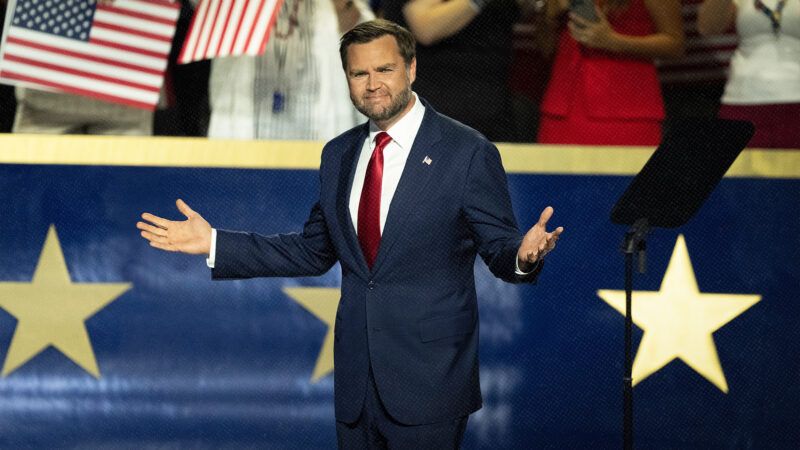
J.D. Vance has unusually formidable bona fides for the argument he once made about America's working class. Vance grew up in Rust Belt Middletown, Ohio. He knew the people he was describing in Hillbilly Elegy. He watched his own family make good decisions and disastrous ones. And he formed a worldview: The problems of the white working class could not simply be blamed on corporations, government, globalization, or distant elites.
"These problems were not created by governments or corporations or anyone else," he concluded. The lesson his grandmother drilled into him was even less equivocal: Never become one of the people who believes the deck is stacked against him.
Then he changed his mind.
People do that! Any intellectual culture worth having has to make space for conversion without treating it as prima-facie evidence of fraud. To demand perfect ideological consistency over a lifetime would itself be a form of bad faith.
I want to begin with that charitable explanation for Vance's about-face too.
But Stephanie Slade's cover story this month—an excerpt from her newly published book, Fusionism—makes that difficult.
The Vance who entered electoral politics began telling essentially the opposite story from the one that had made him famous. Middletown had been "devastated by the policies of the Democrats." Washington had decided America should stop making things and shipped the jobs to Mexico and China. Working-class Americans were no longer primarily people who needed to recover a sense of agency; they were victims of powerful outsiders who had done this to them.
That transformation happened at an awfully convenient moment. During his 2021 Senate campaign, while trying to overcome his previous denunciations of Donald Trump and win Trump's endorsement, Vance proposed using federal power to seize the assets of the Ford Foundation and redistribute them to people whose lives, he said, had been destroyed by its "radical open-borders agenda." Slade documents how this aggressive turn helped Vance establish new political bona fides with Trump's movement.
Again: People change their minds. Political ambition does not prove that a conversion is fake. An incentive is not evidence enough.
But there comes a point when good faith requires something from the other party too. During the 2024 campaign, confronted over false claims that Haitian immigrants were stealing and eating pets in Springfield, Ohio, Vance explained his method with remarkable candor: "If I have to create stories so that the American media actually pays attention to the suffering of the American people," he said, "then that's what I'm going to do."
Bona fides must be both freely assumed and rigorously earned.
Reason has no interest in policing ideological apostasy. We are, if anything, unusually sympathetic to people who rethink the orthodoxies of their tribes. And we will continue to offer the assumption of good faith while doing our best to prove our bona fides—however it's pronounced—to our readers.
This article originally appeared in print under the headline "The Effort of Good Faith."




