

Labor Unions Won Big on Election Day, With Ballot Initiatives and Friendly Politicians
From the East Coast to the Midwest to the West, unions are celebrating.
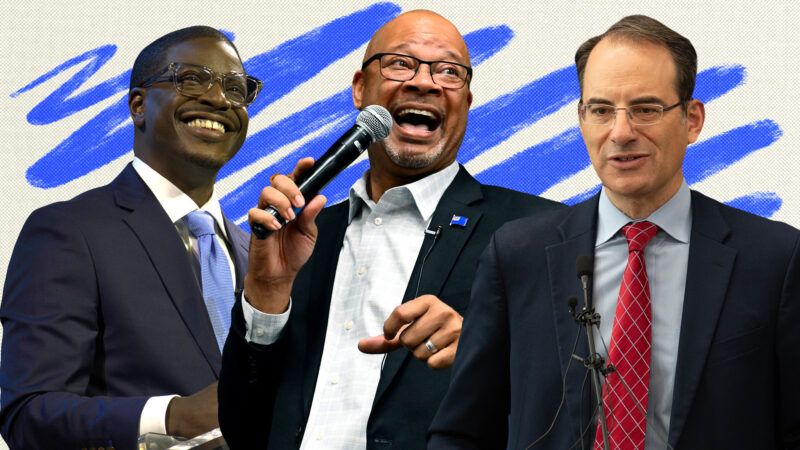
Lost amid the headlines and endless midterm election punditry is the reality that Tuesday was a big night for labor unions across the board. With both major parties increasingly seeking to embrace organized labor, the 2026 elections foreshadow a potential watershed moment in our modern labor politics.
The pro-union momentum started on the East Coast with two proposed state constitutional amendments on the ballot in Vermont and Maryland. In Vermont, voters approved—by a nearly 3-to-1 margin—Proposal 3, which creates a state constitutional right to collectively bargain, while simultaneously prohibiting any future laws that might get in the way of this right. The constitutional amendment also bars the state Legislature from enacting a right-to-work law going forward.
In Maryland, voters passed—again, by almost a 3-to-1 margin—their own constitutional amendment that requires the governor's proposed budget to fully fund any collective bargaining agreements for state employees (it's unclear if the state legislature would then be required to follow suit and fund those agreements in full). If government employees and the state are unable to reach an agreement during the collective bargaining process, the amendment empowers an arbitrator to dictate terms to each side through a process that's known as binding interest arbitration.
Under current Maryland law, the governor is required to deliver a balanced budget proposal to the state Legislature. The new amendment could now create scenarios where collective bargaining agreements or binding interest arbitration locks in high wages and fringe benefits—all while tying the governor's and legislature's hands when it comes to making important fiscal decisions in the state budget. This could theoretically lead to the governor and Legislature having to impose drastic cuts in other important government services to make ends meet.
In the Midwest, Wisconsin voters ushered a Democratic trifecta into office, giving the party complete control of the legislative and executive branches. Democratic Gov.-elect David Crowley explicitly campaigned on overturning former Gov. Scott Walker's famous 2011 collective bargaining reforms. Although Democrats have not controlled the state Legislature in Madison since 2010, they now do, which should give Crowley the needed votes to follow through. (Even if Walker's reforms are not legislatively repealed, they may soon be invalidated by the state's left-leaning Supreme Court).
Out West, Colorado elected Democrat Phil Weiser as its new governor, which could presage the state's own sea change in labor law. Colorado has long operated under a hybrid right-to-work law called the Labor Peace Act. Traditional right-to-work laws prohibit so-called union security clauses in collective bargaining agreements, which require employees to pay union dues as a condition of employment.
Under Colorado's system, a union can be certified with a bare majority of support from workers, but the inclusion of union security clauses in a bargaining agreement requires supermajority support among workers. Colorado's Democratic Legislature has twice sent bills to the governor to repeal the Labor Peace Act's second-vote requirement, only to be vetoed each time by moderate Democrat Gov. Jared Polis. Unlike Polis, Weiser supports the second-vote repeal, so state lawmakers can simply wait out the end of Polis' term.
Finally, Nevada saw its own Democratic trifecta elected to office. Democratic Gov.-elect Aaron Ford has gone on record with his desire to repeal the state's right-to-work law. With unanimous Democratic control of the state government, it appears that Nevada's right-to-work law is likewise on borrowed time.
Perhaps most ominous are the developments at the federal level. Prior to the election, a bill called the Faster Labor Contracts Act (FLCA) started to pick up steam in Congress. The legislation is sponsored by pro-union Sen. Josh Hawley (R–Mo.) and has a handful of Republican supporters on Capitol Hill. The FLCA cleared the House of Representatives but so far has stalled out in the Senate due to lack of votes.
But now, depending on how the remaining uncalled Senate races shake out, the FLCA may be within a stone's throw of President Donald Trump's desk. If Democrats secure 56 seats in the Senate, that puts theoretical support for the FLCA at 58 votes once Republican support is factored in (in addition to Hawley, Sen. Bernie Moreno (R–Ohio) is also a co-sponsor of the FLCA).
This means that only two more GOP votes would be needed to clear the Senate's 60-vote cloture threshold and send the bill to the White House. Given the GOP's ongoing courtship of organized labor—both in Congress and in the White House—the FLCA now has a plausible road to passage.
The FLCA would establish a binding interest arbitration system like that enacted by voters in Maryland, only this version would apply to the private sector workforce—an unprecedented first in American labor law. America's legal tradition has long conceptualized labor contracts as voluntary agreements entered into by employers and employees. If the FLCA passes, a government-backed arbitration panel could force binding terms on parties—a longtime desire of labor unions.
It may seem easy to chalk off organized labor's big night on Tuesday as a natural byproduct of a Democratic wave. But as the FLCA shows, the political math is no longer that simple. In fact, the FLCA could be one of the most consequential bipartisan laws to come out of Washington post-2026.
That, combined with all the state-level developments, shows how big Tuesday night could be in the history of modern labor politics.
Josh Hawley's Pro-Union Bill Would Let Washington Write Your Contract



