

A Trump Appointee Blocks the President's Banishment of Disfavored News Outlets
U.S. District Judge Timothy J. Kelly is skeptical of the belated "national security" rationale for banning CNN, MS NOW, and Politico from the White House.
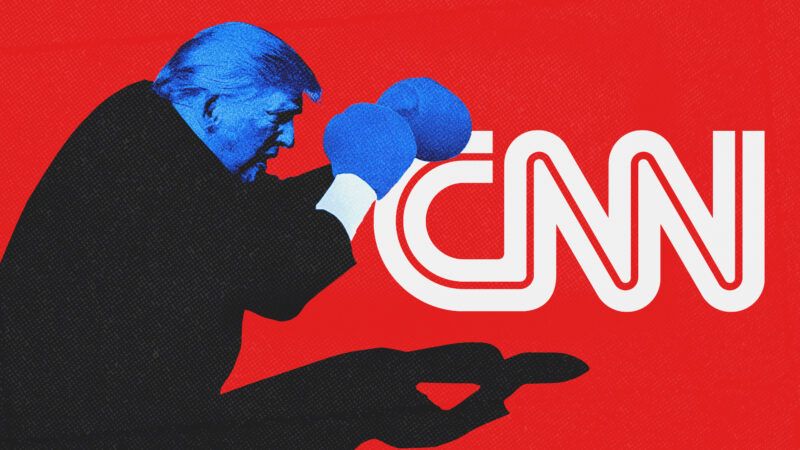
This morning, a federal judge in the District of Columbia temporarily blocked President Donald Trump's attempt to ban CNN, MS NOW, and Politico from the White House, ordering restoration of the "hard passes" held by employees of those news outlets. U.S. District Judge Timothy J. Kelly, a Trump appointee, said the sudden banishment of CNN et al., which the president announced last Friday, seemed inconsistent with the due process required by D.C. Circuit precedents, and he expressed appropriate skepticism about the post-hoc national security rationale for that precipitous decision.
In addition to their due process claims, CNN et al. argued that their exclusion unconstitutionally discriminated against them based on viewpoint and retaliated against them for protected speech. Today's decision does not address those First Amendment issues, but it does not bode well for Trump's attempt to punish disfavored journalists.
In the 1977 case Sherill v. Knight, Kelly notes in his temporary restraining order, the U.S. Court of Appeals for the D.C. Circuit ruled that "the interest of a bona fide Washington correspondent in obtaining a White House press pass…undoubtedly qualifies as liberty which may not be denied without due process of law under the fifth amendment." And six years ago in Karem v. Trump, the D.C. Circuit reiterated that "a duly issued hard pass may not be suspended without due process."
According to the Trump administration, "Sherrill and Karem were wrongly decided," Kelly writes. "Maybe—but this Court is bound by D.C. Circuit precedent, full stop."
Contrary to those precedents, Kelly notes, the White House did not give CNN et al. advance notice before rescinding their reporters' hard passes, let alone "an opportunity to be heard." And as in Karem, he says, "the record is bereft of any relevant 'formally articulated standards' in place before any of the conduct for which Defendants revoked their hard passes."
In letters that the government submitted after CNN et al. sued the Trump administration, the White House Press Office averred that "your organization has exhibited behavior in violation of the standards of professionalism and decorum expected of those given access to the White House Complex." That explanation, Kelly says, "is so vague it hardly does the trick."
Those letters, which were not written until four days after Trump announced the bans, listed stories that supposedly "threatened national security and/or spread falsehoods." But Kelly, who describes the stories as "routine" journalism, notes that the White House renewed CNN reporter Betsy Klein's hard pass "several months after she published some of the identified reporting, undercutting any argument that she or her employer" had "the requisite notice that the conduct at issue violated a relevant standard." And "in most cases," he adds, "the reporters who authored the stories Defendants identify in their letters did not even hold hard passes."
In any event, the defendants "offer little to back up their asserted national security interest to justify revocation of Plaintiffs' hard passes," Kelly writes. "The Court is skeptical—at least on this record—that Defendants' interest in safeguarding national security is the actual motivation for, or is even advanced by, the revocation of Plaintiffs' hard passes."
Kelly elaborates on that point: "Nothing in the record that predates this suit suggests that the revocation of Plaintiffs' hard passes was motivated by national security concerns. Certainly, that is not what President Trump said when he announced that he was 'banning' Plaintiffs from the White House—instead, he focused on the alleged lack of truthfulness and negativity of Plaintiffs' reporting."
Trump said he was banning CNN, MS NOW, and Politico "as a result of their constant 'reporting' [of] FAKE NEWS!" He added that journalists "shouldn't be able to constantly write or report FICTION and LIES when they're covering the President of the United States, the Trump Administration, or the United States of America."
Trump subsequently told reporters he was punishing CNN et al. because he viewed their coverage as "purposely negative," "one-sided," and "never good." They "want to try and diminish the Republicans and a Republican administration," he complained.
Trump did not mention national security as a justification for banning CNN et al. until three days after he did it. "The White House is not instituting an assault on the Free Press, something which I cherish," he insisted in a Truth Social post on Monday, responding to the storm of criticism provoked by the ban. "It is instituting an assault on the FAKE NEWS, something that has grown like Cancer in our beloved United States of America. It is corrupt, purposeful, pervasive, fully coordinated, and totally out of control. It is a threat to our National Security, and must be stopped, NOW!"
The government's lawyers tried to transform that afterthought into a rhetorical bomb powerful enough to obliterate the constitutional concerns raised by Trump's sanctions against CNN et al. But that trick did not sway Kelly.
This outcome was predictable, especially in light of a temporary restraining order that Kelly issued in 2018. Kelly ordered the White House to restore CNN reporter Jim Acosta's hard pass, citing the same due process concerns that motivated today's decision.
Trump himself anticipated that Kelly would rule against him. "The 'good news'" for CNN, MS NOW, and Politico, he said in a Truth Social post on Tuesday, "is that they have a great, for them, and totally disloyal Judge."
Trump, of course, sees loyalty to him, as opposed to the rule of law, as the paramount duty of his judicial appointees. Kelly clearly has a different understanding of his responsibilities.




