

Trump Again Condemns His Supreme Court Nominees As Too Cowardly To Agree With Him
The president's latest tirade against recalcitrant justices reflects his open contempt for judicial review.
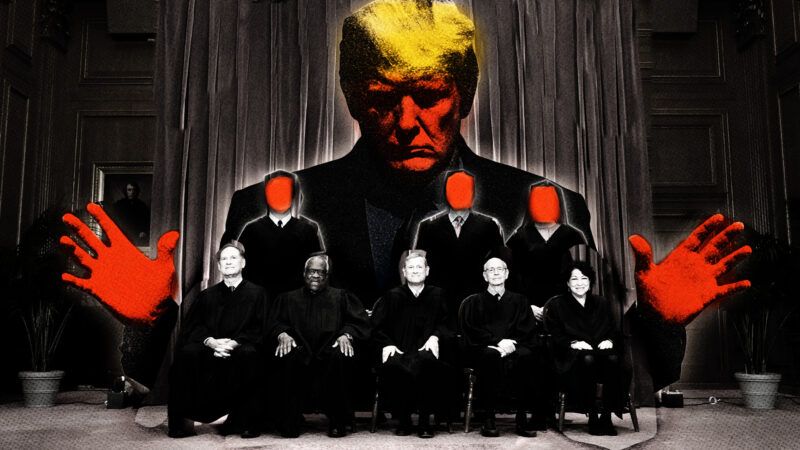
On Tuesday morning, President Donald Trump slammed his own picks for the Supreme Court, condemning them as both cowardly and "highly political." Justices Brett Kavanaugh, Neil Gorsuch, and Amy Coney Barrett "are not the people I interviewed to serve on the United States Supreme Court," he wrote on Truth Social. "They are merely a shell of their original selves."
The immediate impetus for that rant was the Supreme Court's rejection of the Trump administration's application for an emergency stay. Trump wanted the Court to block a preliminary injunction against implementation of a U.S. Postal Service plan to screen mail-in ballots, the result of an executive order he issued in March. That plan was necessary, he said, as "a solution to our totally CORRUPT and out of control Mail-In voting 'disaster,' which is a laughing stock all over the World." But while he was on the subject of "horrible" Supreme Court decisions, he reiterated his complaints about its rulings against his "emergency" tariffs and his attempt to restrict birthright citizenship.
Trump's latest tirade against his nominees reflects his general attitude toward judicial review, which he sees as an illegitimate obstacle to his policy agenda and personal whims. As the president tells it, Trump appointees do not rule against him because they honestly disagree with his legal positions. Rather, they are "totally unable to show the courage necessary to save our America" because they "are petrified of these crazed and depraved Democrats." It is a character defect, as opposed to a careful consideration of the facts and the law, that explains their failure to side with him.
That take is counterintuitive, to say the least. According to Trump, it requires courage for justices to agree with the president who appointed them, while cravenness is the only possible explanation for failing to do so.
"The Government is unlikely to succeed on the merits of its challenge to the
District Court's preliminary injunction," the Supreme Court said on Monday, when it declined to issue a stay in U.S. Postal Service v. California, the mail-in ballot case. "And the equitable factors applicable for obtaining emergency relief from this Court do not favor a stay."
That brief order was unsigned, but the only dissenters on record were Justices Samuel Alito and Clarence Thomas. Kavanaugh wrote a short concurring statement. Although "there is at least a fair prospect" that the Postal Service would win on the merits, he said, "applying the rule in the 2026 elections would be arbitrary and capricious in violation of the Administrative Procedure Act because state and local election officials do not have sufficient time to reasonably implement the rule before the elections."
Seven justices, in other words, did not think a stay was appropriate, either because the Postal Service had probably exceeded its legal authority or because trying to implement the rule now would disrupt the elections. But according to Trump, those rationales were disingenuous.
As he explained after the tariff ruling in February, the three Democratic nominees on the Supreme Court "automatically vote no" because they are "against anything that makes America strong, healthy, and great again." And the Republican nominees who vote against him are, if anything, even more contemptible: They are "fools and lapdogs for the RINOs and the radical-left Democrats." They "may think they're being politically correct," but "they're very unpatriotic and disloyal to our Constitution." Or as he put it in Tuesday, they are "bullied and cajoled by the Radical Left into making decisions that have set America back at least a hundred years."
At the same time, Trump described the order in the Postal Service case as "highly political." How so? "It is a big loss for Republicans, and America itself," he said, because it "makes cheating by the Radical Left 'Dumocrats,' on Mail-In Ballots, a much easier thing to do." The implication that the Republican appointees (presumably including Chief Justice John Roberts as well as Trump's nominees) were eager to facilitate such Democratic chicanery seems inconsistent with the equally implausible claim that they were intimidated into compromising their party's interests.
For Trump, the main point is that his nominees, regardless of their motivation, have betrayed him, which means they have betrayed their country. "Their horrible decision on Tariffs will be costing the U.S.A., for many years to come, Trillions and Trillions of Dollars," he said. "Likewise, the Supreme Court's Decision on Birthright Citizenship is a complete and total disaster for America."
This Court "will go down as having rendered some of the most destructive, hurtful, and damaging decisions in our Country's history," Trump declared. Those "shockingly bad rulings," he said, are "of such magnitude that it won't be easily possible for our Country to recover or heal."
Do Trump's nominees care? They do not! "The damage done to America is incalculable, and they know this, just as everyone else does," he said. "It is an irreparable and unrecoverable harm! The Court's inability and unwillingness to do the right thing for our Country will go down, in a very negative way, in the annals of History."
It seems unlikely that historians will rank the Supreme Court's decisions rejecting Trump's illegal tariffs and his assault on the 14th Amendment alongside Dred Scott v. Sandford, Plessy v. Ferguson, and Korematsu v. United States. But they probably will be struck by this president's open contempt for the crucial role that an independent judiciary plays as a safeguard against tyranny.




