

Can the Feds Ban You From Making Liquor in Your Own Home?
A challenge to the federal prohibition on home distilling could give the Supreme Court a chance to rein in Congress’ Commerce Clause power.
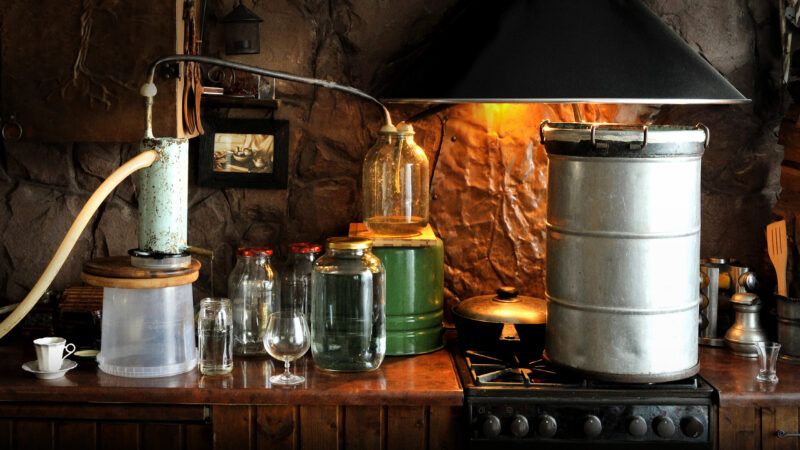
John Ream is trying to do something that should be straightforward: distill his own alcohol. Since the Founding of our country, Americans have sought to distill spirits on their own property for personal consumption. Nearly every famous Founding Father—from George Washington to James Madison to Patrick Henry—distilled spirits on their land, and in modern times, activities like homebrewing have been legalized for decades.
For over a century and a half, however, home distilling has been illegal. The Supreme Court could soon step in.
The trouble dates back about a century and a half ago. In 1868, Congress made it a crime to use or possess a still or boiler for the purpose of distilling spirits "in any dwelling house, or in any shed, yard, or inclosure connected with such dwelling house." The purported reason for the ban was to facilitate collecting tax revenue from authorized commercial distillers. While hobby distillers have long criticized this federal distilling ban, it is now receiving renewed attention, particularly in terms of what it says about the federal government's power in America today.
In 2024, Ream, with the help of the Buckeye Institute, challenged the federal distilling prohibition. After all, if Congress can prohibit Ream from making a product for personal consumption within his own home, where would the federal government's power end?
In response, the federal government has advanced two main arguments to defend the ban: first, that the ban is authorized under Congress' Article I taxing power, and second, that it's permissible under the Interstate Commerce Clause, which allows Congress to regulate commerce "among the several states."
Under the government's theory, these two clauses—in conjunction with the Constitution's Necessary and Proper Clause, which permits Congress to enact all laws that are "necessary and proper" to carry into effect its enumerated powers—give it the authority to prohibit Ream from operating a small home still for the personal consumption of spirits.
Earlier this year, two federal circuit court decisions reached differing conclusions on the distilling ban. In the U.S. Court of Appeals for the 6th Circuit, Ream lost, with the court buying the federal government's claim that it can prohibit home distilling under the taxation power and the Necessary and Proper Clause. In a companion case in the 5th Circuit, however, the government's taxation theory was rejected.
Given that these two decisions have teed up a so-called "circuit split," it's widely expected that the high court could step in to make a final determination. But while the government's troubling taxation power argument in these cases has received ample coverage—including in these pages—relatively little has been written about the government's back-up defense centered on the Commerce Clause.
Neither lower court directly weighed in on the Commerce Clause. But the government's alternative defense is technically still alive on appeal and could be resolved by the Supreme Court. A decision on the issue could be the most important Commerce Clause holding since NFIB v. Sebelius (2012), in which the Court ruled that the individual mandate under the Affordable Care Act was not a valid exercise of congressional power under the Commerce Clause (though the Court ultimately upheld the mandate via different means). Americans interested in federalism should hope that the Supreme Court seizes the opportunity before it to reimpose limits on the federal government's interstate commerce power.
The heart of that debate can be traced back to the Court's notorious 1942 decision in Wickard v. Filburn, which held that a farmer named Roscoe Filburn could be prohibited from growing wheat for home consumption. The Court adopted what became known as the "aggregation principle," arguing that if, on aggregate, farmers like Filburn were allowed to grow wheat for their own consumption, this could have a substantial effect on interstate commerce (since those farmers would presumably be substituting their own wheat for purchases on the open market).
While Wickard stretched the Commerce Clause far beyond its original understanding, it at least dealt with production on a sizable farm. (Filburn grew 11.9 extra acres of wheat for home consumption).
The 2005 ruling in Gonzales v. Raich, however, expanded the Commerce Clause to the breaking point.
In Raich, the Supreme Court used the Commerce Clause to uphold the federal government's authority to criminalize the production of homegrown cannabis. According to the Court, Congress could regulate purely local activities that are part of an economic "class of activities" that have a "substantial effect on interstate commerce."
The problem with this analysis is that it substitutes the broader concept of "economic activity" for what the Constitution actually says—that Congress can regulate "commerce" among the several states. While Founding era usage of the term "commerce" distinguished it from the production or manufacture of a product, the Court labeled production and manufacture as "quintessentially economic" and therefore within the ambit of an elastic interpretation of the Commerce Clause.
This functionally rewrote the Constitution's text by deleting the word "commerce" and replacing it with "economics," a far broader term. If Ream distills his own liquor, the theory holds, then he may be less likely to buy liquor on the open market. And if more would-be home distillers follow his lead, then there could be a "substantial effect" on interstate commerce.
With that reading, it's hard to see where the federal government's power would end here. In an amicus brief before the Supreme Court, my Manhattan Institute colleagues Ilya Shapiro and Trevor Burrus point out that this same reasoning would theoretically reach "virtually every other household activity," giving the feds authority to regulate "all ordinary household life."
A homegrown herb garden, for instance, could result in its planter purchasing fewer herbs at the grocery store. A stay-at-home parent could prevent a family from hiring paid child care. A homeschooling family might forego potential tuition payments at a nearby private school. Taken to its logical conclusion, the Court's analysis could justify federal intrusion into each of these spheres of domestic life, thereby erasing any limits on the federal government's Commerce Clause power altogether.
Ream's case, in that vein, provides the current Court the chance to overturn Raich and clarify that Congress' Commerce Clause authority does have meaningful limits. (Of note, doing so would not require the Court to overturn older precedents, like Wickard).
The Supreme Court may likely hear Ream's case. It is less clear if it will weigh in on the Commerce Clause. Americans wishing for a limited government should hope that it does.




