Reason.com - Free Minds and Free Markets
Reason logo Reason logo
  • Latest
  • Magazine
    • Current Issue
    • Archives
    • Subscribe
    • Crossword
  • Video
    • Reason TV
    • The Reason Roundtable
    • Free Media
    • The Reason Interview
  • Podcasts
    • All Shows
    • The Reason Roundtable
    • The Reason Interview With Nick Gillespie
    • Freed Up
    • The Soho Forum Debates
  • Volokh
  • Newsletters
  • Donate
    • Donate Online
    • Ways To Give To Reason Foundation
    • Torchbearer Society
    • Planned Giving
  • Subscribe
    • Reason Plus Subscription
    • Print Subscription
    • Gift Subscriptions
    • Subscriber Support

Log In

Create new account

Supreme Court

Court Packing Is a Bad Idea. But It's Still Constitutional.

Unwise policies are not always unlawful policies.
Damon Root | 9.10.2026 7:00 AM

Share on FacebookShare on XShare on RedditShare by emailPrint friendly versionCopy page URL Add Reason to Google
Media Contact & Reprint Requests
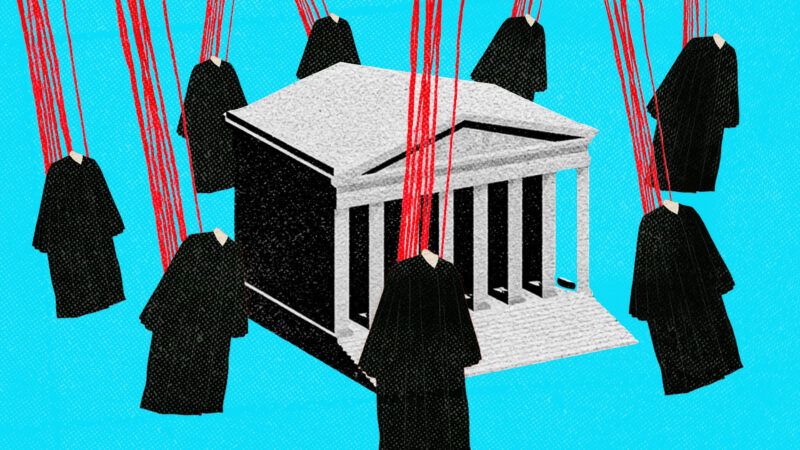
Court-Packing | Adani Samat/Midjourney
(Adani Samat/Midjourney)

Article III, Section 1, of the U.S. Constitution says that "the judicial Power of the United States shall be vested in one supreme Court, and in such inferior courts as the Congress may from time to time ordain and establish." The document says nothing about how many justices should actually sit on the Supreme Court, leaving that rather important decision entirely in the hands of Congress.

For advocates of court packing, or court expansion, or whatever other label the idea of adding new justices to the Court might happen to be going by nowadays, this constitutional language is a very handy ally to call upon and legal authority to cite. Whether you are in favor of court packing, opposed to it, or simply agnostic about the concept, there is no doubt about its constitutionality.

You’re reading Injustice System from Damon Root and Reason. Get more of Damon’s commentary on constitutional law and American history.

This field is for validation purposes and should be left unchanged.

Or is there? A recent Wall Street Journal op-ed tried to make the case that court packing is in fact unconstitutional because "it would undermine the separation of powers and the independence of the judiciary."

I agree that court packing is a bad idea. (My views are spelled out at length in this February 2021 Reason cover story.) But I don't find the legal argument on offer here to be persuasive. In fact, it seems to me that the op-ed undermined its own case at the outset by conceding the following: "Article III establishes 'one Supreme Court,' and Article I mentions 'the Chief Justice,' but otherwise the Constitution leaves to Congress the authority to establish the structure of the federal judiciary, including the number of justices."

It's worth remembering that not every unwise idea in American politics is also an unconstitutional idea. For example, Article I, Section 8, grants Congress the authority "To lay and collect Taxes, Duties, Imposts, and Excises." When President Donald Trump tried to usurp this power by unilaterally imposing tariffs on much of the world, that was unconstitutional because Trump sought to wield tariff-making powers that the Constitution did not assign to him. But if Congress had duly passed its own slate of economically harmful tariffs, there would be no comparable constitutional case against those tariffs because, for better or worse, Congress would have been acting within its lawful sphere.

Here's another example: Article III, Section 2, subjects the Supreme Court's appellate jurisdiction to "such Regulations as the Congress shall make." I happen to think that if Congress ever regulated the Supreme Court's appellate jurisdiction in an overly partisan manner, then such a regulation would harm the independence of the judiciary. And yet, such congressional power, as dangerous as it may be when used in such a fashion, is still present in the Constitution.

Like it or not, court packing, though unwise, is still constitutional.

Start your day with Reason. Get a daily brief of the most important stories and trends every weekday morning when you subscribe to Reason Roundup.

This field is for validation purposes and should be left unchanged.

NEXT: Can a New Weight Loss Treatment Escape the Legal and Regulatory Thicket?

Damon Root is a senior editor at Reason and the author of three books, including A Glorious Liberty: Frederick Douglass and the Fight for an Antislavery Constitution (Potomac Books). His latest book is Emancipation War: The Fall of Slavery and the Coming of the Thirteenth Amendment (Potomac Books).

Supreme CourtCourtsConstitutionJudiciaryLaw & Government
Share on FacebookShare on XShare on RedditShare by emailPrint friendly versionCopy page URL Add Reason to Google
Media Contact & Reprint Requests

Hide Comments (16)

Editor's Note: As of February 29, 2024, commenting privileges on reason.com posts are limited to Reason Plus subscribers. Past commenters are grandfathered in for a temporary period. Subscribe here to preserve your ability to comment. Your Reason Plus subscription also gives you an ad-free version of reason.com, along with full access to the digital edition and archives of Reason magazine. We request that comments be civil and on-topic. We do not moderate or assume any responsibility for comments, which are owned by the readers who post them. Comments do not represent the views of reason.com or Reason Foundation. We reserve the right to delete any comment and ban commenters for any reason at any time. Comments may only be edited within 5 minutes of posting. Report abuses.

  1. Mickey Rat   2 months ago

    "Like it or not, court packing, though unwise, is still constitutional."

    The word is not "unwise", it is "corrupt".

    1. Rossami   2 months ago

      Oh, there are lots of adjectives you could use to describe court-packing, all of them bad. But the article's core point is correct - the one you can't use is "unconstitutional". If Congress is so unwise/corrupt/stupid as to pass a court-packing bill, our only recourse will be to oust the legislators who did that to us.

      Well, there is another choice. We could decide that it's time for the Tree of Liberty to be re-watered. But I really don't want to think it's that bad yet.

      1. Brett Bellmore   2 months ago

        The WaPo has been firmly in "the Constitution means whatever it would be a good idea for it to mean!" territory for quite a while now. The only surprise is that they don't think Court packing is a good idea.

        Yet.

  2. Bhagwad   2 months ago

    Once again, as I mentioned in a comment yesterday, it is norms that hold a country together, not laws:

    https://reason.com/2026/09/09/appeals-court-grants-immunity-to-texas-cops-who-held-handcuffed-woman-face-down-in-a-fire-ant-hill/?comments=true#comment-11579569

    If you only care about what's legal, then we're all doomed. The letter of the law can be infinitely stretched. We've seen Congress redefine a "day" to exclude calendar days! But the US is a legalistic society, and we tend to think that whatever is "legal", is ok. So we think Trump's emergency declarations are okay because they're technically legal.

    But that's BS. Norms first. Law second.

    A nation of laws will fall. A nation of norms will survive.

    1. Don't look at me! ( Is the war over yet?)   2 months ago

      Norm just sat at the bar and drank beer all day.

  3. Rev Arthur L kuckland (5-30-24 banana republic day)   2 months ago

    It would be halarious if trump said "I agree with the dems, the Supreme Court needs to be expanded"
    Then rams through 5 people like posobick.

  4. MWAocdoc   2 months ago

    I wonder if it ever occurred to the Founders that the fact that the Congress is a large committee and, in the context of the rise of political parties and their death-grip on the two-party election system, increasingly unlikely to pass anything significant along these lines for the foreseeable future might eventually serve as an internal "check" on the separation of powers?

    1. Liberty_Belle   2 months ago

      I will never stop mentioning the the Founders were against political parties and warned us not to let them happen.

      1. JesseAz (RIP CK)   2 months ago

        Madison and Washington were against them. Not so much others. And even Madison relented.

        Federalists: Led by Alexander Hamilton and John Adams, they supported a strong central government, a national bank, and close ties with Britain.
        Democratic-Republicans: Led by Thomas Jefferson and James Madison, they advocated for states' rights, an agrarian economy, and strict interpretation of the Constitution.

        1. Liberty_Belle   2 months ago

          Adams: "There is nothing which I dread so much as a division of the republic into two great parties, each arranged under its leader, and concerting measures in opposition to each other. This, in my humble apprehension, is to be dreaded as the greatest political evil under our Constitution."

          Jefferson: "If I could not go to heaven but with a party, I would not go there at all."

          Madison & Washington we already agree on.

  5. creech   2 months ago

    An awful lost of "unwise" but "constitutional" damage can occur in any two year period when one party or another has complete control of Congress and the Executive. And we've certainly seen how seemingly impossible it is to roll back previous legislation.

    1. MWAocdoc   2 months ago

      ... and has done over the last two hundred years ...

  6. IceTrey   2 months ago

    The Constitution is crap. It doesn't prohibit government coercion which has lead to our present situation.

    1. TJJ2000   2 months ago

      Amendment 10. Coercion is limited by enumerated powers.

      Our joke of a SCOTUS during the Wilson & FDR trifecta is what destroyed that.

  7. Rockstevo   2 months ago

    Just for fun what do you think would happen if the Supreme court agreed and declared an expansion unconstitutional?

  8. TJJ2000   2 months ago

    Humorously. UR 'Trump Tariff' example fits the exact same premise as your court packing conclusion.
    The Constitution doesn't say Congress can't pass EO taxing/tariffs.
    So it did. And Trump used it.
    Same, same.

    Making up silly excuses like this is pathetic.

Please log in to post comments

Mute this user?

  • Mute User
  • Cancel

Ban this user?

  • Ban User
  • Cancel

Un-ban this user?

  • Un-ban User
  • Cancel

Nuke this user?

  • Nuke User
  • Cancel

Un-nuke this user?

  • Un-nuke User
  • Cancel

Flag this comment?

  • Flag Comment
  • Cancel

Un-flag this comment?

  • Un-flag Comment
  • Cancel

Latest

Firing Hegseth

Liz Wolfe | 11.10.2026 9:30 AM

The Rise and Fall of Ma Bell

Thomas W. Hazlett | 11.10.2026 8:00 AM

A Bad Day at SCOTUS for Government Accountability

Damon Root | 11.10.2026 7:00 AM

An Absurdist's Exile in Buenos Aires: Witold Gombrowicz's Argentine Years

John Pistelli | From the December 2026 issue

Brickbat: Evergreen Gun Rules

Charles Oliver | 11.10.2026 4:00 AM

Recommended

  • About
  • Browse Topics
  • Events
  • Staff
  • Jobs
  • Donate
  • Advertise
  • Subscribe
  • Contact
  • Media
  • Amazon
Reason Facebook@reason on XReason InstagramReason TikTokReason YoutubeApple PodcastsReason on FlipboardReason RSS Add Reason to Google

© 2026 Reason Foundation | Accessibility | Privacy Policy | Terms Of Use

This site is protected by reCAPTCHA and the Google Privacy Policy and Terms of Service apply.

Reason

The All-Argentina Issue is Here

New from Reason: a look into what Javier Milei has accomplished and what it will take to make the most of Argentina’s window for real change. Out now for subscribers.

Subscribe & Start Reading Learn More

