Reason.com - Free Minds and Free Markets
Reason logo Reason logo
  • Latest
  • Magazine
    • Current Issue
    • Archives
    • Subscribe
    • Crossword
  • Video
    • Reason TV
    • The Reason Roundtable
    • Free Media
    • The Reason Interview
  • Podcasts
    • All Shows
    • The Reason Roundtable
    • The Reason Interview With Nick Gillespie
    • Freed Up
    • The Soho Forum Debates
  • Volokh
  • Newsletters
  • Donate
    • Donate Online
    • Ways To Give To Reason Foundation
    • Torchbearer Society
    • Planned Giving
  • Subscribe
    • Reason Plus Subscription
    • Print Subscription
    • Gift Subscriptions
    • Subscriber Support

Log In

Create new account

Supreme Court

A Limited Supreme Court Win for Trump on Mail-In Ballots

But the legal fighting will continue in the lower courts.
Damon Root | 8.25.2026 9:45 AM

Share on FacebookShare on XShare on RedditShare by emailPrint friendly versionCopy page URL Add Reason to Google
Media Contact & Reprint Requests
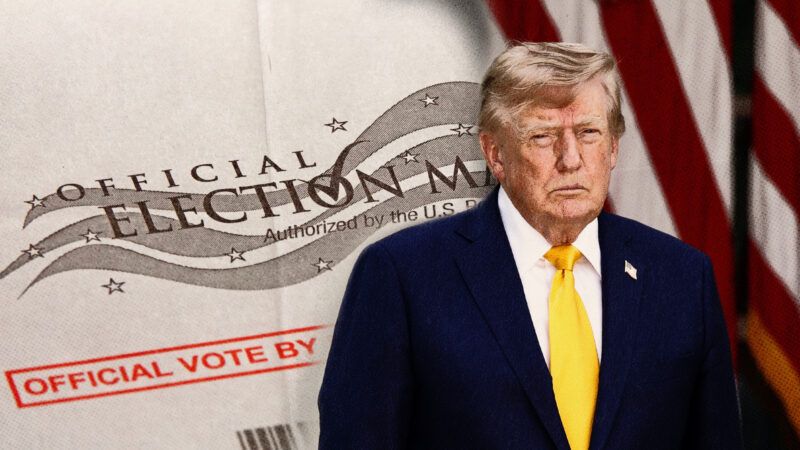
Trump in the foreground, the American flag to the side, a mail-in ballot in the background | Photo: Sipa USA/Newscom/Kilmermedia/Dreamstime
(Photo: Sipa USA/Newscom/Kilmermedia/Dreamstime)

In its recent decision in Watson v. Republican National Committee (2026), the U.S. Supreme Court affirmed the legality of a state mail-in voting system that allows the counting of ballots that are mailed before election day but not received until shortly after election day. "While federal law dictates when ballots must be cast," observed the majority opinion of Justice Amy Coney Barrett, "state law governs when they must be received." It was a clear rebuke to the Republican-led effort to eliminate a common form of voting by mail.

But if you thought that far-reaching decision would be the Supreme Court's final word on mail-in ballots this year, you may want to think again.

You’re reading Injustice System from Damon Root and Reason. Get more of Damon’s commentary on constitutional law and American history.

This field is for validation purposes and should be left unchanged.

Back in March, President Donald Trump issued an executive order that, among other things, directed the Postal Service to promulgate new rules that would restrict the ability to send and deliver ballots via the U.S. mail. Those newly proposed rules were released late last week. Meanwhile, Trump's executive order was promptly challenged and blocked in federal court by a group of states led by California and New York, leading the Trump administration to file an emergency request with the Supreme Court that sought to lift the lower court's block and thereby clear the way for the executive order to be implemented.

Yesterday, a divided Supreme Court issued a limited ruling in Trump's favor, holding that the states had no standing to sue at this point because no federal action had yet been taken against them. The lower court's block on implementing the executive order was therefore lifted.

"The Court's disposition of this application does not mean that any measure taken by the Government to implement the Order will necessarily be lawful," stated the Supreme Court's unsigned majority opinion. "On that score, time will tell. But the Order itself does not harm the States, so the District Court lacked jurisdiction to bar the Government from trying to implement it."

Writing in dissent, Justice Sonia Sotomayor, joined by Justice Elena Kagan, also noted the limited scope of the Court's action. "Today's decision does not address whether the President's attempts to interfere with States' administration of the November 2026 elections are lawful. Nor does it suggest that the Executive Branch has any constitutional or statutory authority to implement the President's directives," Sotomayor wrote. "Instead, today's decision merely postpones adjudication of those challenges. Nonetheless, because I believe the respondent States' challenges are justiciable now, I respectfully dissent."

In other words, the legal fighting is about to get even fiercer in the lower courts now that the Trump administration has been freed up to begin implementing the executive order. It seems quite likely that the matter will be back before the justices sooner or later for a more definitive resolution.

Will yesterday's decision have any bearing on this fall's midterm elections, which are now just a little over two months away?

"If the regulations are enacted," notes Adam Sella of The New York Times, "the Postal Service said that it would not deliver mail ballots in states that do not share voter data with the federal agency." I suppose you can safely guess whether it will be red states or blue states that will feel the impact of this would-be executive crackdown on mail-in voting. But that will only happen if the order's implementation survives further legal challenges.

Trump has certainly made his own partisan intentions clear enough. Passing a federal law that banned mail-in ballots, Trump told a Republican gathering in March, would "guarantee the midterms." Trump seems to believe that the use of mail-in ballots benefits the Democrats and therefore wants to restrict their use in order to benefit the Republicans.

The trouble for Trump is that absent some kind of new federal law that directly limits the use of mail-in ballots, the principal authority over how elections are run may still remain where it has always remained: in the hands of the states. According to Article 1, Section 4, of the U.S. Constitution, "the Times, Places and Manner of holding Elections for Senators and Representatives, shall be prescribed in each State by the Legislature thereof; but the Congress may at any time by Law make or alter such Regulations."

The Trump administration clearly wants greater control over federal elections. But the Constitution already gave that authority to the states, subject to additional regulation by Congress, not by the executive.

Will those federalism principles now prevent Trump from wielding the executive branch to "guarantee the midterms" for the GOP? As of this writing, the Supreme Court has yet to cast its final vote on that pressing constitutional question.


Start your day with Reason. Get a daily brief of the most important stories and trends every weekday morning when you subscribe to Reason Roundup.

This field is for validation purposes and should be left unchanged.

NEXT: Voting by Mail

Damon Root is a senior editor at Reason and the author of three books, including A Glorious Liberty: Frederick Douglass and the Fight for an Antislavery Constitution (Potomac Books). His latest book is Emancipation War: The Fall of Slavery and the Coming of the Thirteenth Amendment (Potomac Books).

Supreme CourtHouse of RepresentativesVotingConstitutionDonald TrumpCongressCampaigns/ElectionsLaw & GovernmentState Governments
Share on FacebookShare on XShare on RedditShare by emailPrint friendly versionCopy page URL Add Reason to Google
Media Contact & Reprint Requests

Hide Comments (21)

Editor's Note: As of February 29, 2024, commenting privileges on reason.com posts are limited to Reason Plus subscribers. Past commenters are grandfathered in for a temporary period. Subscribe here to preserve your ability to comment. Your Reason Plus subscription also gives you an ad-free version of reason.com, along with full access to the digital edition and archives of Reason magazine. We request that comments be civil and on-topic. We do not moderate or assume any responsibility for comments, which are owned by the readers who post them. Comments do not represent the views of reason.com or Reason Foundation. We reserve the right to delete any comment and ban commenters for any reason at any time. Comments may only be edited within 5 minutes of posting. Report abuses.

  1. billyjack   2 months ago

    By refusing to act until there is actual harm, it means that they are refusing to act until the election is over. By the time they can act, the harm, if any, will not be reversible. It's not like the Supreme Court can order a new election next summer.

    1. Stupid Government Tricks   2 months ago

      This article shows "0 comments" but your comment as "6 minutes ago".

      ETA and now "2 comments" and "7 minutes ago".

    2. Rossami   2 months ago

      Eh, maybe. The "harm" in this case means enforcing a ban against a particular state's rule or practice. Since the regulations haven't even been written yet (so far as I know), it's way too speculative to say that any state will actually fall afoul of them.

      Once the states can point to specific regulations that will conflict with their laws, they can refile the suit and we'll all have concrete issues to argue over. That will still happen well before the election. (And if the regulations are delayed such that there's not enough time, that's a different and pretty easy lawsuit to delay implementation rather than interrupt an election mid-stream.)

      1. billyjack   2 months ago

        The first ballots are reportedly set to go out on September 4. That doesn't give much time at all.

    3. Thoritsu   2 months ago

      Good!

  2. Stupid Government Tricks   2 months ago

    As usual, there is zero questioning of the process, of the President having all this executive power instead of Congress, of the Supreme Court letting Congress delegate away so much of their power.

  3. Liberty_Belle   2 months ago

    Time to start impeaching SCOTUS.

    1. DesigNate   2 months ago

      lol, why?

  4. Dillinger   2 months ago

    >>Trump seems to believe that the use of mail-in ballots benefits the Democrats

    no, everyone knows the use of mail-in ballots benefits the Democrats. you so transparent.

    1. billyjack   2 months ago

      The only time I ever voted by mail was in 1976. I voted for all Republicans.

      Also, it seem rather hypocritical of Trump to whine incessantly about voting by mail to be fraudulent when he reportedly votes by mail. If he honestly thought it to be fraudulent, why wouldn't he vote in person?

      It's all nothing more than an attempt to bar people who doesn't agree with him from voting.

      What would happen if in the next administration, the Democrats were to try to deny the right to vote by anyone not driving an electric vehicle, bicycle, or walking to the polls?

    2. billyjack   2 months ago

      "no, everyone knows the use of mail-in ballots benefits the Democrats. you so transparent."

      "Everyone knows" is merely rhetoric that means absolutely nothing.

  5. TJJ2000   2 months ago

    So it's CA and NY who want ineligible voters to get ballots. How predictable.

  6. Jesse fantasizes about having a 3some with Dave Smith and Maddow   2 months ago

    “From our cold dead hands!!!”

    1. JesseAz (RIP CK)   2 months ago

      Boring.

  7. Orbital Mechanic   2 months ago

    The USPS has no business deciding who gets a ballot. This is obvious to anyone who is not a Trump cultist.

    Trump wants the constitutionally mandated postal service to stop delivering mail to people he doesn’t like. He wants them to read your mail to decide whether or not you are allowed to get it. This is blatantly illegal. This is obvious to anyone who is not a Trump cultist.

    The only reason this is a debate is that we have too many Trump cultists around. Just imagine what their reaction would be if Obama or Biden tried this.

    1. JesseAz (RIP CK)   2 months ago

      USPS is authorized to ensure proper delivery to residents.

      The envelopes have bar codes, nothing is being read. Do you know how postal mail systems work?

      1. Orbital Mechanic   2 months ago

        I do, but apparently you are confused. Let me make it simple.

        1. The State of California wants to send me some mail. In this case it is a ballot but they send me lots of other stuff. Taxes, DMV notices, and so on. They only send me a ballot if I am on the voter registration list.

        2. They print up an envelope with my name and address on it. The postage is provided for. It may or may not have a bar code on it that might help in processing but that is totally irrelevant.

        3. They give it to USPS.

        4. The USPS treats it as any other piece of mail and, barring accident or some calamity, delivers it to me.

        Now Trump and friends want something different to happen. Call it step 3.5. They want USPS to look at the envelop and NOT deliver it to me depending on its content and depending on whether someone other than my state thinks I should have it or not. Who is that someone? Someone who is friendly to Trump.

        If you cannot comprehend the above, then there is little that anyone can do for you short of cult deprogramming.

        1. TJJ2000   2 months ago

          OMG! You won't be able to get your crack through USPS anymore! /s

          Maybe USPS is often used to prevent illegal activity.
          It baffles me people are making all sorts of excuses for illegal voting.

  8. Normal Guy   2 months ago

    Imagine making a big deal about the election, only to not vote when the time comes because you refuse to stand in a line for an hour.

    Imagine this laziness being so endemic to your party, that it loses ground despite the military and economic misadventures of the rival.

    If it suffers because people can’t be bothered to vote (or because of fraud) it’ll hardly be worth shedding tears over. They will have earned their outcome either way.

  9. Jack Jordan   2 months ago

    It would help if pundits stopped misrepresenting that we have "federal elections." The Constitution is clear that all elections for federal offices are nonetheless state elections.

    Article I clearly commands that "The Times, Places and Manner of holding Elections for Senators and Representatives, shall be prescribed in each State by the Legislature thereof; but the Congress may at any time by Law make or alter such Regulations, except as to the Places of chusing Senators" (because Senators previously were chosen by state legislatures).

    "The House of Representatives shall be composed of Members chosen every second Year by the People of the several States, and the Electors in each State shall have the Qualifications requisite for Electors of the most numerous Branch of the State Legislature."

    The Seventeenth Amendment commands:
    "The Senate of the United States shall be composed of two Senators from each State, elected by the people thereof, for six years; and each Senator shall have one vote. The electors in each State shall have the qualifications requisite for electors of the most numerous branch of the State legislatures."

    Article II clearly commands, the "President" and "the Vice President" shall be "chosen for the same [four-year] Term" and shall "be elected, as follows." "Each State shall appoint, in such Manner as the Legislature thereof may direct, a Number of Electors, equal to the whole Number of Senators and Representatives to which the State may be entitled in the Congress." "The Electors shall meet in their respective States, and vote by Ballot for two Persons, of whom one at least shall not be an Inhabitant of the same State with themselves. And they shall make a List of all the Persons voted for, and of the Number of Votes for each; which List they shall sign and certify, and transmit sealed to the Seat of the Government of the United States, directed to the President of the Senate."

    The misconception that we have "federal elections" facilitates lies by SCOTUS justices about our Constitution. For example, they lied twice in Trump v. United States when they misrepresented that “federal officers” de facto and de jure somehow “owe their existence and functions to the united voice of the whole, not of a portion, of the people” and “powers over their election and qualifications must be specifically ‘delegated to, rather than reserved by, the States.’ ”

    1. TJJ2000   2 months ago

      "but the Congress may at any time by Law make or alter such Regulations"

Please log in to post comments

Mute this user?

  • Mute User
  • Cancel

Ban this user?

  • Ban User
  • Cancel

Un-ban this user?

  • Un-ban User
  • Cancel

Nuke this user?

  • Nuke User
  • Cancel

Un-nuke this user?

  • Un-nuke User
  • Cancel

Flag this comment?

  • Flag Comment
  • Cancel

Un-flag this comment?

  • Un-flag Comment
  • Cancel

Latest

Iowa Voters Don't Want Police or Flock Tracking Their Cars. Politicians Are Still Catching Up.

Davide Mamone | 10.24.2026 8:00 AM

Trump Wants To Force Data Centers To 'Make Their Own Electricity.' Deregulation Would Work Better.

Josh Pauzé | 10.23.2026 5:30 PM

The U.K.'s Online Safety Act Has Been a Failure. Regulators Want To Broaden It Anyway.

Meagan O'Rourke | 10.23.2026 5:05 PM

How Helping Someone Buy Drugs Can Send You to Prison for 20 Years

Jacob Sullum | 10.23.2026 4:50 PM

Under Proposed Treasury Rule, Corporate Homebuyers Who Don't Track Their Receipts Face $1 Million Fines

Christian Britschgi | 10.23.2026 3:50 PM

Recommended

  • About
  • Browse Topics
  • Events
  • Staff
  • Jobs
  • Donate
  • Advertise
  • Subscribe
  • Contact
  • Media
  • Amazon
Reason Facebook@reason on XReason InstagramReason TikTokReason YoutubeApple PodcastsReason on FlipboardReason RSS Add Reason to Google

© 2026 Reason Foundation | Accessibility | Privacy Policy | Terms Of Use

This site is protected by reCAPTCHA and the Google Privacy Policy and Terms of Service apply.

Reason

The All-Argentina Issue is Here

New from Reason: a look into what Javier Milei has accomplished and what it will take to make the most of Argentina’s window for real change. Out now for subscribers.

Subscribe & Start Reading Learn More
