
A Limited Supreme Court Win for Trump on Mail-In Ballots
But the legal fighting will continue in the lower courts.
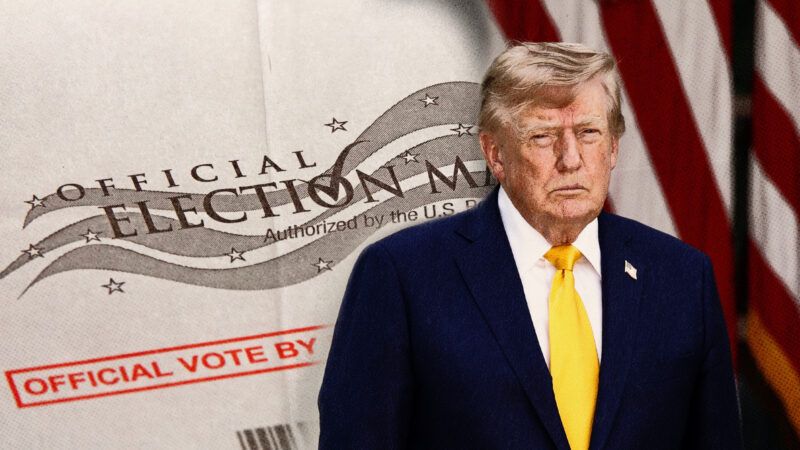
In its recent decision in Watson v. Republican National Committee (2026), the U.S. Supreme Court affirmed the legality of a state mail-in voting system that allows the counting of ballots that are mailed before election day but not received until shortly after election day. "While federal law dictates when ballots must be cast," observed the majority opinion of Justice Amy Coney Barrett, "state law governs when they must be received." It was a clear rebuke to the Republican-led effort to eliminate a common form of voting by mail.
But if you thought that far-reaching decision would be the Supreme Court's final word on mail-in ballots this year, you may want to think again.
You’re reading Injustice System from Damon Root and Reason. Get more of Damon’s commentary on constitutional law and American history.
Back in March, President Donald Trump issued an executive order that, among other things, directed the Postal Service to promulgate new rules that would restrict the ability to send and deliver ballots via the U.S. mail. Those newly proposed rules were released late last week. Meanwhile, Trump's executive order was promptly challenged and blocked in federal court by a group of states led by California and New York, leading the Trump administration to file an emergency request with the Supreme Court that sought to lift the lower court's block and thereby clear the way for the executive order to be implemented.
Yesterday, a divided Supreme Court issued a limited ruling in Trump's favor, holding that the states had no standing to sue at this point because no federal action had yet been taken against them. The lower court's block on implementing the executive order was therefore lifted.
"The Court's disposition of this application does not mean that any measure taken by the Government to implement the Order will necessarily be lawful," stated the Supreme Court's unsigned majority opinion. "On that score, time will tell. But the Order itself does not harm the States, so the District Court lacked jurisdiction to bar the Government from trying to implement it."
Writing in dissent, Justice Sonia Sotomayor, joined by Justice Elena Kagan, also noted the limited scope of the Court's action. "Today's decision does not address whether the President's attempts to interfere with States' administration of the November 2026 elections are lawful. Nor does it suggest that the Executive Branch has any constitutional or statutory authority to implement the President's directives," Sotomayor wrote. "Instead, today's decision merely postpones adjudication of those challenges. Nonetheless, because I believe the respondent States' challenges are justiciable now, I respectfully dissent."
In other words, the legal fighting is about to get even fiercer in the lower courts now that the Trump administration has been freed up to begin implementing the executive order. It seems quite likely that the matter will be back before the justices sooner or later for a more definitive resolution.
Will yesterday's decision have any bearing on this fall's midterm elections, which are now just a little over two months away?
"If the regulations are enacted," notes Adam Sella of The New York Times, "the Postal Service said that it would not deliver mail ballots in states that do not share voter data with the federal agency." I suppose you can safely guess whether it will be red states or blue states that will feel the impact of this would-be executive crackdown on mail-in voting. But that will only happen if the order's implementation survives further legal challenges.
Trump has certainly made his own partisan intentions clear enough. Passing a federal law that banned mail-in ballots, Trump told a Republican gathering in March, would "guarantee the midterms." Trump seems to believe that the use of mail-in ballots benefits the Democrats and therefore wants to restrict their use in order to benefit the Republicans.
The trouble for Trump is that absent some kind of new federal law that directly limits the use of mail-in ballots, the principal authority over how elections are run may still remain where it has always remained: in the hands of the states. According to Article 1, Section 4, of the U.S. Constitution, "the Times, Places and Manner of holding Elections for Senators and Representatives, shall be prescribed in each State by the Legislature thereof; but the Congress may at any time by Law make or alter such Regulations."
The Trump administration clearly wants greater control over federal elections. But the Constitution already gave that authority to the states, subject to additional regulation by Congress, not by the executive.
Will those federalism principles now prevent Trump from wielding the executive branch to "guarantee the midterms" for the GOP? As of this writing, the Supreme Court has yet to cast its final vote on that pressing constitutional question.