Reason.com - Free Minds and Free Markets
Reason logo Reason logo
  • Latest
  • Magazine
    • Current Issue
    • Archives
    • Subscribe
    • Crossword
  • Video
    • Reason TV
    • The Reason Roundtable
    • Free Media
    • The Reason Interview
  • Podcasts
    • All Shows
    • The Reason Roundtable
    • The Reason Interview With Nick Gillespie
    • Freed Up
    • The Soho Forum Debates
  • Volokh
  • Newsletters
  • Donate
    • Donate Online
    • Ways To Give To Reason Foundation
    • Torchbearer Society
    • Planned Giving
  • Subscribe
    • Reason Plus Subscription
    • Print Subscription
    • Gift Subscriptions
    • Subscriber Support

Log In

Create new account

Supreme Court

Texas Requires the Ten Commandments Be Posted in Every Classroom. SCOTUS May Decide If That's Constitutional.

A major separation-of-church-and-state case lands at the Supreme Court.
Damon Root | 8.20.2026 7:00 AM

Share on FacebookShare on XShare on RedditShare by emailPrint friendly versionCopy page URL Add Reason to Google
Media Contact & Reprint Requests
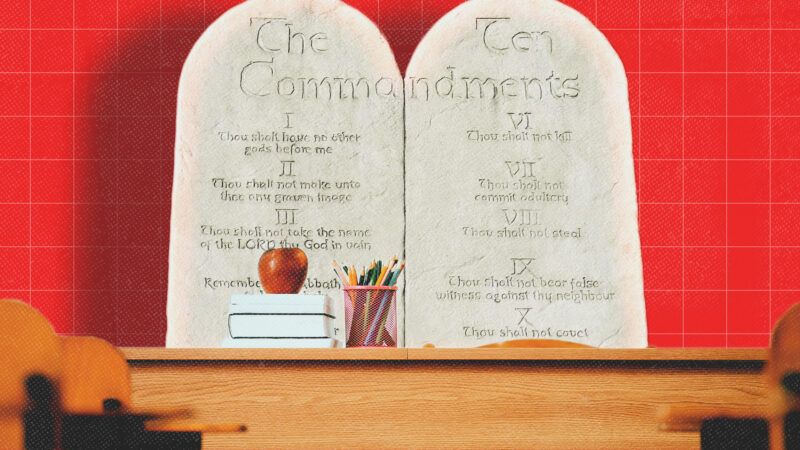
Red background, a desk, an apple stacked on books next to a pencil cup, and the Ten Commandments on stone tablets | Illustration: ESBBasics/Envato/erika8213/Envato
(Illustration: ESBBasics/Envato/erika8213/Envato)

The First Amendment to the U.S. Constitution prohibits the government from passing any law "respecting the establishment of religion." Yet Texas has passed a law requiring every public school classroom in the state to prominently display the text of the Ten Commandments, as it appears in the King James version of the Bible. Does that state law violate the Establishment Clause?

You’re reading Injustice System from Damon Root and Reason. Get more of Damon’s commentary on constitutional law and American history.

This field is for validation purposes and should be left unchanged.

Earlier this week, lawyers from the American Civil Liberties Union (ACLU), representing a number of Texas families "of diverse faiths and beliefs—including Baha'ism, Christianity, Hinduism, Judaism, Unitarian Universalism, and nonreligious traditions—whose children attend Texas public schools," asked the U.S. Supreme Court to step in and rule against the Texas law.

These legal challengers have a strong case based on existing SCOTUS precedent. In Stone v. Graham (1980), the Court struck down a nearly identical Kentucky law that required the posting of the Ten Commandments in public school classrooms. "This is not a case in which the Ten Commandments are integrated into the school curriculum, where the Bible may constitutionally be used in an appropriate study of history, civilization, ethics, comparative religion, or the like," the Court said. "If the posted copies of the Ten Commandments are to have any effect at all, it will be to induce the schoolchildren to read, meditate upon, perhaps to venerate and obey, the Commandments. However desirable this might be as a matter of private devotion, it is not a permissible state objective under the Establishment Clause."

And more recently, in Mahmoud v. Taylor (2025), the Court held that the First Amendment right to the free exercise of religion is infringed when a school "substantially interfere[s] with the religious development" of a family's child or "pose[s] 'a very real threat of undermining' the religious beliefs and practices the parent wishes to instill in the child." As this week's ACLU brief put it, "if the permanent, unavoidable imposition of biblical scripture in public-school classrooms does not interfere with, or threaten to undermine, parents' ability to direct their children's religious education…it is difficult to imagine what would."

However, not every member of the current Supreme Court is such a big fan of the Court's existing jurisprudence in this area of the law. Justice Clarence Thomas, for one, has argued that the Establishment Clause should be read as a limitation only on the federal government. "The Establishment Clause is a federalism provision," Thomas has written, "which…resists incorporation."

Incorporation refers to the legal doctrine under which the various individual liberties and limits on government power that are contained in the Bill of Rights have been applied, or incorporated, against the states through the 14th Amendment. By calling the Establishment Clause a "federalism provision," Thomas meant that the clause was added to the Constitution purely as a structural limit on federal action that should not also limit what the states may do. The clause "protects state establishments from federal interference," according to Thomas, "but does not protect any individual right."

I don't expect the Supreme Court to go that far if it ends up agreeing to hear this case. But other conservative justices have also raised their own complaints about modern Establishment Clause doctrine, which they see as too hostile to religious displays and observations by state officials, including by public school teachers and coaches. It's possible that such conservative judicial views may cut in favor of this particular law.

One thing seems clear enough: If the Supreme Court weighs in on the constitutionality of a state law mandating the display of the Ten Commandments in every one of its public school classrooms, it will be the biggest separation-of-church-and-state case in years.

Start your day with Reason. Get a daily brief of the most important stories and trends every weekday morning when you subscribe to Reason Roundup.

This field is for validation purposes and should be left unchanged.

NEXT: Brickbat: Fake Stop

Damon Root is a senior editor at Reason and the author of three books, including A Glorious Liberty: Frederick Douglass and the Fight for an Antislavery Constitution (Potomac Books). His latest book is Emancipation War: The Fall of Slavery and the Coming of the Thirteenth Amendment (Potomac Books).

Supreme CourtReligionFirst AmendmentConstitutionCivil LibertiesEducationTexas
Share on FacebookShare on XShare on RedditShare by emailPrint friendly versionCopy page URL Add Reason to Google
Media Contact & Reprint Requests

Hide Comments (123)

Editor's Note: As of February 29, 2024, commenting privileges on reason.com posts are limited to Reason Plus subscribers. Past commenters are grandfathered in for a temporary period. Subscribe here to preserve your ability to comment. Your Reason Plus subscription also gives you an ad-free version of reason.com, along with full access to the digital edition and archives of Reason magazine. We request that comments be civil and on-topic. We do not moderate or assume any responsibility for comments, which are owned by the readers who post them. Comments do not represent the views of reason.com or Reason Foundation. We reserve the right to delete any comment and ban commenters for any reason at any time. Comments may only be edited within 5 minutes of posting. Report abuses.

  1. Vernon Depner   2 months ago

    There is no religiously neutral way to display the Ten Commandments. Even dividing them into ten is a particular religious view—the text does not make it obvious there are ten. The choice of translation reflects a particular religious bias. Sorry, not appropriate.

    1. mad.casual   2 months ago

      There is no religiously neutral way to display the Ten Commandments.

      This is kinda bizarre from several perspectives. How about Muhammed? Is there no religiously neutral way to depict Muhammed? How about homosexuals? Is there no way to depict homosexuals that isn't inherently trying to make kids gay? The idea that the mere icon stirs people's souls one way or the other is kind of its own bizarre religious belief.

      I freely admit/agree that TX is going too far mandating it in every classroom but it's kinda in reaction to the flags (Rainbow and Black Supremacy Nationalism Power Lives Matter) in every classroom, teachers preaching advocacy as part of the curriculum, boards and districts lining up behind them, politicians and social justice commissions cheering them on and persecuting non-believers random bystanders...

      1. Nelson   2 months ago

        “ Is there no religiously neutral way to depict Muhammed?”

        Like Mohammed, the Ten Commandments would be appropriate in a discussion or comparison of religions or religious doctrines. Requiring a prominently-displayed list of the Ten Commandments (or the teachings of the Koran or the Torah or the Baghavad Gita) in every classroom is, on it’s face, a violation of the separation of Church and State. And yes, that is a thing in America.

        “ How about homosexuals?”

        Homosexuality isn’t a religion.

        “ inherently trying to make kids gay”

        Dear God, man. Are you really still fighting the lost battles of the 70s? Pride events and flags aren’t “trying to make kids gay”. That’s something that any reasonable or intelligent person would know already, which is why only the most virulent homophobes still claim it.

        “ The idea that the mere icon stirs people's souls”

        That’s not the argument, Strawman Sam. And you know it. Plus, of course, it’s a religious teaching, not an ‘icon’. If it were an icon, it would be prohibited by the Bible.

        “ is kind of its own bizarre religious belief”

        Not by any rational definition of a religious belief.

        “ but it's kinda in reaction to the flags (Rainbow and Black Supremacy Nationalism Power Lives Matter) in every classroom”

        What nonsense. Besides the fact that these are red states implementing religious indoctrination, the purpose, as stated by the religious zealots who created these laws, is to put Christian teachings in front of kids. None have mentioned anything about flags. That’s your personal irrational and unsupported belief.

        Your paranoia, projection, and beliefs about motivations and actions of teachers and politicians get more and more bizarre by the day.

        1. CE   2 months ago

          The 10 Commandments aren't obviously Christian, since they are found in the Old Testament, shared with Jewish and Muslim adherents.

          1. Vernon Depner   2 months ago

            The King James version of the commandments is explicitly Protestant Christian.

      2. damikesc   2 months ago

        Yeah, this is seems like an idiotic regulation.

      3. NM Dave   2 months ago

        In my observation, men who talk about "making kids gay," or claiming that homosexuality is a choice are men who tamped down their instinctive desires to live as a heterosexual, and they indeed did "choose" their sexuality, although the GRINDR server crashes that occur when Republican men congregate.

    2. JesseAz (RIP CK)   2 months ago

      Yes there is. Just like showing the code of hamurrabi or tenets of Buddhism is.

      What an ignorant take.

      1. Nelson   2 months ago

        In a discussion of world religions or comparative religion, it is appropriate to discuss religion in an instructive way.

        Posting the teachings if a specific flavor of a specific religious tradition when it’s completely unconnected to the subject being taught? Clearly unconstitutional.

      2. Vernon Depner   2 months ago

        What a thoughtless take.

        1. JesseAz (RIP CK)   2 months ago

          How? Please defend your argument. Next youll say teaching Greek mythology is wrong too. Lol.

      3. A Thinking Mind   2 months ago

        So is Texas legally requiring that the code of Hammurabi be displayed in every classroom? What about the Bhagavad Gita? Is that a legal requirement?

        1. JesseAz (RIP CK)   2 months ago

          I have zero issue with it.

          Find me one person forced to look at the ten commandments then decide, hey im a Christian now.

          Why only this symbol? Enough tribal cult shit like pride flags.

          Either say no symbols at all. Or stop singling out specific symbols.

          It is just dumb. And yes id prefer no symbols at all. Except for math symbols.

          1. DesigNate   2 months ago

            And those squiggly letters. I believe they called it cursive.

  2. MollyGodiva   2 months ago

    Tell us again how Muslims are trying to install sharia law.

    1. Fu Manchu   2 months ago

      It's funny how insecure many Christians in the US are.

      1. JesseAz (RIP CK)   2 months ago

        Whats funny? You suck at humor sarc.

        1. Nelson   2 months ago

          Funny sad. Funny pathetic. Not funny ha-ha.

    2. TJJ2000   2 months ago

      Let me put that goalpost back where it was for you.....
      Tell us again how [D]emon-craps are trying to install WOKE religious indoctrination laws.

      1. MollyGodiva   2 months ago

        Give an example of those laws.

        1. TJJ2000   2 months ago

          California – Ethnic Studies Requirement (AB 101)
          Oregon – Ethnic Studies Standards (2021)
          Illinois – African American History Requirement
          Minnesota - Ethnic studies integrated into K–12 standards and graduation requirements
          New Jersey - Requires instruction on diversity and contributions of various groups
          New York - Amistad Commission influences curriculum on slavery and Black history

          States with mandatory LGBTQ-inclusive curriculum laws
          California
          Colorado
          Illinois
          Nevada
          New Jersey
          Oregon
          Washington

          Some states require sex ed to include LGBTQ topics
          California
          New Jersey
          Oregon
          Washington
          Illinois
          Maryland
          Massachusetts
          Rhode Island
          Colorado

          26 states have statutes involving ethnic studies requirements
          at least 19 states incorporating ethnic studies into standards or curriculum

          DEI / Equity requirements districts require:
          “Culturally responsive teaching”
          Equity-based discipline policies
          Diversity training for staff

          And on and on and on it goes........

          1. MollyGodiva   2 months ago

            History and culture studies classes are not religious indoctrination. These classes are meant to help keep out kids from becoming bigots.

            1. JesseAz (RIP CK)   2 months ago

              10 commandments are a historical document dumdum.

              1. MollyGodiva   2 months ago

                It is a religious document. The 10C had nothing to do with US history.

              2. Vernon Depner   2 months ago

                No, they're not. They're an interpretation of a translation of an excerpt from a religious scripture.

                1. JesseAz (RIP CK)   2 months ago

                  Lol. Antichristians cant admit what is historical. Amusing.

                2. JesseAz (RIP CK)   2 months ago

                  Are ancient roman sculptures ahistorical? Ancient temples? Ancient mosques?

                  What a dumb assertion.

                  You can separate history from the accompanying religion.

                  Some of you athiest are straight ignorant.

                  1. JesseAz (RIP CK)   2 months ago

                    Should say Greek and roman*

              3. charliehall   2 months ago

                Nazis would have promoted such nonsense.

            2. TJJ2000   2 months ago

              LOL... And the 10C are meant to help out kids from becoming criminals and degenerates.
              Does the Pot want to accuse the Kettle of being Black again?

          2. Nelson   2 months ago

            None of those are religion. They’re just things you don’t like.

            1. TJJ2000   2 months ago

              None of these are religion either....

              Thou shalt love thy neighbor as thyself.
              Honour thy father and thy mother.
              Thou shalt not kill.
              Thou shalt not commit adultery.
              Thou shalt not steal.
              Thou shalt not bear false witness.
              Thou shalt not covet thy neighbour's inheritance

              100% Human ethics in a civilized society.

          3. charliehall   2 months ago

            Nothing about religion in your list.

            1. TJJ2000   2 months ago

              WOKE doesn't Identify-as Religion therefore it must be Science!!! /s
              Yet for some biological mystery gay doesn't create offspring.
              Cognitive Dissonance about *beliefs* doesn't free it from being just a religion.

    3. Leo Kovalensky II   2 months ago

      Nobody is trying to install sharia law in the US. Our Constitution prevents it, just like it prevents this garbage from Texas. It's mere projection from Christian Nationalists who want to install their own religious law, like this one.

    4. Fats of Fury   2 months ago

      https://www.courant.com/2026/07/24/new-law-on-arab-and-islamic-studies-in-ct-schools-sparking-criticism/

  3. TJJ2000   2 months ago

    So is it time yet for School Choice and an end to Commie Indoctrination Camps for Kids leftards?

    Or will you keep demanding Socialist 'Public' Education that indoctrinates WOKE BS with all our Tax $.

    Here's a thought. Maybe Texas did this EXACTLY to demonstrate to the world how much the leftards have infected the nation with their own BS religion.

    1. MollyGodiva   2 months ago

      It is people like you who give morons a bad name.

      1. TJJ2000   2 months ago

        ...and when all else fails there's always personal attacks! /s

        1. MollyGodiva   2 months ago

          There was nothing of substance to respond to.

          1. TJJ2000   2 months ago

            Watch as the Leftard Self-Projects his/her subtance-less comment.
            How predictable.

      2. JesseAz (RIP CK)   2 months ago

        Take it from reasons biggest moron. Stop making tony feel bad.

    2. charliehall   2 months ago

      Name a single mandatory communist camp in the US.

      1. TJJ2000   2 months ago

        LOL... Playing cognitive dissonance about 'public' education are we?
        Mandatory and Communist.

  4. Nick's Frilly Panties   2 months ago

    Earlier this week, lawyers from the American Civil Liberties Union (ACLU), representing a number of Texas families "of diverse faiths and beliefs

    Ever notice that wherever there's a shit show, the word "diverse" makes an appearance?

    1. Nelson   2 months ago

      You mean whenever Christian Nationalists try to double down on religious indoctrination by bringing it from the church to the schoolhouse?

      The shitshow is caused by religious supremacists, not victimizing them.

      1. TJJ2000   2 months ago

        Christian Nationalists?? LOL ...
        Watch the Leftard try to Self-Project their [Na]tional So[zi]al[ism].
        And ^that^ my friends is exactly how the leftards got so ignorant and bigoted.
        When everything you do/believe/vote-for is other people's fault.

  5. Mickey Rat   2 months ago

    I eagerly await a court decision whether Pride Flags must be removed from public schools on anti-establishment of religion grounds.

    1. Vernon Depner   2 months ago

      Being gay is not a religion, but pride flags could be challenged on other grounds.

      1. JesseAz (RIP CK)   2 months ago

        A religion is just a cult over time. Pride is a cult.

        1. Nelson   2 months ago

          “ religion is just a cult over time.”

          Sure, if you want to completely redefine words whenever and however you want. If words have actual meanings, it is not.

        2. Vernon Depner   2 months ago

          Wrong. A cult is a particular type of religious sect. Its age is irrelevant.

          1. JesseAz (RIP CK)   2 months ago

            Lol. Just fucking wrong.

            Do you always argue from atheistic bias?

      2. mad.casual   2 months ago

        Being gay is not a religion

        Flying a flag isn't being gay.

        1. Vernon Depner   2 months ago

          And flying a gay flag is not an expression or establishment of religion. But it could be considered inappropriate for other reasons.

          1. mad.casual   2 months ago

            This is getting into the "This is just about public restrooms." Motte-and-Bailey/equivocation.

            1. Vernon Depner   2 months ago

              This is getting into the "let's throw apples, oranges, doorknobs, and bottle caps into the same basket and shake." We were talking about religious expression in the classroom.

              1. JesseAz (RIP CK)   2 months ago

                Why do you think youre tge one who provides definitions for everyone else? When youre clearly trying to find false walls to separate your beliefs to attack others whose beliefs are structured from the same structure?

          2. JesseAz (RIP CK)   2 months ago

            Its a religion. Have the same beliefs in the intangible. Has same assumed group tenets.

            You really are terrible on understanding reality.

    2. Leo Kovalensky II   2 months ago

      Is there a law requiring pride flags in classrooms? If there is I would certainly be against that one too.

  6. JesseAz (RIP CK)   2 months ago

    A school in Texas also took students to an Islamic center where they were preached to, even non Muslim students. Did reason miss that story?

    1. Nelson   2 months ago

      Jesse’s go-to is ‘this one time, this thing happened’ as a counterargument for a statewide policy. Thinking isn’t his strong suit.

  7. DesigNate   2 months ago

    I don’t agree with mandating it, but I think we’ve gone a little too far in equating the display of something as “establishing”. Displaying the Ten Commandments is no more an “establishment of religion” than posting the Code of Hammurabi (if for no other reason than they are important to at least three distinct religions, thus not establishing a particular religion. Though more importantly they bear significant historical importance in Western Civilization.)

    Personally, I think the teachers should be allowed to express themselves however they wish. If some teacher wants to post a picture of the Flying Spaghetti Monster or Buddha, or The Dude, or whatever, let them.

    (And as always, the libertarian solution is to get the government out of schooling and this ceases to be a problem.)

    1. MollyGodiva   2 months ago

      The government mandating that every school room has a poster telling students which god to believe in is most definitely establishment of religion. The Code of Hammurabi is a secular document.

      1. DesigNate   2 months ago

        I already said it shouldn’t be mandated. Try to keep up comrade.

      2. TJJ2000   2 months ago

        "which god to believe in"?? Ha....
        Says the "WOKE isn't a religion" BS'er.
        There isn't a single part of the 10C that says "Christian God" in it.
        Maybe "Your God" is WOKE so it's not religious at all. /s (per your own assertion)

        Yep. That's how pathetic your counter-arguments are.

        1. TJJ2000   2 months ago

          How about you socialist/communists get with the USA program and start supporting Individual 'School' CHOICE?

    2. Nelson   2 months ago

      “ Displaying the Ten Commandments is no more an “establishment of religion” than posting the Code of Hammurabi”

      The Ten Commandments is literally a core religious teaching of one flavor of religion. The Code of Hammurabi wasn’t a religious document at all, it was a legal document. It made no religious dictates at all. Your claim would be like calling the Constitution a religious teaching.

      “ (And as always, the libertarian solution is to get the government out of schooling and this ceases to be a problem.)”

      The problem is that the effect of universal education is stark and highly beneficial to the country as a whole. There is a clear governmental interest. Education is the single most significant factor in preventing poverty and economic failure in a population, which is one significant reason why most blue states, as well as red states that emphasize education (like Texas and Georgia) are so economically successful and those that don’t (basically the bottom third of states, which is dominated by red states, particularly in the Bible Belt), aren’t.

      Whether moderate libertarian beliefs would oppose public school is debatable, but there is a functional benefit to universal K-12 education that mitigates against a maximalist approach. Schooling is just too beneficial to the nation as a whole to leave 1/4- 1/3 of the population un- or undereducated.

      I agree that in a perfect world the government would be a night watchman. But we will never live in a perfect world so our policies have to be grounded in ideals, but flexible enough to accommodate reality.

      1. DesigNate   2 months ago

        Fair enough that the reality is government isn’t getting out of most things any time soon. And while I disagree with you on the historical significance of the 10 Commandments, we both agree it shouldn’t be mandated.

      2. See.More   2 months ago

        [...] There is a clear governmental interest[...]

        That's not a selling point. Governmental interest never aligns with individuals' liberty. The government's primary interest is, and always will be, power and control.

      3. CE   2 months ago

        More like 3 flavors of religion. 4 if you count Catholic and Protestant separately. 5 if you count Orthodox. 6 if you count Mormons. etc.

      4. ravenshrike   2 months ago

        In point of fact, the more control and influence the feds have had over education, and thus the more "Universal" it becomes, the worse the outcomes have gotten. So no, "Universal" education is not beneficial. At most literacy, numeracy, and a basic grounding in the hard sciences are beneficial.

  8. Dillinger   2 months ago

    >>Does that state law violate the Establishment Clause?

    it establishes history before religion if religion at all

    1. MollyGodiva   2 months ago

      What history?

      1. Dillinger   2 months ago

        they're not just a philosophy. things happened.

        1. Nelson   2 months ago

          Your sentence fragments aren’t very clear. What are you positing?

          1. Dillinger   2 months ago

            if the signing of the Magna Carta is history so is the delivery of the Ten Commandments

            1. A Thinking Mind   2 months ago

              Is the Magna Carta required to be displayed in the classroom? Is the Declaration of Independence? Is the Constitution? Is the Napoleonic Code?

              1. Dillinger   2 months ago

                while similar historic documents, none of those are the question.

                1. A Thinking Mind   2 months ago

                  So why bring up the Magna Carta if it’s not relevant? Is it because it’s not legally required to be displayed in the classroom?

                  1. Dillinger   2 months ago

                    to correlate the 10C to other historic documents taught in public schools

                    1. Nelson   2 months ago

                      The Ten Commandments, historically, were insignificant. They broke no new ground, presented no new ideas, and changed nothing in the historical context. To Jews and Christians, it was religiously significant, but historically they didn’t make a difference.

                      The Magna Carta was the first constitution limiting the power of a sovereign. It changed history significantly. Displaying the Magna Carta, from a historical perspective, makes more sense than the Ten Commandments, unless you want to erode the wall between church and state.

                    2. Dillinger   2 months ago

                      >>The Ten Commandments, historically, were insignificant.

                      to you. 4000+ years of other people may believe different. I believe different.

                    3. Nelson   2 months ago

                      Like I said. To Christians, they are important. To history, they made no difference whatsoever.

                      They have only religious significance, not historical significance.

            2. A Thinking Mind   2 months ago
            3. Nelson   2 months ago

              “ if the signing of the Magna Carta is history so is the delivery of the Ten Commandments”

              Then when discussing religion as part of the curriculum, the Ten Commandments can be visible to students as part of the discussion. When not discussing religion, they shouldn’t be.

              Historically, the Ten Commandments aren’t important. They didn’t change or impact history like, for example, the life of Jesus did. Only Christians care about the Ten Commandments, in a historical context.

              Remember, the Ten Commandments are seven rules about worship and personal behavior, plus three (lying, stealing, and murdering) that were introduced into law centuries before the Ten Commandments. There wasn’t anything unique or historically relevant about them.

              1. ravenshrike   2 months ago

                A basic aspect of civilization growing beyond mud huts is the idea that scheming to take you neighbor's shit even if legal and fuck their wife is a bad thing.

                1. Nelson   2 months ago

                  Trying to fuck your neighbor’s wife is perfectly fine. If you have a strong marriage, there’s no problem. The answer will always be no.

                  But if you fail to keep your marriage strong, you may have a problem.

                  Much like in the business context, competition makes your marriage better and stronger.

            4. Square = Circle   2 months ago

              if the signing of the Magna Carta is history so is the delivery of the Ten Commandments

              Not sure what you're trying to say here, but the signing of the Magna Carta is history - we know who wrote it, when, and why, what circumstances led to it, who signed and when, and what the consequences were both short-term and long. Four executed copies of the original document from 1215 still exist.

              In contrast, there is literally not a shred of evidence that Moses existed - it's 100% mythology, and teaching it as history would be like teaching the life of Achilles as history.

              1. Dillinger   2 months ago

                >>it's 100% mythology

                sorry that's opinion. things happened. people wrote them down.

                1. Vernon Depner   2 months ago

                  And people wrote things down that didn't happen.

                  1. JesseAz (RIP CK)   2 months ago

                    This is so fucking dumb for you two, embarrassing.

                    Even with Greek and Egyptian scholars the writings are self decorators on a) being at some events and b) being the suthors. Roman's were famous for rewriting historical records of defeated tribes.

                    Guess we cant believe in history at all.

                    Or. Youre being irrationally biased.

                2. Square = Circle   2 months ago

                  sorry that's opinion. things happened. people wrote them down.

                  It is not opinion that there is exactly as much evidence for the Achilles story as there is for the Moses story, and each is just as written as the other. It is religion, not history.

                  1. DesigNate   2 months ago

                    While the veracity of a flesh and blood Moses existing may be dubious, the rules and laws (including the 10 Commandments) absolutely exist and have for close to 3000 years.

                    Not sure why everyone is acting like they aren’t historical.

                    1. JesseAz (RIP CK)   2 months ago

                      Because they are irrational children with a hatred of reality.

                      Almost all of pre Roman history is only confirmed through writings. Yet they would never make the same claims. Only for religions.

                      This despite the dead sea scrolls confirming many of the passed down writings as being fairly consistent in telling.

                      It is amusing watching them create random definitions that make no fucking sense just to try to declare a religious historical document not historical.

                    2. MollyGodiva   2 months ago

                      There are written laws that predate the 10C, thus the 10C was not even new (other than the religious parts).

                    3. Square = Circle   2 months ago

                      Not sure why everyone is acting like they aren’t historical.

                      Because arguing that they are being mandated to be displayed as part of the history curriculum is disingenuous. If it's really about the history of lawmaking, it would make much more sense to make it mandatory to post Hammurabi's laws, but that's not what is being done. The reason that's not being done is because the TX government wants this particular religious formulation mandated by law.

              2. JesseAz (RIP CK)   2 months ago

                Ancient Egypt never existed either because we have no definitive proof those who wrote documents existed.

                Amazing rationalization there lol.

                1. Square = Circle   2 months ago

                  Ancient Egypt never existed either because we have no definitive proof those who wrote documents existed.

                  You regularly say some pretty idiotic things, but this may be in the top 10.

  9. Social Justice is neither   2 months ago

    So I can only take from this that Damon, the ACLU and various leftist commentators are pro theft, adultery and murder. The various policy positions they have endorsed over the years seem to support that.

    1. Leo Kovalensky II   2 months ago

      4/10 of the 10C are about how to worship God and then there is the throught-crime of "Thou shalt not covet." 1/2 of the entire document is utter garbage, legally speaking.

      Meanwhile not a word on slavery, abusing children, assaulting your neighbor, rape. By your logic, we should assume God is for that stuff?

      Get out of here with that argument.

    2. Nelson   2 months ago

      “ So I can only take from this that Damon, the ACLU and various leftist commentators are pro theft, adultery and murder.”

      Then your reading comprehension needs work.

      What exactly makes you claim a wide swath of people support theft and murder, never mind think that adultery is anyone else’s concern than the married couple?

    3. See.More   2 months ago

      So I can only take from this that Damon, the ACLU and various leftist commentators are pro theft, adultery and murder[...]

      Sure. Because... like... nobody could ever be opposed to mandating the display of religious tenets unless they support to exact opposite of those tenets. Just like... like... nobody could ever be opposed to SNAP unless they want poor people to starve. Or, if you oppose Section 8 Housing, you must want people to die of exposure.

  10. SMP0328   2 months ago

    Stone v. Graham (1980) is a zombie decision that will almost assuredly be put down if SCOTUS takes this case. It was completely based on the Lemon Test, which was repudiated in Kennedy v. Bremerton School District (2022).

    If public-school imposed displays of the Ten Commandments are to remain prohibited, such a prohibition will have to survive Kennedy. This means it will have to be seen as coercive based on American history and tradition. A tough road to hoe with the current SCOTUS, but not impossible. The display doesn't require any student to do anything, but it may be placed in a way to make it hard for students to ignore it. The question is whether that makes it coercive for Establishment Clause or Free Exercise Clause purposes.

    1. MollyGodiva   2 months ago

      Imagine a public school putting up a poster that says "The Christian god is the only god and you shall not worship any other god." Would that be coercive? That is exactly what posting the 10C is.

  11. DRM   2 months ago

    The First Amendment to the U.S. Constitution prohibits the government from passing any law "respecting the establishment of religion."

    No, it doesn't. It prohibits Congress from doing so. Just as there's a prohibition in Article I section 9 on Congress laying direct taxes. Neither prohibition on Congress has anything to do with an individual right, and accordingly, the Fourteenth Amendment did not incorporate either of those limitations on Congress against the states.

    Congress cannot lay direct taxes (except, since the 17th Amendment, on income), but states always could and did. Similarly, Congress cannot pass any law to mess with state decisions to establish or disestablish their own state religions. But states were free to establish whatever religions they like, including requiring prayer and readings of specific editions of Bibles in schools, and have only been subject since 1868 to the actually incorporated (under the Privileges and Immunities clause) individual right to the free exercise of religion.

    And no, non-establishment is not in full generality a corollary of free exercise. Your freedom of speech and the press does not imply that either the state or federal governments may not spend tax dollars promoting opposing views. Similarly, your free exercise of religion does not imply that your state may not spend money promoting a religious establishment contrary to you views.

    Accordingly, there is exactly one circumstance under which a lawsuit under the Establishment clause should not be immediately dismissed with prejudice and sanctions; and that is when it it filed by a state against the Federal Government, on the grounds that the Feds have passed a law messing with the exclusive power of the states to legislate respecting the establishment of religion.

    That, of course, does not make any specific exercise of the power to establish a state religion wise for a state. But the Constitution does not prohibit stupidity.

    1. SMP0328   2 months ago

      Congress cannot lay direct taxes (except, since the 17th Amendment, on income)

      First, you meant the 16th Amendment. Second, Congress can impose direct taxes if it follows the proportionality rule set out in the Constitution.

      Accordingly, there is exactly one circumstance under which a lawsuit under the Establishment clause should not be immediately dismissed with prejudice and sanctions; and that is when it it filed by a state against the Federal Government, on the grounds that the Feds have passed a law messing with the exclusive power of the states to legislate respecting the establishment of religion.

      You think the Establishment Clause is merely a federalism provision; that individuals do not have a right to not have a federally established religion. Fortunately, Clarence Thomas is the only Justice who might agree with you.

    2. charliehall   2 months ago

      "the Fourteenth Amendment did not incorporate either of those limitations on Congress against the states."

      It did.

      But we now see that MAGA wants to allow states to impose Christian Fascism on the rest of us.

      1. TJJ2000   2 months ago

        Are you ready for School Choice and an end to Commie Indoctrination Camps YET?
        Or is it you insist on WOKE indoctrination while crying about Christian indoctrination?

      2. EISTAU Gree-Vance   2 months ago

        Awww, you poor thing, chuck. How will you ever survive?

        Lol. What an idiot.

    3. charliehall   2 months ago

      "Congress cannot lay direct taxes"

      It could and did. Five times between 1798 and 1861, in each case to pay for wars. The taxes were apportioned by state population.

      You need to read the Constitution before commenting on it.

    4. Nelson   2 months ago

      “ No, it doesn't. It prohibits Congress from doing so.”

      Riiiight. That’s why they call it the Bill of Restrictions on the Federal Government’s Power, not the Bill of Rights. Oh, wait …

      Individuals have the right to be free of religious government. Not just a religious federal government. That right is what requires a secular government, not the other way around.

      They specifically and overtly put the power in the hands of the people and place the rights that individuals have above government’s right to take them away. That’s the “inalienable” part.

      I don’t want to be a fundamentalist Christian. I have the right not to be forced to act like I am. The government isn’t justified in forcing Christian indoctrination on me (or my children, or my community). Religion and government are separate, under our Constitution. Despite what theocrats insist.

      Don’t get me wrong, I understand your argument. But it is motivated reasoning that supports and applauds coercive state government behaviors that are forbidden to the federal government. Religious coercion is wrong, period.

      1. See.More   2 months ago

        [...] Riiiight. That’s why they call it the Bill of Restrictions on the Federal Government’s Power, not the Bill of Rights[...]

        As a pedantic point of fact, the First Amendment (of The Bill of Rights) does did, in fact, only restrict the Federal Government. Something about the first five words being, "Congress shall make no law...," not "No law shall be made..." and not "The rights of the people to... shall not be infringed."

        Now, jurisprudence has establish, through 14th Amendment "incorporation," that those first five words no longer apply.

        * Freedom of Speech: Incorporated in Gitlow v. New York (1925).

        * Freedom of the Press: Incorporated alongside speech in Gitlow v. New York (1925).

        * Free Exercise of Religion: Incorporated in Hamilton v. Regents of the University of California (1934).

        * Freedom of Assembly and Petition: Incorporated in De Jonge v. Oregon (1937).

        * Establishment Clause (Separation of Church and State): Incorporated in Everson v. Board of Education (1947)

      2. See.More   2 months ago

        As a point of historical note, prior to the 14th Amendment -- contravening Article 5 (the amendment process, establishing that duly ratified amendments are, for all intents and purposes, part of the Constitution) and Article 6 (the supremacy clause) -- common jurisprudence held that the other amendments of The Bill of Rights, even though they lacked any limiting language like "Congress shall make no law...", did not, in fact, apply to the states.

      3. CE   2 months ago

        It was literally a bill of restrictions on the federal government's power. "Congress shall make no law" ring a bell? In Amendments without that phrase, it was clear that Congress could not infringe the other listed rights.

    5. Leo Kovalensky II   2 months ago

      the Fourteenth Amendment did not incorporate either of those limitations on Congress against the states.

      The U.S. Supreme Court incorporated the establishment clause against state and local governments through the Due Process Clause of the Fourteenth Amendment in Everson v. Board of Education (1947)

      1. DRM   2 months ago

        The adjective you're missing is "illegitimately". Article V does not allow SCOTUS to unilaterally amend the Constitution however it sees fit.

    6. See.More   2 months ago

      The First Amendment to the U.S. Constitution prohibits the government from passing any law "respecting the establishment of religion."

      No, it doesn't. It prohibits Congress from doing so [...]

      What about freedom of speech, the press, peaceable assembly, petition for redress of grievances? Those also follow, "Congress shall make no law..."

      Are you intellectually consistent, or is "respecting the establishment of religion," somehow different with regards to incorporation?

      1. DRM   2 months ago

        That you did not understand what I wrote does not create an inconsistency on my part.

        The Fourteenth Amendment prohibits the states from abridging the "privileges and immunities of citizens". That is not a declaration that anything the Constitution says Congress could not do, a state cannot. Instead, one must identify the individual rights of citizens -- indeed, given the Ninth Amendment, whether they were ever enumerated in the Constitution or not* -- and prevent states from abridging them.

        The First Amendment lists many separate topics. One, establishment of religion, is not an individual right (how could there be an individual right to establish a religion?), while five (free exercise of religion, freedom of speech, freedom of the press, the right to peaceably assemble, and the right to petition) are. The Fourteenth Amendment prohibits abridgment of any of those rights by states, not because of their location in the First Amendment, but because they are individual rights. The Fourteenth does not do anything regarding establishment of religion, regardless of where Congress was prohibited from monkeying with it, because that was never (and could never be) an individual right.

        *And no, this is not a license for courts to make up shit. An unenumerated right for purposes of the Ninth Amendment is a right so non-controversial in the context of late 18th Century America, so taken-for-granted, that it was overlooked as a possible target of infringement in need of protection. The first sweep for such rights is to look at those that were specifically named in the common law, enumerated in state bills of rights, or included in the English Bill of Rights -- the right to self-defense, for example.

        The second, more difficult sweep is for those things so unexceptionally assumed that they didn't even get that sort of mention. Robert Bork would, incorrectly, discourage us from even trying -- thus he concludes there is no right to marry protected by the Constitution. But when evaluating whether something might be a right under the "unexceptionally assumed" standard, there is a very simple first screening test; was this putative right something unanimously outlawed under the regimes of King Charles I, Lord Protector Cromwell, and King Charles II? Then it was clearly not an unexceptionally assumed right.

        1. See.More   2 months ago

          [...] The First Amendment lists many separate topics. One, establishment of religion, is not an individual right (how could there be an individual right to establish a religion?), while five (free exercise of religion, freedom of speech, freedom of the press, the right to peaceably assemble, and the right to petition) are. The Fourteenth Amendment prohibits abridgment of any of those rights by states, not because of their location in the First Amendment, but because they are individual rights[...}

          Ah. That is a very good distinction. Thank you for that clarification!

  12. CE   2 months ago

    We could abolish government schools, just to be sure not to offend anyone.

    Posting a list of religious and moral edicts that the great majority of American religions follow doesn't force anyone to follow them or pledge fealty, of course, (just like not posting them doesn't condemn everyone to Hell) but the pro-Commandments side can't say they're neutral when the first rule is "no other gods before Me."

    Maybe just get some painter's tape for A1 and A3, maybe A2 and A4 as well. Hopefully everyone can agree on the other 6.

    1. 5Arete22   2 months ago

      "We could abolish government schools, just to be sure not to offend anyone." -- CE

      Separating education and state is a common libertarian goal, though the reasons for most libertarians are the same reasons as for separating church and state.

  13. Vernon Depner   2 months ago

    I'm going to have to give Jesse a time out in the grey box for while. He's sounding like Sevo all of a sudden. Maybe he's on a bender.

Please log in to post comments

Mute this user?

  • Mute User
  • Cancel

Ban this user?

  • Ban User
  • Cancel

Un-ban this user?

  • Un-ban User
  • Cancel

Nuke this user?

  • Nuke User
  • Cancel

Un-nuke this user?

  • Un-nuke User
  • Cancel

Flag this comment?

  • Flag Comment
  • Cancel

Un-flag this comment?

  • Un-flag Comment
  • Cancel

Latest

Justice Department Will Investigate Conditions at D.C. Jail After Years of Reports of Filth and Neglect

C.J. Ciaramella | 10.19.2026 5:18 PM

Britain Wants To Punish Microsoft for Being Too Successful

Reem Ibrahim | 10.19.2026 4:55 PM

A Texas Lawsuit Dubiously Accuses Students for Life of Violating the State's Abortion Pill Restrictions

Jacob Sullum | 10.19.2026 4:40 PM

A Months-Old Anti-Robotaxi Group Is Steering Transportation Policy From Albany to D.C.

Tosin Akintola | 10.19.2026 4:15 PM

Matt Gaetz Lawsuit Shows How Twisted the Term 'Sex Trafficking' Has Become

Elizabeth Nolan Brown | 10.19.2026 12:40 PM

Recommended

  • About
  • Browse Topics
  • Events
  • Staff
  • Jobs
  • Donate
  • Advertise
  • Subscribe
  • Contact
  • Media
  • Amazon
Reason Facebook@reason on XReason InstagramReason TikTokReason YoutubeApple PodcastsReason on FlipboardReason RSS Add Reason to Google

© 2026 Reason Foundation | Accessibility | Privacy Policy | Terms Of Use

This site is protected by reCAPTCHA and the Google Privacy Policy and Terms of Service apply.

Reason's July 4 Special!

For America's 250th, Get 2 Years of Reason for $17.76

Celebrate your independence with a subscription to Reason magazine, your most trusted source of honest, insightful news and analysis.

Subscribe to Reason