

Texas Man Arrested After Ranting About Age Verification Laws Blocking His Anime
Did he make a true threat? Or was this just hyperbolic ranting about bad policy?
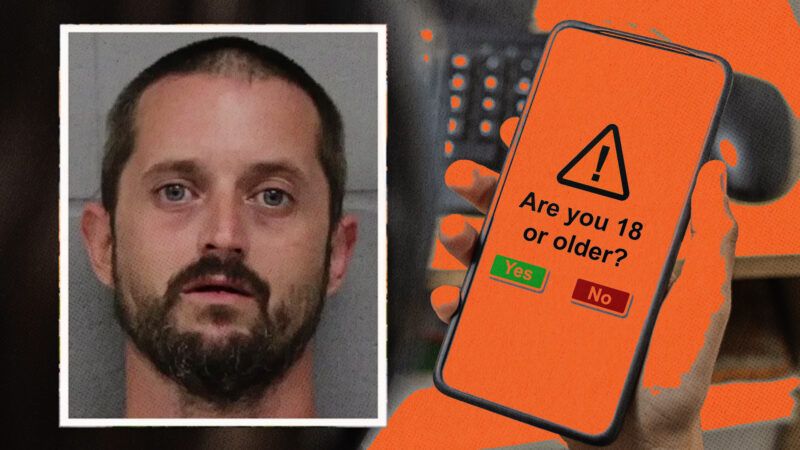
"Unlock my fucking anime," a Texas man told authorities in an expletive-laden rant last month. He now faces criminal charges.
The man called the office of Texas Gov. Greg Abbott on July 25, apparently upset that he was being blocked from viewing anime of some sort.
You are reading Sex & Tech, from Elizabeth Nolan Brown. Get more of Elizabeth's sex, tech, bodily autonomy, law, and online culture coverage.
"I don't know which one of you sons of bitches passed this motherfucking bill to get this damn shit blocking my motherfucking anime, but you whole ass motherfuckers need to unpass this shit," he allegedly said in a voicemail, the transcript of which was provided to KXAN by the Texas Department of Public Safety. "Y'all are fucking ridiculous with your bitch asses. My Google account says I'm fucking over the age of 18, and your dumbass is passing these dumbass laws"
So far: hero. Because the caller—identified by the state as Joseph Roy Ozment—is spot on about these laws, even if it's not quite clear precisely which law he's talking about.
Texas law now requires age verification by app stores and age verification by adult websites. Either might be responsible for preventing an adult from viewing anime of certain varieties.
Some porn platforms have blocked Texas viewers entirely, which could explain why the caller was blocked. Or it's possible he wasn't literally blocked but still couldn't access the content he wanted to because he wasn't able or willing to show an ID. (Of course, he may have just had an internet connection issue, or been delusional, or otherwise been blocked from intended content somehow. But for the sake of discussion, I'll take him at his word that this had something to do with proving his age.)
These laws are huge invasions of privacy and undoubtedly deeply frustrating to many. They mean that adults trying to access legal content—including literally any app, not just ones intended for mature audiences—have to go through an age verification process of some sort. (In a recent Carnegie Mellon University study, most people asked to participate in a survey for the chance to win prizes would not go ahead with it when asked to verify their age by submitting an ID).
Here's where Ozment went wrong: He allegedly ended his anti-age-verification rant with "I'm a fucking stab every goddamn one of you bitches. Unlock my fucking anime."
While kind of hilarious if not taken literally, of course authorities took it literally.
Ozment was arrested on suspicion of making a terroristic threat against a public servant. According to Travis County, Texas, court records, Ozment has not yet been formally indicted on the charge, a third-degree felony that could come with a penalty of up to 10 years imprisonment and a $10,000 fine.
Should he be? That depends on whether he was making what's known as a "true threat." True threats are not protected by the First Amendment. But what counts as a true threat isn't always so simple to determine.
"A true threat is a statement that frightens or intimidates one or more specified persons into believing that they will be seriously harmed by the speaker or by someone acting at the speaker's behest," writes law professor Kevin Francis O'Neill. "The speaker need not actually intend to carry out the threat, but the prosecution must prove that he or she intended to communicate a threat."
One can't definitively tell from the call transcript alone here whether Ozment was being serious. But I highly doubt he actually intended to stab anyone. This seems like hyperbolic and expressive language, uttered to convey exasperation rather than actually to threaten anyone. He doesn't even quite know who he's mad at ("I don't know which one of you sons of bitches passed this motherfucking bill"), and he directs the stabbing comment at "every goddamn one of you bitches," further suggesting he's not serious.
Unfortunately for Ozment, it might not matter if the threat of stabbing was never serious. According to the Texas Department of Public Safety, the governor's office employee who first listened to the voicemail said he feared for him and his coworkers' lives. If they believed they were threatened, what matters is whether Ozment intended to communicate the threat, not whether he intended to actually carry it out.
And, on one level, of course he intended to communicate the threat—he intentionally called the office, and then he said it. But did he really intend to communicate a threat? A free-speech-friendly lawyer might argue that while he obviously intended to make the phone call and to rant about his displeasure, he was using exaggerated or symbolic language and didn't actually intend for his message to be threatening.
The Supreme Court has recognized hyperbole as a consideration in threat assessments. More from O'Neill:
In Watts v. United States (1969), the Supreme Court sided with an 18-year-old anti-war protester who was being prosecuted for allegedly threatening President Lyndon B. Johnson. The defendant was arrested at an anti-war rally after telling a crowd of demonstrators, "If they ever make me carry a rifle, the first man I want to get in my sights is L.B.J." He was convicted under a federal statute that criminalizes any threat to kill or injure the president. Although the court deemed the statute constitutional on its face, it held that the defendant's remark was the sort of "political hyperbole" that did not constitute a "true threat." Accordingly, it could not be deemed to fall within the statute's reach and could not be punished under the First Amendment.
But the court determined that part of what made Watts' comments acceptable was their conditional nature (if they make him carry a rifle, then…) and the fact that they were said at a political rally. Calling a political office and leaving a private voicemail with a non-conditional statement about stabbing is certainly different in nature than making a performative, theoretical statement in front of a crowd.
In a more recent Supreme Court case, the justices held that for a statement to be a true threat, the speaker must realize that their words are likely to be perceived as threatening. Did Ozment meet this threshold? I guess that remains to be seen.
Maybe time will prove that Ozment was dead serious (no pun intended) about stabbing people, but I would be very surprised by that. To me, this seems like an understandable rant about bad and frustrating policies—policies that are, alas, proliferating around the country. I hope Ozment finds a good lawyer.
In the News
Meta ordered to pay $567 million in New Mexico case. Terrible metaphor alert: Social media is "a factory [that is] emitting pollution into the air," writes New Mexico judge Bryan Biedscheid in an August 8 decision finding "significant numbers of people in New Mexico experience harm from Meta's products due to risks of sexual exploitation, interference with education, and adverse mental health outcomes." The decision comes after a two-phase trial held earlier this year in a case involving New Mexico accusing Facebook, Instagram, and WhatsApp of being a public nuisance and violating the New Mexico Unfair Practices Act.
In a melodramatic and widely overreaching decision, Biedsschied wrote that "Meta's platforms and its conduct related to those platforms cause harms that significantly interfere with public safety, public peace, and public comfort" and that "Meta has interfered with a public right and shared public resources."
"Biedscheid fined the company $567 million in his ruling Thursday, but he also prescribed steps to clean up what he described as its byproducts," notes PBS:
He ordered new safety measures, including a time limit of 90 hours per month for users under 18, AI chatbot restrictions and mandatory warnings on the platforms….
The ruling came in the second phase of a trial in a lawsuit the state of New Mexico filed against the social media giant. The new financial penalty is in addition to the $375 million in civil penalties that jurors ordered against Meta in March after determining the company knowingly harmed children's mental health and concealed what it knew about child sexual exploitation on its platforms.
Meta said in a statement Thursday that it works to keep people safe on its platforms and has been transparent about the challenges of identifying and removing bad actors and harmful content.
"We remain confident in our record of protecting teens online and will continue to defend ourselves against claims that misrepresent the facts," the company said.
Several states have proposed or passed laws mandating warning labels of the sort that the judge in this case imagines. A federal court is considering whether Minnesota can require a warning label on social media. Another federal court already struck down such a requirement for adult websites in Texas.
As Clay Calvert of the American Enterprise Institute points out, there are "constitutional problems" with government-mandated warning labels on social media.
It's also just silly. Does anyone honestly think that people who have been impervious to years of cultural hype (and government propaganda) around social media's alleged harms are going to be suddenly swayed by a line of boilerplate text telling them to log off?
Nonetheless, the New Mexico case is worrying in that is a success for a strategy of circumventing the First Amendment by couching concerns over content on social media as "product design" issues or a matter of "failure to warn."
Read This Thread
Sure citizens support "child safety" policies when they don't even understand how they would work. If you tell them the truth…
that all of these policies create mass data collection, surveillance, and censorship…they may not be as likely to jump on the "Save us, please, Daddy… https://t.co/RHvMTm6Ck1— Julie Barrett (@juliecbarrett) August 9, 2026
Followup
Senators advanced the awful "child safety" package that this newsletter covered last week. The Shielding Children's Retinas from Egregious Exposure on the Net (SCREEN) Act, which would have set a national ID verification requirement for online adult content, failed to advance, but the Kids Online Safety Act (KOSA) did. Reason's Megan O'Rourke has more:
"It imposes what courts have refused—on First Amendment grounds—to impose for decades: a duty to protect listeners from subjective, unknowable reactions to constitutionally protected speech," [lawyer Ari] Cohn wrote on Wednesday.
KOSA, which Congress has considered in various forms since 2022, requires "covered online platforms" like social media sites and video streaming services to "implement tools and safeguards to protect users and visitors under the age of 17." The most recent version of Sen. Marsha Blackburn's (R–Tenn.) bill is expected to pass, but could face opposition from the House of Representatives, reports The Hill. The main point of disagreement between the two chambers is a "duty of care" measure, which would require social media companies to "prevent and mitigate certain harms that they know their platforms and products are causing to young users." An FAQ page by cosponsor Sen. Richard Blumenthal (D–Conn.) claims the "Kids Online Safety Act would not censor, block, or remove any content from the internet," and that the duty of care "requires social media companies to prevent and mitigate certain harms that they know their platforms and products are causing to young users as a result of their own design choices." But, as the Foundation for Individual Rights and Expression has noted, "design features" can be "broadly defined to include any feature of the platform that would cause minors to spend time on it."
The committee's children's safety push did not end with KOSA. The committee also advanced a bill that would require users under 18 to get parental consent before using chatbots, and another "requiring AI companies to implement critical privacy safeguards" on chatbots. It also supported the Children's Artificial Intelligence Toy Safety Act, which would require the Federal Trade Commission to make a plan to "address" the potential harms from AI-enabled toy products and would require the National Academies of Sciences, Engineering, and Medicine to conduct a comprehensive study about the potential harms of AI-enabled toys. The committee reportedly planned to mark up additional AI bills, but Sen. Ted Cruz (R–Texas) told Politico last week that the committee moved the markup to September due to a lack of "bipartisan agreement" on the issue.
More Sex & Tech
I'll soon be introducing a bill to withhold all federal funding for cameras used to track American citizens. pic.twitter.com/NcOVllu63b
— Thomas Massie (@RepThomasMassie) August 7, 2026
• Meet the 77-year-old Florida man who is singlehandedly thwarting automated license plate readers. Carl Gunn "goes up to a different camera each day and holds a sign in front of its lens," reports Cybernews. The "Down with Flock" sign "is not touching, damaging, or interfering with the equipment itself. Authorities say he is not violating the law."
• One Night Only's marketing makes it appear to be an ordinary rom-com, but it's premised on a dystopian U.S. in which unmarried people can have sex only once per year. "But this isn't really a movie about regulatory crackdowns and legislative maneuvering," writes Peter Suderman. "It's just a quirky, high-concept romantic comedy, reasonably competent and, concept aside, perfectly formulaic."
• "A brand new, peer-reviewed study found that data centers actually caused average U.S. retail electricity rates to 'fall modestly' between 2015 and 2024, because the centers' high, steady power demand helped spread a grid's fixed costs over more usage," reports Scott Lincicome. "This finding is counterintuitive but consistent with research from 2025 that high-demand areas—including ones like North Dakota and Virginia that saw an explosion of data centers—'saw lower prices overall,' while prices rose in places like California where demand had declined."
• Kids under age 16 would be banned from social media without parental consent under a new bill proposed by Sen. Ruben Gallego (D–Ariz.). The measure would, of course, require ID verification for all social media users. And in other bad legislative news:
🚨DIGITAL ID Whack-A-Mole continues…a new "screen time" bill in Congress is being sold as a simple tool to help parents manage kids' devices. And…it's bi-par-ti-san 👏👏👏
The Tracking Online Time and Limits Screen Time Act (TOTAL Screen Time Act) creates the first federal… pic.twitter.com/hMoNYNt4J7
— Julie Barrett (@juliecbarrett) August 7, 2026
• Artificial intelligence is already beating doctors at diagnosing patients.
• Democratic lawmakers propose taxing AI companies to offset potential future job losses.
• Erich Grunewald points out what I always think of as the biggest case against using AI to write even so much as your grocery list: "The writing process is an essential part of the thinking process."




