

Texas Tech's Vague Restrictions Show You Don't Have To Ban Speech To Silence It
If someone is uncertain enough about meaning, they will censor themselves first.
Nine years ago this summer, the Supreme Court ruled unanimously in my favor in Matal v. Tam—the case about my band's trademark that most people remember as a fight over offensive speech. It wasn't, really. The government never argued I couldn't call my band The Slants. It argued that officials, not I, got to decide what the name meant. The Court rejected that claim to interpretive authority: "Speech may not be banned on the ground that it expresses ideas that offend."
That fight didn't end in 2017. Once again, public officials are trying to restrict speech protected by the First Amendment by trying to implement vague standards of meaning.
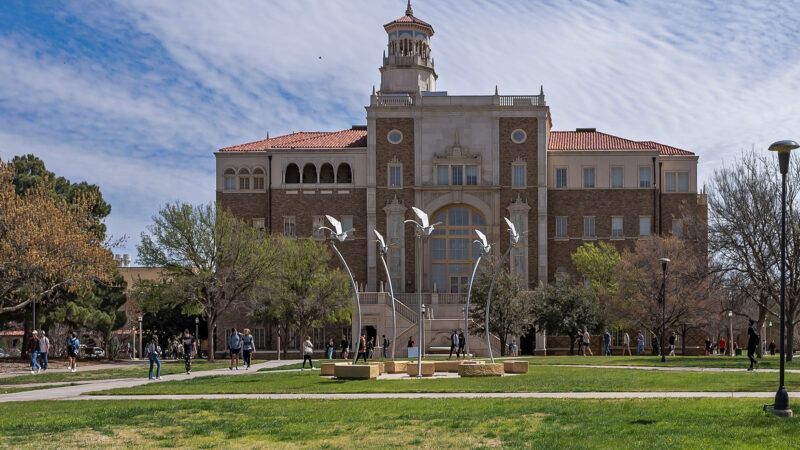
Faculty at the public Texas Tech University System have been directed to review their course materials, syllabi, and curricula and to make "timely adjustments where needed." Instructors must avoid "advocacy/promotion" of certain viewpoints and keep instruction "neutral," without "compelling students to adopt a particular belief." Materials touching on race, gender identity, or sexual orientation must, in some cases, be submitted for approval before they reach a classroom. There will be a "system-wide phase-out" of programs "centered on" sexual orientation and gender identity, and future graduate theses on those topics face new restrictions.
Faculty groups sued the system on July 8, arguing these directives violate the First Amendment's Free Speech Clause and the 14th Amendment's protections against vague standards and racial discrimination. The lawsuit also argues the directives chill speech, because professors "cannot reasonably make sense of what is and is not prohibited." The university maintains the policies are lawful.
A Faculty Senate survey at Texas Tech's Lubbock campus found that professors altered, or were asked to alter, material in 277 courses. (That claim is refuted by the university, which questioned the survey's methods and total of altered courses.) Around half of the faculty surveyed changed content on their own out of concern over the memos; roughly a quarter said administrators asked them to. More than half said they were job-hunting elsewhere because of the restrictions. Whether or not you think the directives constitute censorship, faculty are behaving as though their speech is constrained: rewriting syllabi, dropping readings, steering clear of topics. That behavior is the chilling effect. Public universities don't need to ban speech. They only need faculty to wonder, in advance, whether their words will be interpreted as a violation.
That's the same mechanism I encountered at the U.S. Patent and Trademark Office. Those officials never explicitly said I couldn't use the name, just that I couldn't register it as a trademark. They claimed the authority to interpret it, to decide that "The Slants," regardless of my stated intent or my community's actual reception of it, disparaged people of Asian descent. When the government becomes the editor of meaning, everyone downstream behaves accordingly.
The Supreme Court understood this in 2017. The vagueness doctrine exists precisely because speech-restricting standards that are undefined distort behavior even when no one is ever formally punished. Texas Tech's "advocacy" and "centered on" standards are functionally vague: Professors must guess at what runs afoul of these standards, and rational actors guess conservatively. The Faculty Senate survey captured that dynamic in real numbers.
Teaching historical facts—that slavery existed, that Japanese Americans were incarcerated during World War II, that LGBTQ+ people have faced legal persecution, or that health disparities exist along racial lines—doesn't automatically endorse a political position. Once academic inquiry has to dodge disfavored interpretations to survive review, the government has effectively become the editor of academic meaning.
Public universities have legitimate authority to set educational priorities. What they can't do under the First Amendment framework that Matal v. Tam reinforced is position themselves as the final interpreter of what a given academic discussion means and require prior approval before it happens.
Beneath the ideology sits a bureaucratic problem that compounds the constitutional one. When faculty must submit material for approval, run content through AI flagging tools, and guess at what counts as "centered on" a disfavored subject, the system produces distorted behavior long before anyone is formally sanctioned. The Trademark Office operated the same way: Examiners applied subjective standards inconsistently; the process excluded the kinds of community evidence that would have corrected their conclusions, and the official record propagated the error.
Professors on the left and right face the same problem when the government claims interpretive authority over teaching. The same apparatus underway in Texas is taking similar form in Florida and Ohio. There's a consistent pattern in each of those states: vague standards, approval requirements, and administrative gates that leave speakers guessing at what will draw scrutiny. The mechanism persists regardless of which side of the political aisle is running it.
Whether it's a band name that's under fire from the Trademark Office or a professor teaching an unpopular topic, the constitutional problem is the same: The government doesn't need to ban speech to silence it—it only needs to make speakers uncertain enough about meaning that they censor themselves first.




