

Calling Cartels 'Narcoterrorists' Turns Drug Enforcement Into War Making
Brazil’s gangs show why the “narcoterrorist” label is tempting, misleading, and unlikely to stop drugs.
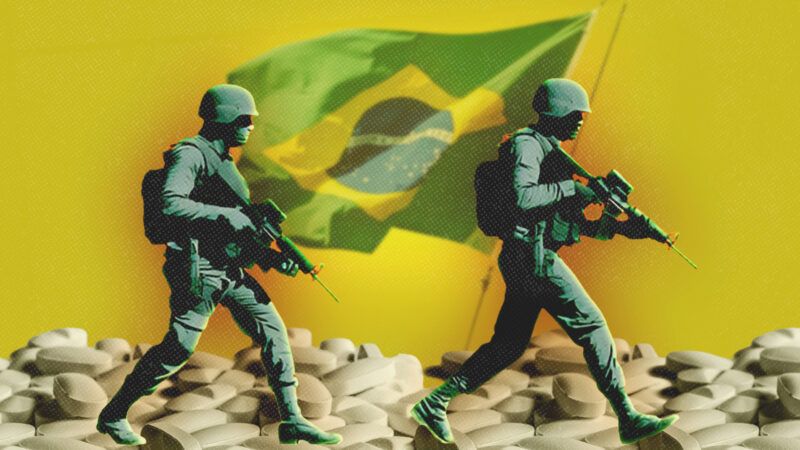
In most countries, gang wars unfold in the shadows. Police collect the bodies, prosecutors hold press conferences, and anyone who avoids the news can pretend nothing is happening. In Rio de Janeiro's favelas, the violence can look more like conventional war: territory changes hands, armed lookouts patrol the hills, and teenagers in flip-flops carry military-grade rifles in the open.
"In Rio de Janeiro, there are three main factions [gangs]," says Fabio Serra, better known as Sagat B. "We have a lot of guns but mainly to fight each other over territory. If the police come, we'll only fight them if there's no other choice—the exchange of gunfire is to cover our escape."
Sagat once managed a crew of drug dealers. "I was more intelligent than the others and very good at dealing with numbers, so I handled the logistics of selling the drugs as well as purchasing weapons and ammunition," he explains. At the time, he was affiliated with Brazil's two most powerful criminal organizations: Rio's Red Command and the Sao Paulo–based First Capital Command (PCC).
After three prison terms totaling 12 years, Sagat left crime behind. He is now an author, podcaster, barbershop owner and anti-crime activist. But his former associates have become targets in a much larger campaign: the Trump administration's efforts to recast drug gangs as terrorist organizations and drug trafficking as war.
Since returning to office, President Donald Trump has escalated his campaign against "narcoterrorists," treating drug smuggling as an "armed attack" and blurring the line between criminal enforcement and war. His administration has described foreign drug cartels and other criminal gangs as "non-state armed groups" or "unlawful combatants," a term introduced during the Bush era to deny suspected terrorists protections afforded under the Geneva Conventions.
In August of last year, Trump signed a secret directive authorizing military strikes on narco-terrorists. By September, U.S. forces were bombing alleged drug boats in the Caribbean. In December, the administration followed with an executive order classifying fentanyl as a weapon of mass destruction, claiming that it could be "weaponized for concentrated, large-scale terror attacks by organized adversaries."
"I think we're just gonna kill people that are bringing drugs into our country," Trump said.
The narco-terrorist label keeps expanding. In May, the State Department added the PCC and Red Command to its terrorism blacklist, designating them as foreign terrorist organizations. But what has that accomplished for drug control?
Why the Terrorist Label Changes What the U.S. Military Can Do
The label matters because it changes the tools available to the U.S. government. A drug trafficker is normally a criminal suspect. A terrorist can be treated as a military target. That shift—from law enforcement to war making—is the central move in Trump's new drug strategy, though the idea of treating cartels as terrorists has been gaining ground for years.
Trump considered the move during his first term after cartel gunmen killed nine American women and children from a Mormon community in northern Mexico in 2019. The idea persisted as the overdose crisis worsened in the U.S., with annual deaths surpassing 100,000 in the early 2020s. The late Sen. Lindsey Graham (R–S.C.) even compared the Mexican cartels to terrorist groups like ISIS and Al Qaeda.
The PCC shows why the label is tempting—and why it can be misleading.
The group was born after the Carandiru prison riot in 1992, which ended when military police stormed the facility and killed 111 inmates. The PCC became a crime syndicate, but it also functions as a prisoners' advocacy group and family support network. Its antiestablishment rhetoric appeals to alienated young prisoners, especially those who have experienced police brutality, and to Afro-Brazilians, who are disproportionately imprisoned in the war on drugs.
"When I first arrived in prison, I was afraid I'd be abused for no reason," Sagat remembers. Instead, he says, he was given a rulebook. Prisoners were forbidden from abusing one another, disputes were judged by a commission, and guards were to be treated with respect so long as they treated prisoners with dignity. "That's why bad things didn't happen in the prison," he says. "We were all united against the authorities."
But PCC rules did not eliminate violence altogether, and when prison authorities used torture, Sagat says, "the situation gets out of control, claiming the lives of both inmates and guards."
While the PCC has something like an ideology—prisoners' rights, mutual protection, and resistance to abusive state power—it's also capable of great violence. In May 2006, the group paralyzed Sao Paulo—South America's biggest metropolis—with coordinated attacks on police stations, buses, banks, and public buildings, while prison riots broke out across the state. Over the course of four days, 39 police officers and prison guards, and four civilians, lost their lives.
"They use terror as a tool sometimes," says Marcos Alan Ferreira, an associate professor at the Federal University of Paraíba. But, he adds, "they prefer to use other tools because violence invites [a stronger response from the state]."
In the weeks after the Sao Paulo attacks, police death squads allegedly executed more than 500 people, some of them innocent bystanders from the city's poorest neighborhoods.
Still, Ferreira argues, the PCC's core purpose is not political reform. "Their ideology is economic gain," he says, "mainly dealing in drugs but in recent years, environmental crimes in the Amazon like illegal mining or timber exploitation."
That profit motive has helped make the PCC Brazil's largest gang, with more than 100,000 members and associates, and a major player in the trans-Atlantic cocaine trade together with Italy's 'Ndrangheta mafia. "This is far from Islamic terrorism or any other group that uses terror as a tool to reach political objectives," Ferreira says.
Its counterpart in Rio, the Red Command, had more explicitly ideological origins. In the late 1970s, left-wing militants were imprisoned alongside ordinary criminals on Ilha Grande, Brazil's version of Alcatraz. The militants brought revolutionary theory; the criminals brought practical knowledge of robbery, smuggling, and street violence. But by the 1980s, the cocaine trade had expanded, the favelas had become ideal open-air markets, and the Red Command had become less about robbing for the revolution and more of a conventional gang.
"The word terrorism doesn't really fit, because even if the factions are extremely violent, there's never been any serious intention to overthrow the government for a new regime," says Sagat.
But once Washington applies the label, the question is no longer just whether it fits. It's what the label allows the U.S. government to do.
"It doesn't matter if they have some similarities or not to Al Qaeda or the Islamic State," says Guadalupe Correa-Cabrera, a professor at George Mason University and author of the book Carteles, Inc. "They are now foreign terrorist organizations for U.S. law, and that really changes the whole role of the United States outside its frontiers within the Western Hemisphere….Now you can use the military directly to go after these nominated terrorist organizations, and this is a transformation from a law enforcement problem towards a military issue."
How the Drug War Went From Arrests to Airstrikes
The terrorism label turns the drug war into something closer to an actual war. A campaign that once moved through arrests, extraditions, seizures, and sanctions can now move through military strikes, intelligence operations, and regional security alliances.
The clearest evidence is the U.S. government's grainy footage of alleged drug-smuggling boats being blown out of the water off the Caribbean coast of Venezuela. So far, 221 people have been killed, including some who were allegedly "double-tapped"—struck again after surviving the first hit—or attacked while attempting to surrender.
The U.S. government insists its targets are drug smugglers chosen based on intelligence, but it has not publicly presented evidence of their guilt. Given the record of U.S. intelligence during the extrajudicial drone campaigns of Presidents George W. Bush and Barack Obama, there is reason to be skeptical. In an ordinary drug case, the government's claims could be tested in court. Here, the targets are often dead before that can happen.
The strikes have damaged the cooperation the drug war depends on. Drug trafficking is, by definition, a transnational business: Coca leaves can't be grown in Nebraska. Any serious effort to combat trafficking requires international cooperation. Instead, fearful of being implicated in war crimes, Britain, the Netherlands and Canada are among those who've reportedly stopped sharing intelligence with the U.S.
The boat strikes are only the most visible part of a broader military campaign. The CIA is also helping track down narco leaders in Mexico, while the U.S. is leading joint operations with the military in Ecuador. In March, Ecuadorian President Daniel Noboa, Salvadoran President Nayib Bukele, Argentine President Javier Milei, and other right-leaning leaders joined the Shield of the Americas, a U.S.-led alliance against criminal gangs. The trend is clear: Across the Western Hemisphere, the drug war is becoming increasingly militarized.
Brazil is not being targeted by U.S. airstrikes. But it shows what that militarized thinking can look like when led to its logical conclusion. In October, Rio's military police launched Operation Containment, a paramilitary invasion of the Penha and Alemão favelas meant to arrest a Red Command boss and his lieutenants. The raid was the deadliest in Brazilian history, leaving between 117 and 132 dead. Suspects retreated into nearby woods, where they reportedly ran straight into a police ambush. Officers fired at anything that moved. Echoing Trump's rhetoric, Rio Gov. Cláudio Castro described the operation as a great success against "narcoterrorism."
But the boss escaped, and residents reported seeing gang members patrolling the streets the very next day. The operation may have boosted the governor's approval ratings, but it did little to break the gang's grip on the favelas.
The terrorist designation also gives an old tool new reach: financial sanctions. Anyone who does business with these groups, knowingly or unknowingly, can have bank accounts frozen, businesses sanctioned, and U.S. visas revoked. And since the PCC now has interests in everything from public transport to healthcare, those penalties could reach far beyond gang members and into ordinary economic life.
"Do not play games with the sovereignty of this country," Brazil's President Luiz Inácio Lula da Silva warned in response to the U.S. labeling criminal groups as terrorists. "Do not play games with our democracy."
Cocaine Prices, Seizures, and Overdose Deaths Since the Strikes Began
For all the war-on-terror rhetoric, Trump's counternarcotics strategy has produced little evidence of success. Cocaine remains accessible and affordable. Prices have stayed roughly stable, at about $60 to $100 a gram.
Meanwhile, the volume of cocaine intercepted by U.S. Customs and Border Protection (CBP) actually increased, from more than 43,000 pounds in the eight months before the strikes began to nearly 48,000 between September and April. That doesn't necessarily mean the CBP is winning. The Department of Homeland Security (DHS) estimates that only about 3 percent of cocaine is seized at the border. Higher seizures might simply reflect higher traffic or shifting routes.
Fortunately, overdose deaths have been falling dramatically, as has the quantity of fentanyl seized by the CBP (likely indicating that less of the potent opioid is now being sent across the border). But both of those positive trends began during Joe Biden's presidency, well before Trump began sinking suspected smugglers. The causes are largely other factors—including supply chain disruptions in China and wider availability of the overdose-reversing drug naloxone—rather than waging war against narcos.
Even if military strikes against drug smugglers were effective, they appear to be aimed in the wrong direction. Much of the cocaine shipped from Venezuela and Brazil is headed across the Atlantic, not to the United States. It is therefore unsurprising that attacking these routes has done little to affect the U.S. drug markets.
"Regarding the reaction of criminal organizations, I don't think things will be too difficult for them because it's important to remember that for both the PCC and Red Command, internationally, the European and West African markets are more important than the U.S.," says Ferreira. "Maybe they will avoid any travel to North America, but in general, I don't think they are too concerned."
Why Trump Pardoned One Trafficker and Targeted Maduro for the Same Crime
The poor results are not the only reason to doubt the strategy. The narco-terrorism framework also appears to bend around political convenience.
In December, Trump pardoned former Honduran President Juan Orlando Hernández, a convicted cocaine trafficker from the same right-wing party as the presidential candidate that Trump was backing. Yet the administration pursued far more aggressive action against Venezuelan leader Nicolás Maduro over similar allegations. The same drug-war framework that could be softened for one political ally could be intensified against an enemy.
The PCC and Red Command's terrorist designation also came after lobbying from Flávio Bolsonaro, a presidential candidate and the son of former Brazilian President Jair Bolsonaro, a Trump ally. The Bolsonaro family, meanwhile, has long faced scrutiny over its links to Rio's milícias—mafia-like paramilitary gangs made up largely of off-duty and former police officers. These groups have wrested control of large parts of Rio from the Red Command, and engage in many of the same criminal activities as favela drug dealers, but with institutional protection and political connections.
Notably, the milícias are not on the State Department's blacklist.
The selective use of terrorist designations points to a deeper problem with the narco-terrorism framework. It treats criminal organizations as ideological enemies when they are better understood as suppliers in an illegal market. The result is not better drug control, but a broader permission slip for war making. The violence follows not from terrorism, but from prohibition: a market made illegal, extremely profitable, and therefore worth killing over.




