

Washington Promised Puerto Rico $14 Billion To Fix Its Grid. Most of the Money Is Still Stuck.
A new GAO report attributes the delays to onerous regulations and poor coordination among government agencies.
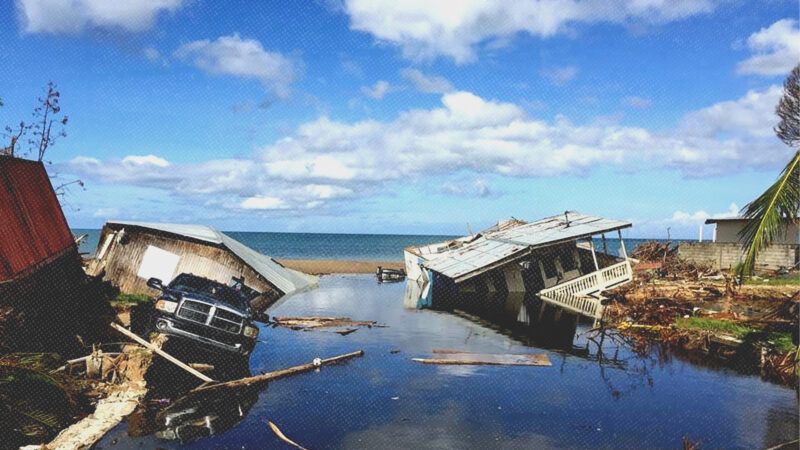
In 2017, Hurricane Maria devastated Puerto Rico, causing an 11-month blackout in some parts of the island. In the years since, the federal government has allocated billions of dollars to fix the grid. However, only a quarter of this funding has actually reached the island, according to a new government report.
A federal audit released last week by the Government Accountability Office (GAO) revealed that of the $14 billion obligated for grid repair and modernization in Puerto Rico since 2017, around 75 percent, or $10.7 billion, remains undisbursed. The Federal Emergency Management Agency (FEMA) was the slowest mover of funds identified in the report, with only $2.7 billion of its total $11.1 billion in obligated funds disbursed. According to the GAO, a measly nine FEMA-funded projects have been completed as of December 2025, while 249 are "at different stages of completion."
Approximately half of the island's frequent outages are caused by vegetation growing too close to transmission and distribution lines. Luma Energy, the island's private utility, estimated that clearing vegetation around power lines, substations, and facility access roads would cost $1.2 billion. The utility has submitted funding requests for 34 vegetation-clearing projects to FEMA as of December, but FEMA has obligated only roughly $103 million for nine of them. And, thanks to the many layers in the federal bureaucracy, numerous environmental reviews, and complex permitting, most of these projects are still less than halfway complete. Overall, federal funding has cleared only 400 of the 16,000 miles planned for vegetation clearing, according to the GAO.
With the island's antiquated power plants unable to generate about a third of the electricity needed during peak demand last year, upgrading Puerto Rico's aging power generation is critical to ensuring reliable electricity for the island. However, here too, the federal government has been slow to provide a solution.
As of December 2025, FEMA had obligated about $1.3 billion to 24 generation projects, only seven of which were complete. Part of these delays was due to the island's aging infrastructure; as some stakeholders told the GAO, given the age of Puerto Rico's generation assets, finding replacement parts often requires "reverse engineering or long wait times, sometimes up to 2 years." Luma officials have identified substations as a key area for grid stability, yet just one of 32 substation projects for which FEMA has obligated almost $482 million has been completed. FEMA has also obligated $44 million for a project to upgrade Puerto Rico's energy management system, which was only about 65 percent complete as of late 2025. According to one stakeholder, these and other grid projects continue to face delays due to FEMA's lengthy review process, which includes "conducting an environmental and historic preservation review."
Operators also have to contend with the growing number of Puerto Ricans who have switched to rooftop solar panels—which generate over 10 percent of the island's electricity—to provide a buffer against the grid's instability. Consequently, the rapid growth of decentralized rooftop solar creates grid-management challenges for an aging system, especially if the grid lacks the smart inverters, storage, and controls needed to balance variable output.
However, it is not just the federal government that has failed the Puerto Rican taxpayer; the Puerto Rican government is also at fault for actively inhibiting the timely use of recovery funds and basic grid repairs. This includes legislation passed in 2024 to levy a construction excise tax on federally funded recovery projects—resulting in higher project costs and slower grid repairs—and a series of legal battles between the Puerto Rican government and Luma Energy, which has compounded the delays and mismanagement of the island's grid recovery.
The GAO, with federal concurrence, outlines several recommendations to address the island's grid woes. These include streamlining FEMA's environmental review process and establishing strong mechanisms to facilitate coordination between the federal and Puerto Rican governments.
While not mentioned in the report, another clear fix would be repealing the Merchant Marine Act of 1920. Often called the Jones Act, this law requires any goods shipped between two U.S. ports to be transported on an American-built ship manned by a mostly American crew. Since there is only one Jones Act-compliant ship for liquefied natural gas, which accounts for a significant portion of the island's electricity generation, the law has forced the island to pay more for American liquefied natural gas than its neighbor, the Dominican Republic, and regularly slowed down hurricane recovery.
In March, President Donald Trump issued a Jones Act waiver, which has allowed "bulk propane shipments [to reach] Puerto Rico from Texas and Pennsylvania for the first time ever," writes the Cato Institute's Colin Grabow. Repealing the law would ensure that shipments like these become a regular thing and allow Puerto Rico to deliver more affordable electricity to its grid.
Government infighting and incompetency have condemned 3.5 million Puerto Ricans to suffer under what is perhaps the worst power grid system in the Western world. Even without accounting for natural disasters, customers in Puerto Rico experienced an average of 27 hours of power grid interruptions per year between 2021 and 2024. For the continental United States, that number is only two hours. Yet, despite this abysmal quality, Puerto Ricans continue to pay electricity bills up to 31 percent above the national average.
As Washington drags its feet and San Juan plays politics, ordinary Puerto Ricans are left paying high rates for a grid that routinely fails them, while mainland taxpayers fund what has essentially become an endless money pit.




