Reason.com - Free Minds and Free Markets
Reason logo Reason logo
  • Latest
  • Magazine
    • Current Issue
    • Archives
    • Subscribe
    • Crossword
  • Video
    • Reason TV
    • The Reason Roundtable
    • Free Media
    • The Reason Interview
  • Podcasts
    • All Shows
    • The Reason Roundtable
    • The Reason Interview With Nick Gillespie
    • Freed Up
    • The Soho Forum Debates
  • Volokh
  • Newsletters
  • Donate
    • Donate Online
    • Ways To Give To Reason Foundation
    • Torchbearer Society
    • Planned Giving
  • Subscribe
    • Reason Plus Subscription
    • Print Subscription
    • Gift Subscriptions
    • Subscriber Support

Log In

Create new account

Supreme Court

10 Big Supreme Court Cases To Go

Plus: The Kelo debacle turns 21.
Damon Root | 6.25.2026 7:00 AM

Share on FacebookShare on XShare on RedditShare by emailPrint friendly versionCopy page URL Add Reason to Google
Media Contact & Reprint Requests
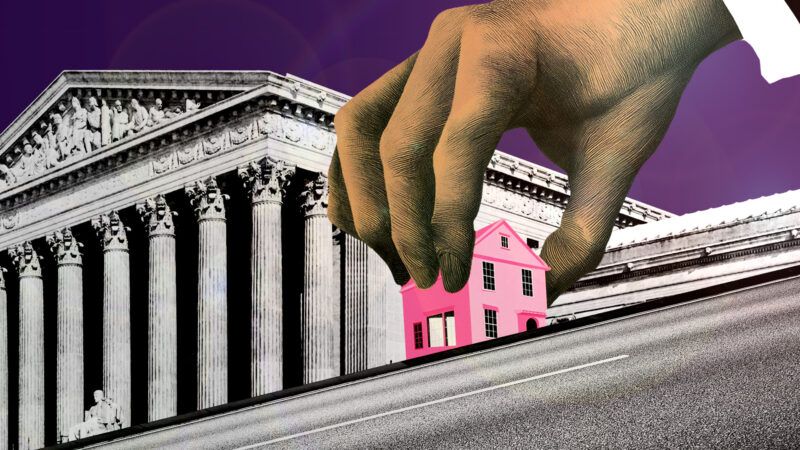
PinkHouse-SCOTUS-6-24 | Adani Samat/Midjourney/Svitlana Lutso
(Adani Samat/Midjourney/Svitlana Lutso)

Greetings and welcome to the latest edition of the Injustice System newsletter. The month of June is rapidly coming to a close, and the U.S. Supreme Court has officially begun its mad dash to the finish line, aiming to release all opinions in argued cases by either the end of the month or—judicial vacation plans permitting—by sometime in early July.

How are the justices doing in terms of the workload? Well, a little over a month ago, I wrote about the "11 big cases that I'll be watching out for in the weeks ahead." As of this writing, a whopping one of those 11 has been decided. I was a history major back in college, so I'll let you do the math.

We're expecting more opinions today. Which means that by the time you're reading this newsletter, we may already be dealing with momentous rulings on issues ranging from state bans on transgender student athletes to the reach of the Second Amendment's right to keep and bear arms to the constitutionality of mail-in ballots that were sent by election day but not received until after election day.

You’re reading Injustice System from Damon Root and Reason. Get more of Damon’s commentary on constitutional law and American history.

This field is for validation purposes and should be left unchanged.

And then there is the none-too-small matter of executive power. If any single issue is going to define this rambunctious 2025–26 SCOTUS term, then the debate over the proper scope of presidential power is probably it. The showdown over birthright citizenship, for instance, all started with an executive order from President Donald Trump that purported to do what the text and history of the Birthright Citizenship Clause do not permit the president to do. So in addition to being a case about the original meaning of the 14th Amendment, Trump v. Barbara is also a case about executive authority.

Meanwhile, executive power is truly front and center in Trump v. Slaughter and Trump v. Cook, each of which deals with the scope of presidential control over the leadership of "independent" federal agencies. Trump seems likely to win at least one of these cases, with a majority of the Court seeming likely to allow him to fire a commissioner of the Federal Trade Commission for purely political reasons, rather than "for cause," as the law, and perhaps soon-to-be-overruled Supreme Court precedent, currently require. That's Trump v. Slaughter.

Trump v. Cook is a horse of different color. In this case, Trump seeks to fire a member of the Federal Reserve's Board of Governors "for cause," yet whether or not his purported cause for firing her actually satisfies the "for cause" requirement in federal law is far from settled. I can imagine Trump losing this one. But you never know.

In Other Legal News

This week marks an unhappy anniversary in American legal history. On June 23, the case of Kelo v. City of New London (2005) turned 21 years old. That's the case in which a 5–4 Supreme Court let a local government bulldoze a thriving neighborhood so that private developers would have a blank slate on which to build, all in the hopes of increasing the local tax base.

The constitutional question at the heart of Kelo was whether this use of eminent domain was lawful under the Fifth Amendment, which says that private property may only be taken by the government for a "public use," a term that has traditionally been understood to cover things such as roads, bridges, tunnels, and parks.

Writing for the majority, Justice John Paul Stevens embraced a far more elastic concept that appears nowhere in the text of the Constitution. "The disposition of this case," Stevens asserted, "turns on the question whether the City's development plan serves a 'public purpose.' Without exception," he declared, "our cases have defined that concept broadly, reflecting our longstanding policy of deference to legislative judgments in this field."

How did that misguided judicial deference work out in the end? The homeowners got the boot, the neighborhood was razed, and then the entire redevelopment scheme fell apart. Nothing was ever built. In 2011, local officials urged residents to use the location as a dumpsite for storm debris from Hurricane Irene. And last I checked, the once-attractive neighborhood was still a barren lot.

Sometimes the Supreme Court gets it right. The Kelo debacle is a reminder that sometimes the Court gets it disastrously wrong.


Start your day with Reason. Get a daily brief of the most important stories and trends every weekday morning when you subscribe to Reason Roundup.

This field is for validation purposes and should be left unchanged.

NEXT: Prohibition Didn't Stop Marijuana Use. It Stopped Marijuana Research.

Damon Root is a senior editor at Reason and the author of A Glorious Liberty: Frederick Douglass and the Fight for an Antislavery Constitution (Potomac Books). His next book, Emancipation War: The Fall of Slavery and the Coming of the Thirteenth Amendment (Potomac Books), will be published in June 2026.

Supreme CourtLaw & GovernmentConstitution14th AmendmentDonald TrumpExecutive PowerEminent DomainJudiciary
Share on FacebookShare on XShare on RedditShare by emailPrint friendly versionCopy page URL Add Reason to Google
Media Contact & Reprint Requests

Hide Comments (6)

Editor's Note: As of February 29, 2024, commenting privileges on reason.com posts are limited to Reason Plus subscribers. Past commenters are grandfathered in for a temporary period. Subscribe here to preserve your ability to comment. Your Reason Plus subscription also gives you an ad-free version of reason.com, along with full access to the digital edition and archives of Reason magazine. We request that comments be civil and on-topic. We do not moderate or assume any responsibility for comments, which are owned by the readers who post them. Comments do not represent the views of reason.com or Reason Foundation. We reserve the right to delete any comment and ban commenters for any reason at any time. Comments may only be edited within 5 minutes of posting. Report abuses.

  1. SRG2   2 months ago

    Kelo was indeed an abominably decided case. But 47 states have responded by amending law or constitution to give home-owners greater rights.

    https://ij.org/case/kelo/

    1. Nelson   2 months ago

      Sometimes federalism works to protect rights instead of restricting them. I still find it mindboggling that eminent domain could be used in such an egregious fashion. Eminent domain is deeply concerning to begin with, and expanding it to private actors seems indefensible.

  2. Mike Hansberry   2 months ago

    Kelo is worth remembering, especially for illuminating the political divide. The left leaning justices raised governmental power over individual rights. The right leaning justices sought to uphold individual rights by adhering to the protections written into the constitution.

    Dissent of Justice Thomas:
    "If such "economic development" takings are for a "public use," any taking is, and the Court has erased the Public Use Clause from our Constitution, as Justice O'Connor powerfully argues in dissent. Ante, at 1-2, 8-13. I do not believe that this Court can eliminate liberties expressly enumerated in the Constitution and therefore join her dissenting opinion. Regrettably, however, the Court's error runs deeper than this. Today's decision is simply the latest in a string of our cases construing the Public Use Clause to be a virtual nullity, without the slightest nod to its original meaning."

  3. JesseAz (RIP CK)   2 months ago

    2 big losses for reason.

    Temporary ruled to mean temporary.

    Arrived in means inside, not at the border.

    Us a striking down of hawaiis vampire gun laws requiring affirmative invites for gun carriers.

    Poor damon.

  4. See.More   2 months ago

    Re: Kelo

    The homeowners got the boot, the neighborhood was razed, and then the entire redevelopment scheme fell apart. Nothing was ever built.

    The (former)residents should sue again arguing that, since the expected benefits that justified the "public use" designation for exercising Eminent Domain never materialized, the taking was fraudulent.

  5. Greg J   2 months ago

    Trump v. Cook is a horse of different color. In this case, Trump seeks to fire a member of the Federal Reserve's Board of Governors "for cause," yet whether or not his purported cause for firing her actually satisfies the "for cause" requirement in federal law is far from settled. I can imagine Trump losing this one. But you never know.

    Oh, please. Lisa Cook flat out committed, and continues to commit, mortgage fraud. "For cause" does not mean "you have to have a court trial". She's been given months to prove she didn't commit mortgage fraud, and she's provided no actual defense.

    SCOTUS could rule for her, but it would take a great leap of dishonesty for them to do so

Please log in to post comments

Mute this user?

  • Mute User
  • Cancel

Ban this user?

  • Ban User
  • Cancel

Un-ban this user?

  • Un-ban User
  • Cancel

Nuke this user?

  • Nuke User
  • Cancel

Un-nuke this user?

  • Un-nuke User
  • Cancel

Flag this comment?

  • Flag Comment
  • Cancel

Un-flag this comment?

  • Un-flag Comment
  • Cancel

Latest

Brendan Carr's Vendetta Against ABC Conflates the 'Public Interest' With Trump's Personal Grievances

Jacob Sullum | 8.26.2026 12:01 AM

How Much Will Andy Burnham's 'No. 10 North' Cost British Taxpayers?

Reem Ibrahim | 8.25.2026 4:56 PM

California Bill Would Cap Rents During U.S.-Involved War

Christian Britschgi | 8.25.2026 3:45 PM

The Freedom 250 IndyCar Race Only Looked Like MAGA Propaganda if You Already Hate Trump

Jason Russell | 8.25.2026 12:00 PM

J.D. Vance's Interest in Huey Long Should Be a Red Flag for Conservatives

Eric Boehm | 8.25.2026 11:45 AM

Recommended

  • About
  • Browse Topics
  • Events
  • Staff
  • Jobs
  • Donate
  • Advertise
  • Subscribe
  • Contact
  • Media
  • Amazon
Reason Facebook@reason on XReason InstagramReason TikTokReason YoutubeApple PodcastsReason on FlipboardReason RSS Add Reason to Google

© 2026 Reason Foundation | Accessibility | Privacy Policy | Terms Of Use

This site is protected by reCAPTCHA and the Google Privacy Policy and Terms of Service apply.

Reason's July 4 Special!

For America's 250th, Get 2 Years of Reason for $17.76

Celebrate your independence with a subscription to Reason magazine, your most trusted source of honest, insightful news and analysis.

Subscribe to Reason