

Reason.com - Free Minds and Free Markets
Reason logo Reason logo
  • Latest
  • Magazine
    • Current Issue
    • Archives
    • Subscribe
    • Crossword
  • Video
    • Reason TV
    • The Reason Roundtable
    • Free Media
    • The Reason Interview
  • Podcasts
    • All Shows
    • The Reason Roundtable
    • The Reason Interview With Nick Gillespie
    • Freed Up
    • The Soho Forum Debates
  • Volokh
  • Newsletters
  • Donate
    • Donate Online
    • Ways To Give To Reason Foundation
    • Torchbearer Society
    • Planned Giving
  • Subscribe
    • Reason Plus Subscription
    • Print Subscription
    • Gift Subscriptions
    • Subscriber Support

Log In

Create new account

Supreme Court

The Founders Revered the Right to Trial by Jury. Will SCOTUS Now Follow Their Example?

Understanding the stakes in Kian v. Florida
Damon Root | 6.18.2026 7:00 AM

Share on FacebookShare on XShare on RedditShare by emailPrint friendly versionCopy page URL Add Reason to Google
Media Contact & Reprint Requests
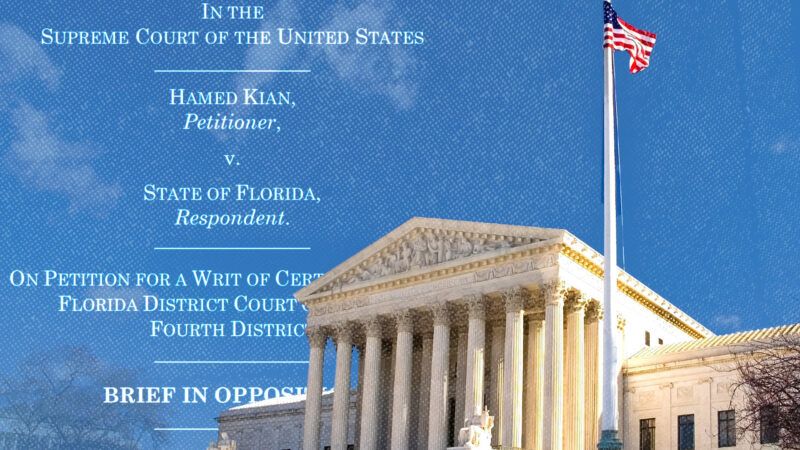
Supreme Court building with text across the image | Ken Cole/Dreamstime
(Ken Cole/Dreamstime)

The U.S. Supreme Court just added a new case to its upcoming 2026–27 docket that should interest fans of early American history.

At issue in Kian v. Florida is whether the Sixth Amendment right to trial by jury requires 12-person juries in all criminal cases. Florida law says it does not. According to that state's statute books, "twelve persons shall constitute a jury to try all capital cases, and six persons shall constitute a jury to try all other criminal cases." Hamed Kian, who was tried by a six-person Florida jury and sentenced to prison for practicing chiropractic medicine with a suspended license, wants the Supreme Court to overturn his conviction and restore the 12-person jury in the Sunshine State and the handful of other states that currently lack it.

You’re reading Injustice System from Damon Root and Reason. Get more of Damon’s commentary on constitutional law and American history.

This field is for validation purposes and should be left unchanged.

To win, Kian will have to persuade a majority of the justices to overrule the Supreme Court's 1970 precedent in Williams v. Florida, which allowed the use of six-person juries. "Williams was incorrectly decided," Kian argues, "and is contrary to the understanding of the Sixth Amendment at the time of the Founding."

At least one member of the Supreme Court seems more than ready to reach that same conclusion and rule in Kian's favor. In 2022, the Supreme Court declined to hear a similar case about the constitutionality of an eight-person jury called Khorrami v Arizona. Dissenting from that denial of certiorari, Justice Neil Gorsuch argued that "a mountain of evidence suggests that, both at the time of the [Sixth] Amendment's adoption and for most of our Nation's history, the right to a trial by jury for serious criminal offenses meant a trial before 12 members of the community—nothing less."

Two years later, the Court declined to take up a six-person jury case called Cunningham v. Florida (2024). And once again, Gorsuch filed a sharp dissent. "Florida does what the Constitution forbids because of us," he declared. "In Williams v. Florida, this Court in 1970 issued a revolutionary decision approving for the first time the use of 6-member panels in criminal cases." And "in doing so," Gorsuch continued, "the Court turned its back on the original meaning of the Constitution, centuries of historical practice, and a 'battery of this Court's precedents.'"

Gorsuch's historical argument is convincing. The Sixth Amendment's right to trial by jury was rooted in the British common law. And that British common law right, as William Blackstone explained in 1769 in his widely read Commentaries on the Laws of England, rested on the existence of 12-person juries. "The founders of the English law," Blackstone observed, "have, with excellent forecast, contrived, that…the truth of every accusation, whether preferred in the shape of indictment, information, or appeal, should afterwards be confirmed by the unanimous suffrage of twelve of his equals and neighbours, indifferently chosen, and superior to all suspicion."

To say that the right to trial by jury was of paramount importance to America's founding generation would be putting it mildly. Among the "repeated Injuries and Usurpations" charged against King George III in the Declaration of Independence, for example, is the fact that the crown "depriv[ed] us, in many Cases, of the Benefits of Trial by Jury."

Likewise, when the Anti-Federalists complained in the late 1780s about the lack of a Bill of Rights in the new U.S. Constitution, they frequently lamented the lack of additional jury trial safeguards. "How does your trial by jury stand?" Patrick Henry demanded of the Virginia Ratification Convention on June 5, 1788. "In civil cases gone—not sufficiently secured in criminal—this best privilege is gone." The Sixth Amendment was ultimately added to the Constitution to assuage such Anti-Federalist concerns.

Kian v. Florida thus presents the Supreme Court with the opportunity to both correct one of its past mistakes and vindicate a venerable constitutional right the founding generation clearly held dear.

Start your day with Reason. Get a daily brief of the most important stories and trends every weekday morning when you subscribe to Reason Roundup.

This field is for validation purposes and should be left unchanged.

NEXT: 1776 All-Stars: Why a Pseudonymous Anti-Federalist Is My Favorite Founder

Damon Root is a senior editor at Reason and the author of A Glorious Liberty: Frederick Douglass and the Fight for an Antislavery Constitution (Potomac Books). His next book, Emancipation War: The Fall of Slavery and the Coming of the Thirteenth Amendment (Potomac Books), will be published in June 2026.

Supreme CourtConstitutionLaw & GovernmentSixth AmendmentCriminal LawBill of RightsCivil LibertiesHistory
Share on FacebookShare on XShare on RedditShare by emailPrint friendly versionCopy page URL Add Reason to Google
Media Contact & Reprint Requests

Hide Comments (7)

Editor's Note: As of February 29, 2024, commenting privileges on reason.com posts are limited to Reason Plus subscribers. Past commenters are grandfathered in for a temporary period. Subscribe here to preserve your ability to comment. Your Reason Plus subscription also gives you an ad-free version of reason.com, along with full access to the digital edition and archives of Reason magazine. We request that comments be civil and on-topic. We do not moderate or assume any responsibility for comments, which are owned by the readers who post them. Comments do not represent the views of reason.com or Reason Foundation. We reserve the right to delete any comment and ban commenters for any reason at any time. Comments may only be edited within 5 minutes of posting. Report abuses.

  1. Mickey Rat   2 hours ago

    "Kian v. Florida thus presents the Supreme Court with the opportunity to both correct one of its past mistakes and vindicate a venerable constitutional right the founding generation clearly held dear."

    Or is it an attack on federalism and States Rights, in favor of a single standard?

    Much rests on the contention that only a twelve person panel can be a jury. The reasoning of Williams v. Florida is not directly discussed here at all, even to refute.

    Log in to Reply
    1. GOD OF PENGUIN ISLAND   1 hour ago

      Neither is the fact that the 6th doesn't say 12. Common Law does, but I'm pretty sure The Federalist papers don't. Did any other writings by the founders?

      Seems like the kind of thing that should be discussed, since it's the question at hand.

      Log in to Reply
      1. Stupid Government Tricks   1 hour ago

        The 6th doesn't say they have to be adults either, or a lot of other things. The fact is that "jury" meant 12 competent adults, and changing it to 6 is just another constitutional amendment by reinterpretation, bypassing Article V.

        Log in to Reply
        1. GOD OF PENGUIN ISLAND   6 minutes ago

          Is there a state law that specifically allows jurors to be children?

          If one state set the minimum age at 18 and another 21, would that be in conflict with the 6th?

          It also originally meant 12 knights, so obviously not every part of the original meaning is being used.

          My point was that Damon’s article is arguing that 12 is acceptable and 6 is not, but he makes no actual argument for why that is.

          Log in to Reply
      2. Mickey Rat   38 minutes ago

        It is typical of Root's question begging style of writing. He does at least offer some historical support on the 12 man jury being proper, but does not examine any counterargument.

        Log in to Reply
  2. Stupid Government Tricks   1 hour ago

    Let's look at the Supreme Court and jury trials, shall we? Here's the Sixth Amendment:

    In all criminal prosecutions, the accused shall enjoy the right to a speedy and public trial, by an impartial jury of the State and district wherein the crime shall have been committed, which district shall have been previously ascertained by law, and to be informed of the nature and cause of the accusation; to be confronted with the witnesses against him; to have compulsory process for obtaining witnesses in his favor, and to have the Assistance of Counsel for his defence.

    Look at those bolded bits. All criminal prosecutions get a jury trial. No exceptions.

    Then look at this (https://www.cato.org/blog/when-constitutional-right-petty-exception):

    Accordingly, the Supreme Court confected a doctrine to subvert the jury process altogether. They called it the "petty offense exception."

    In the 1968 case of Duncan v. Louisiana, the Supreme Court incorporated the right to a criminal jury trial against the states. In doing so, the Court indicated that "[t]he penalty authorized for a particular crime is of major relevance in determining whether it is a serious one subject to the mandates of the Sixth Amendment." Two years later, in Baldwin v. New York, the Court established a bright-line rule, holding that any crime with a maximum sentence of more than six months is a serious one, deserving of a jury. But nearly two decades later, in Blanton v. City of North Las Vegas, absent any historical foundation, the Court cemented the "petty offense exception," firmly holding that if an offense carries a maximum sentence of six months or less, a jury is not required.

    The Sixth Amendment says nothing of the sort. The Supreme Court just gutted it without batting an eye; Wikipedia says they claimed common law had such an exception, but I am not impressed when it took 180 years to "discover" something so common. How can anyone believe in the Rule of Law when mere Men can so easily make up such nonsense out of thin air? What is the point of a written Constitution when its words mean nothing?

    It gets worse. The defendant in that article was being prosecuted for two six-month crimes. The Supreme Court says each one counts separately, not together, in spite of him having one trial for both charges. Six plus six equals six in Supreme Court arithmetic.

    But what about someone — like Jay Carey — who is facing multiple petty offenses, where the combined maximum term of incarceration exceeds six months? This question was answered in the 1996 case of Lewis v. United States, in which the Court held that even if a defendant is facing multiple petty charges, each with a maximum six-month sentence, the person is still not entitled to a jury trial. The justices ruled that the right to a jury trial is tied to the severity of each individual offense, not the total potential sentence.

    Log in to Reply
  3. MollyGodiva   31 minutes ago

    If hedge BoR required 12 people it would have said so.

    Log in to Reply

Please log in to post comments

Mute this user?

  • Mute User
  • Cancel

Ban this user?

  • Ban User
  • Cancel

Un-ban this user?

  • Un-ban User
  • Cancel

Nuke this user?

  • Nuke User
  • Cancel

Un-nuke this user?

  • Un-nuke User
  • Cancel

Flag this comment?

  • Flag Comment
  • Cancel

Un-flag this comment?

  • Un-flag Comment
  • Cancel

Latest

The War on Economic Growth Is a War on the Poor

Veronique de Rugy | 6.18.2026 8:05 AM

The Founders Revered the Right to Trial by Jury. Will SCOTUS Now Follow Their Example?

Damon Root | 6.18.2026 7:00 AM

1776 All-Stars: Why a Pseudonymous Anti-Federalist Is My Favorite Founder

Jesse Walker | From the July 2026 issue

Brickbat: Sacré Bleu

Charles Oliver | 6.18.2026 4:00 AM

New York City Has a History of Public Bathroom Failures. Will This New Plan Flush Away More Tax Dollars?

Meagan O'Rourke | 6.17.2026 5:05 PM

Recommended

  • About
  • Browse Topics
  • Events
  • Staff
  • Jobs
  • Donate
  • Advertise
  • Subscribe
  • Contact
  • Media
  • Shop
  • Amazon
Reason Facebook@reason on XReason InstagramReason TikTokReason YoutubeApple PodcastsReason on FlipboardReason RSS Add Reason to Google

© 2026 Reason Foundation | Accessibility | Privacy Policy | Terms Of Use

This site is protected by reCAPTCHA and the Google Privacy Policy and Terms of Service apply.

r

I WANT FREE MINDS AND FREE MARKETS!

Help Reason push back with more of the fact-based reporting we do best. Your support means more reporters, more investigations, and more coverage.

Make a donation today! No thanks
r

I WANT TO FUND FREE MINDS AND FREE MARKETS

Every dollar I give helps to fund more journalists, more videos, and more amazing stories that celebrate liberty.

Yes! I want to put my money where your mouth is! Not interested
r

SUPPORT HONEST JOURNALISM

So much of the media tries telling you what to think. Support journalism that helps you to think for yourself.

I’ll donate to Reason right now! No thanks
r

PUSH BACK

Push back against misleading media lies and bad ideas. Support Reason’s journalism today.

My donation today will help Reason push back! Not today
r

HELP KEEP MEDIA FREE & FEARLESS

Back journalism committed to transparency, independence, and intellectual honesty.

Yes, I’ll donate to Reason today! No thanks
r

STAND FOR FREE MINDS

Support journalism that challenges central planning, big government overreach, and creeping socialism.

Yes, I’ll support Reason today! No thanks
r

PUSH BACK AGAINST SOCIALIST IDEAS

Support journalism that exposes bad economics, failed policies, and threats to open markets.

Yes, I’ll donate to Reason today! No thanks
r

FIGHT BAD IDEAS WITH FACTS

Back independent media that examines the real-world consequences of socialist policies.

Yes, I’ll donate to Reason today! No thanks
r

BAD ECONOMIC IDEAS ARE EVERYWHERE. LET’S FIGHT BACK.

Support journalism that challenges government overreach with rational analysis and clear reasoning.

Yes, I’ll donate to Reason today! No thanks
r

JOIN THE FIGHT FOR FREEDOM

Support journalism that challenges centralized power and defends individual liberty.

Yes, I’ll donate to Reason today! No thanks
r

BACK JOURNALISM THAT PUSHES BACK AGAINST SOCIALISM

Your support helps expose the real-world costs of socialist policy proposals—and highlight better alternatives.

Yes, I’ll donate to Reason today! No thanks
r

FIGHT BACK AGAINST BAD ECONOMICS.

Donate today to fuel reporting that exposes the real costs of heavy-handed government.

Yes, I’ll donate to Reason today! No thanks


