

Illinois Just Adopted a Half-Baked Scheme to Tax Social Media
A lack of comprehension and sloppy language make a mess of a new tax scheme.
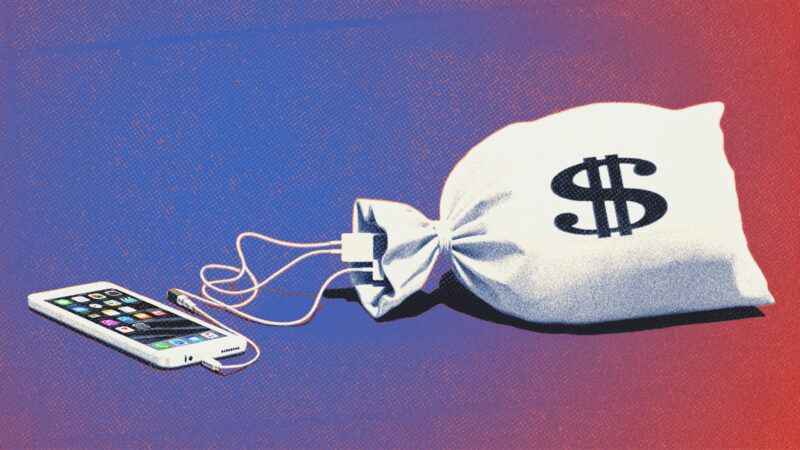
Government officials may not fully understand what social media is, but they damned well plan to do something about the ills it may or may not inflict on our society. They'll happily start with extracting some money from the companies behind social media, though it may take a few tries, given politicians' complete lack of understanding of the thing they want to tax. Illinois is a good example, where legislators just passed an attempt at a social media levy that runs afoul of its authors' ignorance.
You are reading The Rattler from J.D. Tuccille and Reason. Get more of J.D.'s commentary on government overreach and threats to everyday liberty.
Illinois Hopes for Big Revenue From New Social Media Tax
"A nearly $56 billion state spending plan is headed to Gov. JB Pritzker's desk after the Democratic-controlled Illinois legislature approved it in the early-morning hours of another overtime spring session," the Chicago Tribune's Dan Petrella noted last week. "The biggest source of new revenue is a new per-user tax on large social media companies."
The governor's signature is essentially guaranteed, since the budget proposal and social media tax originated in his office. Pritzker hopes to raise $200 million per year from the scheme. But the plan faces challenges, not least of which is that a similar tax passed by Chicago is tied up in court. Another and potentially more serious problem, as pointed out by Dan Levin of Straight Arrow News, is that "one of the elements that remains the most unclear is what exactly is being taxed? The language in the bill does not answer that question directly and is, frankly, confusing."
As passed, the budget plan imposes a tax on social media companies based on "the average number of monthly users of the platform located in the State of Illinois." Platforms with 100,000 to 500,000 "Illinois users" will have to pay $0.10 per user each month; platforms with 500,000 to 1 million "shall pay $40,000, plus $0.25 per month" per user; and platforms with over 1 million users will pay $165,000, plus $0.50 per user, each month on the number of users over 1 million. A provision adjusts the tax for inflation starting in 2028. Companies that fail or refuse to pay will be punished with a fee of "an amount equal to 100% of the unpaid fee and any penalties each month until the fee is paid."
That's an awful lot of numbers backed by dire threats. But it still doesn't clarify how to tally up the bill.
Legislators Don't Seem To Understand What They're Taxing
"Let's begin here: what is a user?" asks Jared Walczak of the Tax Foundation. "Is a user a person or an account? If a person has multiple accounts on the same social media platform, does each account constitute a separate user, or is the person one user? To the extent that those accounts are not linked and social media companies lack identifying information on the owners of free accounts, what information, if any, may they use to associate multiple accounts with a single person?"
And what if a person uses multiple platforms owned by the same company, like Meta's Facebook, Instagram, Messenger, and WhatsApp? How is that counted?
"Indeed, is an account even required?" adds Walczak. "If someone reads a Reddit thread without an account, do they count as a user?"
More particularly, the budget plan purports to tax "Illinois users" without specifying how that term is defined even beyond its failure to define "user." It doesn't say whether an Illinois user is a person or account resident in the state, or if it counts anybody using a social media platform while physically present in the state—say, posting on TikTok while passing through the airport. Is an Illinois resident still an Illinois user if posting on social media while out of state?
And in the era of shifting IP addresses and VPNs, how do you nail down people's physical locations?
The budget plan also has a sloppy definition of "social media platform," which it defines as "a website or internet medium that…permits a person to become a registered user, establish an account, or create a profile for the purpose of allowing users to create, share, and view user-generated content through that account or profile." That captures the big platforms—Facebook, LinkedIn, and the like—that we traditionally think of as social media. But it could also scoop up review sites, messaging services, email services, and publishing platforms.
The Tax Scheme May Violate Federal Law
Walczak raises other objections to the social media tax, some of which are based on lawmakers' seeming lack of understanding of how the world works, and others rooted in what appears to be lazy cutting and pasting of language from other legislation without appropriate changes. Another important point he and others raise is that the whole tax scheme looks to be illegal under federal law.
"The federal Permanent Internet Tax Freedom Act prohibits discriminatory taxes on e-commerce," point out Bryce Hill and Ravi Mishra of the Illinois Policy Institute. "Opponents of the governor's plan would likely argue it violates that law, as it targets large online platforms without a comparable tax on offline media or communication services."
Passed in 2014, the Permanent Internet Tax Freedom Act extended the expiring Internet Tax Freedom Act of 1998. As explained by a House of Representatives press release at the time, "this broadly bipartisan legislation permanently bans states from taxing Internet access or placing multiple or discriminatory taxes on e-commerce."
The governor of Illinois and his enablers in the state legislature may be salivating over revenues from a measure that is so poorly drafted as to leave it to the courts to determine what is being taxed and how that tax should be calculated, and in its intent, prohibited by a nearly 30-year-old federal law.
"The policy also could raise Commerce Clause concerns if courts conclude that it shifts burdens across state lines, pushes companies to adopt nationwide pricing adjustments, or restricts their freedom to impose different prices in other states," add Hill and Mishra.
There are also free speech implications in taxes specifically targeted at some media platforms—specifically, those that enable the public to communicate and share information—and excluding others.
"It would be hard to take the new tax seriously, except that it's now Illinois law," concludes Walczak.
The planned social media tax in Illinois is a great example of why government officials shouldn't meddle in things they don't understand. To be honest, the category of things beyond politicians' comprehension includes most of the world around us. But the point remains.
Illinoisans concerned about lawmakers' efforts to tax social media platforms should spread the word. Perhaps, before it's taxed, they could share their worries on the internet.




