

Trump Is the High-Prices President
Trump's signature policies are pushing prices higher—and voters are pushing back.
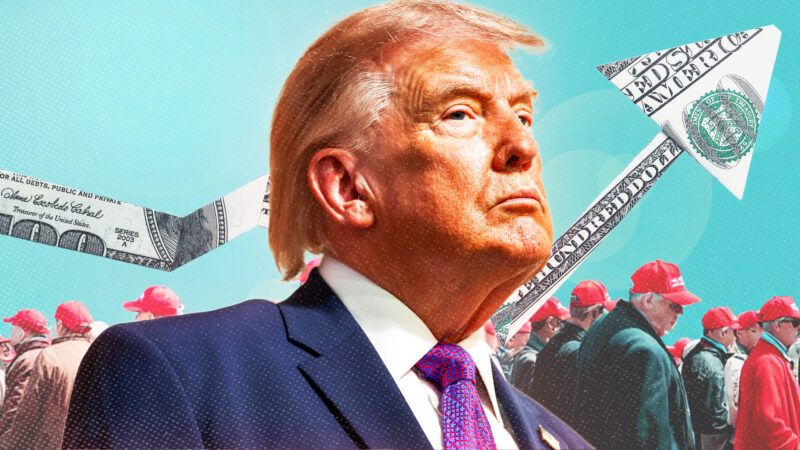
When Donald Trump won his second presidential election in 2024, supporters crowed that this time would be different. Trump's sometimes chaotic instincts had been honed and refined into a populist-nationalist conservative policy agenda that was supposed to make Americans better off and build a broader, more durable right-wing coalition, with a particular appeal to working-class voters.
MAGA 2.0 would be predicated on a rejection, or at least a skepticism, of the free market, libertarian economics that Trumpian intellectuals insisted were hobbling the GOP. These ideas filtered up to the presidential ticket itself. In 2024, then-Sen. J.D. Vance (R–Ohio) told The New York Times that mainstream economists were simply wrong about the effects of clamping down on immigration and the deployment of tariffs, and that free market libertarians were out of touch.
In many ways, the administration has governed accordingly. No, Trump hasn't abandoned capitalism entirely. But his second term has been a populist-statist-protectionist mishmash, with a heavy dollop of crony self-dealing.
That approach has left Americans worse off and struggling with economic uncertainty and the highest inflation in years. And it has resulted in cratering approval ratings for the president and his party—including, notably, with the white, non-college-educated voters the new Trumpism was supposed to win over.
There are many reasons for voters' turn against Trump, but one looms above all others: the persistently high cost of living, and rising energy and food prices in particular.
Trump has become the high-prices president. Voters correctly view those high prices as a direct consequence of his policies.
Three of Trump's signature initiatives are the war with Iran, crackdowns on immigration, and his on-again, off-again tariffs. All three have contributed to rising prices, especially on household essentials. This was borne out in the government's most recent inflation report, which showed the highest inflation rate in three years, a larger-than-expected increase driven by increasing energy and food prices. Wage gains have been eaten by inflation, leaving American families feeling squeezed and uncertain.
Voters see a direct connection between Trump's policies and the worsening economic situation, and it's not hard to understand why. There's plenty of evidence linking Trump's policies to higher prices and economic sclerosis, and the combination of tariffs and immigration restrictionism hasn't led to the boom in domestic manufacturing jobs Trump used to predict. On the contrary, recent research by economists at the University of Colorado Boulder looked at labor market changes in areas highly affected by immigration raids and found that employment for low-skilled, native-born men dropped by 1.3 percent.
Notably, all three of Trump's signature initiatives—the war, the tariffs, and the immigration crackdowns—have been implemented through the executive branch. They are all a direct result of Trump's personal whims and preferences. Trump can't blame Congress or a political rival for policies that come directly from him.
What's more, Trump and other administration officials have at times all but admitted that their policies have pushed up prices on food and gas. After gas prices shot up in response to the war, Trump pushed to suspend the federal gas tax, an implicit nod to the war's impact on pump prices. Last October, Trump's Labor Department warned in a document that "the near total cessation of the inflow of illegal aliens" threatened "the stability of domestic food production and prices for U.S. consumers," drawing a direct link between immigrant workers and grocery prices. And recently, Trump proposed reducing beef tariffs in response to the high price of meat—effectively acknowledging that trade levies make consumer goods more expensive. High prices are the crime, and Trump keeps admitting that he's the perpetrator.
So it's no surprise that even sympathetic voters have turned on Trump and his economic performance. Trump's approval ratings have crashed, driven by pessimism about inflation and the economy. Early in his second term, voters gave Trump positive marks on the economy, but multiple recent polls show declines of 30 points or more in his economic approval rating. Part of the problem for Trump is that he campaigned on improving the economy and addressing high prices after inflation spiked under President Joe Biden. Yet on inflation, Trump's poll numbers are now significantly worse than Biden's ever were. MAGA 2.0's insistence on ignoring free market ideas has backfired spectacularly.
One thing you can say about Trump is that he has decidedly not governed as a libertarian. Even beyond the tariffs, immigration restrictions, and foolhardy war, Trump has refused to manage runaway federal spending, allowed the deficit to grow, and taken federal stakes in multiple private companies. He has discarded free market ideology and governed as a populist, personalist, nationalist, unbound by Congress, constitutional strictures, or the tenets of economics—just as so many MAGA intellectuals encouraged him to do. Yet instead of growing the conservative coalition, Trump has wrecked it.
Maybe the laws and principles of economics mattered after all.
Too often, populists and nationalists seem to think they can succeed by shouting over the dull realities of the market. But economies can't be tricked by policy chicanery or silenced by political rhetoric. They have ways of speaking back—often through prices, which reveal the burdens and inefficiencies imposed by politics. And prices are a language that voters understand.
There's a lesson here for populist politicians of all political persuasions: Ignore free market ideas at your own risk.
You can shrug at the lessons of Economics 101 and dismiss its adherents, but that way lies political peril. Voters see the consequences of that dismissal every time they go to the grocery store or put gas in their cars—or have to choose between one or the other. And they will hold you to account.




