

Ron DeSantis Clamps Down on Free Speech in the Name of Fighting Terror
A new Florida law would allow state leaders to designate certain groups as terror organizations.
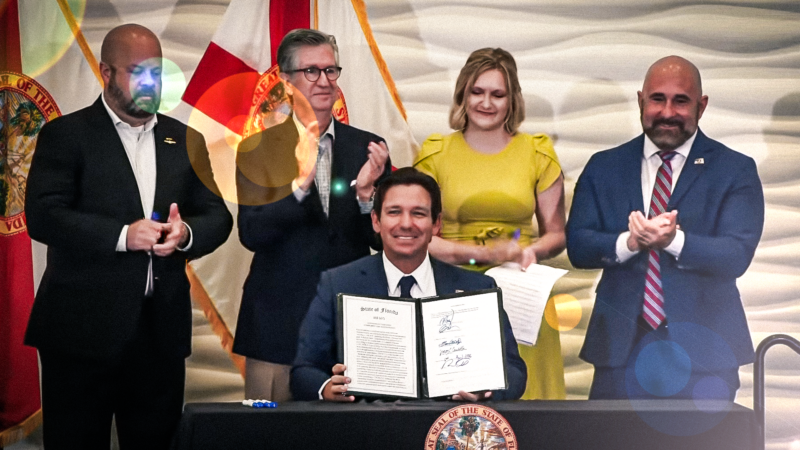
A new Florida law, which will broaden the state's terrorism laws, has civil liberties groups worried about the future of free speech in the Sunshine State.
Florida Gov. Ron DeSantis signed House Bill (H.B.) 1471 into law on Monday. The bill, which will go into effect on July 1, was drafted to increase "accountability" at Florida's public universities by prohibiting "the use of taxpayer funds to support or promote terrorist organizations." It also allows some state officials to label certain groups as domestic or foreign terror organizations.
Once a group is designated as a terror organization, it would become "subject to strict prohibitions, including bans on public funding and support, and individuals who provide material support face significant criminal penalties," according to a press release from DeSantis' office. Anyone who provides "material support" to a designated terrorist organization would face criminal penalties, while any public institutions that violate the law may see their state funding lost.
DeSantis said that H.B. 1471, which also bans courts from enforcing Sharia Law in the state, will "defend our institutions from those who would harm us—especially terrorist organizations that seek to infiltrate and subvert our education system."
Free speech organizations don't share DeSantis's view, warning that the law will infringe upon Floridians' civil rights.
The American Civil Liberties Union (ACLU) of Florida said the bill would "threaten First Amendment freedoms and due process for people across our state." Tyler Coward, an attorney at the Foundation for Individual Rights and Expression, says that although the government can prohibit material support for foreign terrorist organizations (including things such as cash or items of value), "mere advocacy in support of these organizations remains protected by the First Amendment."
"This bill goes too far in regulating unlawful conduct and will cast an impermissible chilling effect on campus discourse at Florida's colleges and universities," adds Coward.
DeSantis has attempted to label certain groups as terrorists before. In December, he issued an executive order designating the Council on American-Islamic Relations (CAIR) as a foreign terrorist group, along with the Muslim Brotherhood. CAIR is a nonprofit civil rights group whose stated mission is "to enhance understanding of Islam, protect civil rights, promote justice, and empower American Muslims." CAIR quickly filed a lawsuit against DeSantis, arguing that the designation was unconstitutional. In March, a federal court issued a temporary injunction blocking the executive order, the Florida Phoenix reported.
CAIR also says that this new law will be used to target the Muslim community. "There's a clear message, at least from these lawmakers, that Florida Muslims are not welcome in Florida: that's their message," said CAIR-Florida attorney Omar Saleh told CBS News.
While H.B. 1471 may seem like a sensible policy on paper (after all, nobody wants to support terror), laws like these have given the government broad discretion to target groups it opposes.
"Over the past 25 years, we've learned the government won't waste an opportunity to increase its power in the name of fighting 'terror,' whether at home or abroad," writes Reason's Joe Lancaster. He notes that "the FBI cited January 6 as justification to dramatically increase surveillance of American citizens who opposed then-President Joe Biden." The Trump administration, meanwhile, has claimed the authority to label people "domestic terrorists" based on such perceived offenses as "anti-Americanism, anti-capitalism, and anti-Christianity."
The potential objections by civil liberties groups appear not to be lost on DeSantis, who predicts that Florida's new law will prompt lawsuits. However, he says the state will likely "win on appeal."




