

Trump's Unconstitutional Attack on Birthright Citizenship Finally Reaches the Supreme Court
Understanding the stakes in Trump v. Barbara.
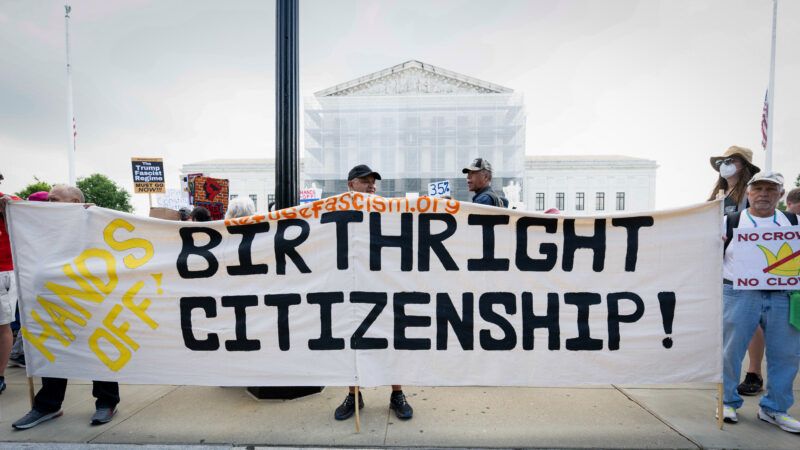
A decade ago, I wrote a cover story for Reason magazine titled "Trump vs. the Constitution." It explained how then-candidate Donald Trump's call to abolish the constitutional guarantee of birthright citizenship for millions of U.S.-born children ran afoul of the text, history, and original meaning of the 14th Amendment. It also noted the dismaying fact that so many Republicans appeared ready to support Trump's unconstitutional agenda.
"Most Republicans claim to revere the Constitution," I wrote. "Yet when it comes to the issue of birthright citizenship, far too many Republicans, from Ed Meese on down to Donald Trump, seem willing to ignore the text and history of the 14th Amendment. Not exactly a reassuring indication of the GOP's fidelity to originalist constitutional principles."
Tomorrow, the U.S. Supreme Court will hear oral arguments in Trump v. Barbara, the case arising from Trump's 2025 executive order on birthright citizenship. And just as I warned a decade ago, the Republican Party is effectively marching in lockstep under Trump's unlawful direction.
But what about the self-professed originalists who currently sit on the Supreme Court? Will those Republican-appointed justices now side with Trump, too?
You’re reading Injustice System from Damon Root and Reason. Get more of Damon’s commentary on constitutional law and American history.
If they do, it will only be because they have decided to ignore the overwhelming originalist evidence that refutes Trump's case.
Start with the constitutional text. According to the 14th Amendment, "All persons born or naturalized in the United States, and subject to the jurisdiction thereof, are citizens of the United States and of the State wherein they reside." That language was drafted in 1866 and ratified in 1868. How was it originally understood?
The 1865 edition of Noah Webster's popular An American Dictionary of the English Language defined "jurisdiction," when applied to a government, as meaning the "power of governing or legislating," "the right of making or enforcing laws," and "the power or right of exercising authority." To be "subject to the jurisdiction" of the United States, in other words, meant to be subject to U.S. law and authority. It meant that a person must follow U.S. law or else face punishment in the U.S. legal system.
In his executive order, Trump asserted that birthright citizenship must be denied to the U.S.-born children of illegal immigrants and lawful temporary visitors. Yet both illegal immigrants and lawful temporary visitors are subject to U.S. law and authority. The U.S. has "the right of making or enforcing laws" that apply to such persons when they are on U.S. soil. Their U.S.-born children thus satisfy the textual requirements for birthright citizenship set forth in the Citizenship Clause. Trump's executive order against such newborns is unconstitutional under the original public meaning of the text.
This original understanding of the phrase "subject to the jurisdiction" was already well-known in U.S. law by the time of the 14th Amendment's framing and ratification. "When private individuals of one nation spread themselves through another as business or caprice may direct, mingling indiscriminately with the inhabitants of that other," Chief Justice John Marshall wrote in Schooner Exchange v. McFadden (1812), "it would be obviously inconvenient and dangerous to society, and would subject the laws to continual infraction, and the government to degradation, if such individuals or merchants did not owe temporary and local allegiance, and were not amenable to the jurisdiction of the country." When foreigners are present on U.S. soil, for "business or caprice," they are subject to the laws—subject to the jurisdiction—of the U.S.
There are certain limited exceptions to the constitutional guarantee of birthright citizenship. The U.S.-born children of foreign ambassadors and foreign ministers, for example, do not become U.S. citizens at birth because their parents have diplomatic immunity and are therefore not subject to U.S. law. Likewise, the U.S.-born children of invading foreign troops do not receive birthright citizenship because their parents are subject to the laws of war, not to the laws of the U.S.
Sen. Jacob Howard (R-Mich.), who spearheaded the 14th Amendment's passage as its floor manager in the Senate, detailed these limited exceptions in a widely reprinted 1866 speech. "While birthright citizenship would not extend to "persons born in the United States who are foreigners, aliens, who belong to the families of ambassadors or foreign ministers accredited to the Government of the United States," Howard said, those eligible for birthright citizenship "will include every other class of persons." The children of illegal immigrants and lawful temporary visitors all fall within this category of "every other class of persons."
Trump, by contrast, has repeatedly argued for a much more restrictive view of the Citizenship Clause. "Birthright Citizenship is about the babies of slaves," Trump has claimed. "It had to do with Civil War results, and the babies of slaves who our politicians felt, correctly, needed protection."
One problem with Trump's simplistic claim is that the 1866–68 debates over the framing and ratification of the amendment are also replete with references to the establishment of birthright citizenship for the children of aliens. For example, the first senator to speak out against the proposed 14th Amendment was Edgar Cowan, a Republican from Pennsylvania. He objected that it would make citizens out of the U.S.-born children of unpopular immigrants. "Is it proposed that the people of California are to remain quiescent while they are overrun by a flood of immigration of the Mongol race?" Cowan demanded. "Are they to be immigrated out of house and home by Chinese?"
Cowan also mentioned the presence of "Gypsies" in Pennsylvania. "They wander in gangs in my State," he declared. "These people live in the country and are born in the country. They infest society." Are their children also to be granted birthright citizenship by the proposed amendment? "If the mere fact of being born in the country confers that right," Cowan said, "then they will have it; and I think it will be mischievous."
The supporters of the 14th Amendment agreed with Cowan's assessment of what its language would accomplish: namely, that "the mere fact of being born in the country" can and would confer birthright citizenship. "I beg my honorable friend from Pennsylvania to give himself no further trouble on account of the Chinese in California or on the Pacific coast," responded Sen. John Conness (R–Calif.). "We are entirely ready to accept the provision proposed in this constitutional amendment, that the children born here of Mongolian parents shall be declared by the Constitution of the United States to be entitled to civil rights and to equal protection before the law with others."
Another fatal problem with the Trump administration's position is that it would wreck the one thing that all sides—including Trump himself—agree that the Citizenship Clause was designed to do: namely, to make citizens out of all black Americans and thereby overrule the Supreme Court's notorious decision in Dred Scott v. Sandford (1857), which said that black Americans had "no rights which the white man was bound to respect."
In other words, if Trump's executive order is allowed to stand, it would annihilate a central purpose of the 14th Amendment itself.
This devastating argument against the Trumpian position has been laid out in detail by the legal scholars Gabriel Chin and Paul Finkelman. "Whatever else it did, the citizenship clause unquestionably granted citizenship to the formerly enslaved African Americans born in the United States," they observed in the UC Davis Law Review. Yet "the parents of some of those children had been trafficked here in violation of federal laws regulating or prohibiting the slave trade, and were in fact living in the United States in violation of federal law. Accordingly, whatever else 'subject to the jurisdiction thereof' might mean, it necessarily included the children of unauthorized migrants."
When I first raised the alarm a decade back about Trump's gathering attack on birthright citizenship, I argued that "if the courts follow the Constitution," Trump "will surely fail." Tomorrow, we will get our first indications as to what the Supreme Court's self-described originalists will actually do now that the conflict has finally reached their courtroom.




